


Future of Solar Energy: How Space-Based Solar Power (SBSP) Will Deliver 24/7 Clean Power

The future of solar energy is no longer confined to rooftops and ground-mounted panels. As global energy demand surges and climate targets tighten, scientists and engineers are looking skyward to a revolutionary concept: collecting solar power in orbit and beaming it wirelessly to Earth. This breakthrough approach, known as Space-Based Solar Power (SBSP), promises to solve one of renewable energy's most persistent challenges—delivering 24/7 continuous energy regardless of weather, darkness, or location.

The future of solar energy may well depend on our ability to harness the sun's unlimited power from space.
What is the Future of Solar Energy?
The future of solar energy is undergoing a dramatic transformation driven by technological innovation, economic competitiveness, and urgent climate imperatives.
According to the International Energy Agency (IEA), solar photovoltaic (PV) capacity is projected to increase by approximately 4,600 GW between 2025 and 2030—more than double the deployment of the previous five years. Solar PV alone accounts for over 80% of global renewable capacity growth through 2030, representing the fastest expansion of any electricity generation technology in history.
In 2024, global solar generation surpassed 2,000 TWh, growing by 30% year-on-year—the highest growth rate since 2017. The IEA predicts that solar will meet approximately half of global electricity demand growth through 2027, overtaking hydropower to become the world's second-largest low-emissions electricity source. By 2033, solar is projected to surpass coal as the single-largest source of global electricity generation.
However, terrestrial solar faces inherent limitations: intermittency, land requirements, weather dependency, and the day-night cycle.
Even with advanced battery storage systems, these challenges create grid integration complexities and limit solar's ability to provide baseload power. This is where Space-Based Solar Power emerges as the logical next evolution—positioning the future of solar energy beyond Earth's atmospheric constraints.
What is Space-Based Solar Power (SBSP)?
Space-Based Solar Power (SBSP), also known as Solar Power Satellites (SPS), represents a paradigm shift in renewable energy generation.
The concept involves deploying massive solar arrays in geostationary Earth orbit (GEO) approximately 36,000 kilometers above the planet. At this altitude, satellites maintain a fixed position relative to Earth and receive uninterrupted sunlight 99% of the year, experiencing only brief eclipse periods.
The collected solar energy is converted into microwaves or laser beams and transmitted wirelessly through Earth's atmosphere to ground-based receiving stations called rectennas (rectifying antennas). These rectennas convert the microwave energy back into electricity and feed it directly into the power grid. The beam intensity at ground level is approximately 230 watts per square meter—about one-quarter the strength of midday sunlight—making it safe for humans, wildlife, and the environment.
How SBSP Collects and Transmits Energy
SBSP systems employ advanced engineering architectures to capture and deliver solar power:
1. Solar Collection: Orbiting satellites deploy solar panels or reflector arrays spanning several square kilometers. NASA's recent study examined two reference designs: the RD1 heliostat design with 11.5 km² of solar panels, and the RD2 planar design with 19 km² of panels. These systems generate power at the 2-gigawatt (GW) scale—comparable to large terrestrial power plants.
2. Energy Conversion: Photovoltaic cells convert sunlight into electricity with conversion efficiencies currently at 33% (state of practice) and projected to reach 70% (state of the art). The RD1 design generates power 99% of the year, while RD2 generates power approximately 60% of the year due to its limited repositioning capability.
3. Wireless Power Transmission: The electricity powers microwave transmitters or laser emitters that beam energy to Earth. Microwave transmission uses frequencies in the 2.45 GHz or 5.8 GHz range, similar to telecommunications systems but at significantly higher power levels.
4. Ground Reception: Rectennas consisting of lightweight mesh antenna arrays on poles receive the microwave beam. Because rectennas are largely transparent, the land beneath can be used for agriculture or co-located with terrestrial solar panels, enabling dual-purpose land use. A single 2-GW satellite requires a rectenna area of approximately 6 kilometers in diameter.
SBSP vs. Terrestrial Solar Panels
The fundamental difference between SBSP and terrestrial solar lies in energy availability and reliability:
Characteristic | Terrestrial Solar PV | Space-Based Solar Power |
Energy Availability | 15-30% capacity factor (day/night cycle) | 99% capacity factor (continuous) |
Weather Dependency | Highly affected by clouds, rain, snow | Unaffected by weather conditions |
Sunlight Intensity | Peak ~1,000 W/m² (atmospheric losses) | ~1,367 W/m² (144% of Earth surface) |
Land Requirements | 2-4 hectares per MW | Minimal ground footprint (rectenna) |
Storage Needs | Extensive battery systems required | Minimal (provides baseload power) |
Geographic Flexibility | Location-dependent | Can beam power anywhere on Earth |
Maintenance Access | Easy ground-based maintenance | Complex in-orbit servicing required |
According to Harvard Technology Review, SBSP offers superior land efficiency because sunlight intensity in space is approximately 144% higher than maximum ground-level intensity. Furthermore, SBSP systems can deliver energy to remote locations, disaster-stricken areas, or regions with limited grid infrastructure—applications impossible for traditional solar installations.
Why SBSP Matters in the Future of Solar Energy
Space-Based Solar Power addresses three critical energy challenges that define the future of solar energy: reliability, scalability, and decarbonization.
1. 24/7 Renewable Baseload Power
The most transformative aspect of SBSP is its ability to provide continuous, dispatchable energy—a characteristic previously available only from fossil fuels or nuclear power. Grid operators require baseload generation sources that deliver consistent power regardless of time of day or weather conditions. Terrestrial renewables, despite rapid deployment, cannot fulfill this role without massive energy storage infrastructure.
NASA's January 2024 study revealed that SBSP systems could deliver electricity with 3,600 to 4,200 grams of CO₂ equivalent per megawatt-hour (gCO₂e/MWh)—comparable to or lower than terrestrial solar with storage, wind, hydroelectric, and geothermal sources. This positions SBSP among the cleanest energy technologies available for achieving net-zero emissions targets.
2. Atmospheric and Land Use Advantages
As Harvard Technology Review notes, SBSP bypasses atmospheric interference entirely. Terrestrial solar panels lose significant energy due to:
Cloud cover (reducing output by 40-90%)
Atmospheric absorption and scattering (approximately 30% loss)
Air pollution and particulate matter
Seasonal variations in sunlight angle
Space-based systems eliminate these losses while requiring dramatically less land than terrestrial solar farms. A European Space Agency (ESA) study found that 54 satellites could provide between 7-33% of Europe's power demand by 2050, with each satellite delivering 1.4 GW of continuous power—equivalent to a large nuclear power plant operating at full capacity.
3. Grid Reliability and Renewable Integration
As renewable energy penetration increases, grid operators face growing challenges with curtailment (wasting excess renewable energy) and negative electricity prices during peak generation periods. The IEA reports that curtailment levels have been rising in China, Germany, Brazil, Chile, the United Kingdom, and Ireland.
SBSP provides predictable, schedulable power that complements variable renewables. Recent modeling by PyPSA-Eur demonstrates that if SBSP heliostat designs achieve costs 6-9 times the projected 2050 cost of ground PV, total European system costs could fall by 7-15%. At these price points, SBSP could displace up to 80% of wind and solar capacity and reduce battery storage needs by over 70%, though seasonal hydrogen storage would remain essential.
Technical Architecture of SBSP
Understanding the future of solar energy requires examining the complex engineering systems that make SBSP possible:
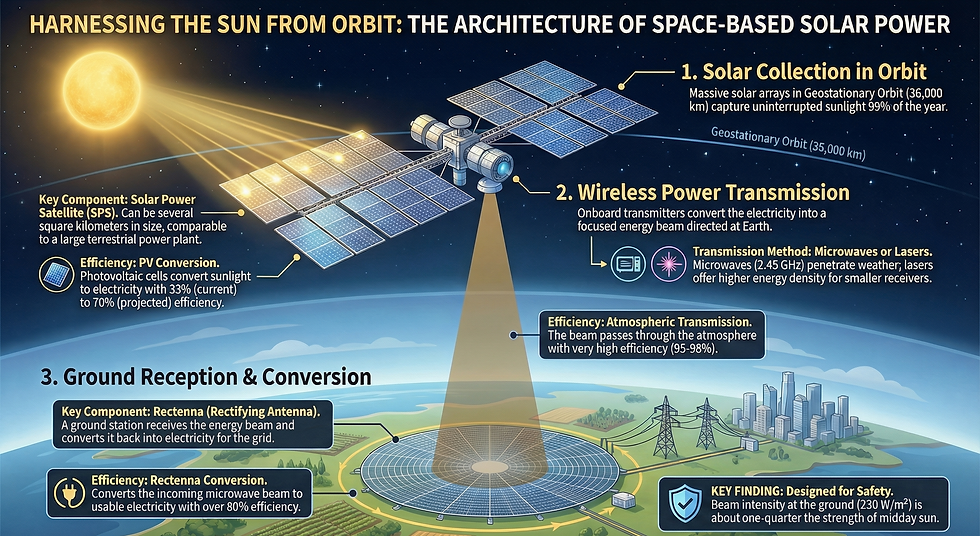
Solar Power Satellites (SPS)
Two primary architectural approaches dominate SBSP design:
Heliostat Swarm Design (RD1): This innovative approach uses thousands of autonomous, lightweight mirrors (heliostats) that track the sun and redirect sunlight toward a central concentrator. The concentrator houses photovoltaic cells and microwave transmitters.
This design generates power 99% of the year with minimal eclipse interruption. Mass: 5.9 million kg; Solar array area: 11.5 km².
Planar Array Design (RD2): Based on conventional satellite architecture, this design uses flat solar panels with cells facing away from Earth and microwave emitters facing toward Earth. It generates power approximately 60% of the year due to limited self-repositioning capability.
Mass: 10 million kg; Solar array area: 19 km².
Both designs require unprecedented advances in in-space servicing, assembly, and manufacturing (ISAM). Current ISAM capabilities exist for individual satellites (such as Northrop Grumman's GEO servicing), but scaling to construct multi-kilometer structures remains a formidable challenge.
Wireless Power Transmission (WPT)
Two transmission methods are under development:
Microwave Transmission: Uses radio frequency energy in the 2.45 GHz or 5.8 GHz bands. Microwave transmission has been successfully demonstrated over short distances, with the ESA Solaris program testing 36-meter wireless power beaming in 2022. Advantages include mature technology and weather penetration. Challenges include large antenna requirements and spectrum allocation coordination.
Laser Transmission: Uses infrared laser beams for higher energy density and smaller receiving stations. Aetherflux, a venture-funded company, is developing infrared laser-based systems with receiving stations just 5-10 meters in diameter. However, laser transmission is more susceptible to atmospheric interference from clouds and precipitation.
Rectennas (Rectifying Antennas)
Ground receiving infrastructure converts microwave energy to electricity with efficiencies exceeding 80%. Modern rectenna designs use lightweight mesh structures mounted on poles, allowing dual land use for agriculture or co-located solar PV beneath the receiving array. Safety protocols ensure beam intensity remains at 230 W/m²—well below harmful levels.
Challenges & Roadblocks for SBSP
Despite its promise, SBSP faces substantial technical, economic, and regulatory hurdles that will determine whether it becomes a cornerstone of the future of solar energy.
Launch Cost and Infrastructure
The most significant barrier to SBSP deployment is the cost of transporting materials to orbit. Current launch costs average approximately $10,000-$20,000 per kilogram to GEO.
A single 2-GW SBSP satellite weighing 5-10 million kilograms would require 150-300 launches using current heavy-lift vehicles.
NASA's 2024 study used SpaceX's Starship as the baseline launch vehicle, assuming costs could drop to $300 per kilogram—still requiring launches costing $1.5-3 billion per satellite.
The Frazer-Nash/ESA study estimates that building the first operational SBSP system requires capital expenditure of €9.8 billion, dropping to €7.6 billion for the tenth system as economies of scale develop.
Launch infrastructure must expand dramatically.
NASA projects that Starship alone would require a 5-10 fold increase in spaceport infrastructure to accommodate the launch cadence needed for SBSP deployment. Alternative approaches include developing specialized space elevators or orbital assembly facilities, both requiring breakthrough technological advances.
Wireless Transmission Efficiency Limits
Current wireless power transmission systems achieve approximately 40-60% end-to-end efficiency from solar collection to electricity delivery at the rectenna. This compares unfavorably with terrestrial solar PV systems achieving 90%+ efficiency. Major losses occur during:
Photovoltaic conversion (33-70% efficiency)
Microwave generation (80-85% efficiency)
Atmospheric transmission (95-98% efficiency)
Rectenna conversion (80-85% efficiency)
Improving each stage by just a few percentage points could dramatically enhance SBSP competitiveness.
Research continues on advanced solar cell architectures, including tandem cells and quantum dot technologies that could push conversion efficiencies beyond 70%.
Space Debris and Safety Concerns
Deploying massive kilometer-scale structures in geostationary orbit raises concerns about space debris creation, collision risks, and long-term orbital sustainability.
The NASA study notes that each SBSP satellite is 27 times larger than the entire 4,000-satellite Starlink v2.0 constellation by solar panel area.
Decommissioning and end-of-life disposal present additional challenges. Satellites must either be de-orbited safely or moved to graveyard orbits, requiring significant propellant and careful planning to avoid creating debris that could threaten other space infrastructure.
Safety protocols must ensure microwave beams don't pose risks to aircraft, birds, or ground personnel. While beam intensity at 230 W/m² is generally considered safe, regulatory frameworks and real-world safety demonstrations remain necessary before public acceptance.
Investment and Long-Term Financial Models
SBSP requires unprecedented capital investment with decades-long payback periods. The Frazer-Nash/London Economics study for ESA estimates total R&D investment of €15.8 billion across four phases before deploying the first operational system.
Building 54 satellites by 2050 would require total investment of €418 billion against projected benefits of €601 billion—a net present value of €183 billion.
Securing this capital requires public-private partnerships (PPPs) combining government funding, energy utility investment, and private sector innovation. Traditional venture capital models don't align with the scale and timeline of SBSP development, necessitating new financial structures similar to major infrastructure projects like transcontinental pipelines or submarine telecommunications cables.
SBSP in the Future of Solar Energy vs. Terrestrial Solar + Storage
How does Space-Based Solar Power compare to rapidly advancing terrestrial renewable technologies?

Cost Competitiveness Analysis
NASA's January 2024 baseline analysis found that SBSP systems would cost 12-80 times more than terrestrial renewable alternatives per unit of electricity generated (Levelized Cost of Energy - LCOE).
However, sensitivity analyses revealed that with favorable combinations of technological advances, SBSP could achieve costs of $0.03-$0.08 per kWh by 2050—competitive with terrestrial solar ($0.02-$0.04/kWh) and onshore wind ($0.03-$0.05/kWh).
Critical cost reduction factors include:
Launch costs dropping to $100-300 per kg (vs. current $10,000-20,000/kg)
Solar cell efficiency improving to 50-70% (vs. current 33%)
Hardware lifetime doubling to 60 years (vs. current 30 years)
Manufacturing learning curves similar to terrestrial solar PV
Recent PyPSA-Eur modeling demonstrates that the RD1 heliostat design becomes complementary to terrestrial renewables at roughly 14 times the 2050 solar PV capital cost and becomes dominant at 9 times. The RD2 planar design requires even lower costs—9 times to be complementary and 6 times to dominate.
Hybrid System Integration
Rather than replacing terrestrial renewables, SBSP would likely integrate into hybrid energy systems alongside:
High-efficiency ground PV: Continued deployment for daytime peak generation
Battery storage: Short-duration storage for hour-to-hour grid balancing
Hydrogen storage: Seasonal energy storage for multi-week renewable gaps
Onshore/offshore wind: Geographic and temporal diversity with solar resources
Advanced nuclear: Complementary baseload capacity in regions with SBSP limitations
The future of solar energy will likely feature diverse portfolios optimized for regional resources, with SBSP providing baseload capacity in energy-import regions and terrestrial renewables dominating areas with excellent solar and wind resources.
Policy, Regulation & International Collaboration
Realizing SBSP's potential requires unprecedented international cooperation and regulatory frameworks.
NASA Space Solar Power Program
NASA's Office of Technology, Policy and Strategy published a comprehensive SBSP assessment in January 2024, marking the agency's renewed interest after decades of intermittent studies. While NASA currently views SBSP as requiring significant technological maturation before becoming a formal agency mission, the study recommends:
Tracking global SBSP developments and maintaining technical expertise
Evaluating SBSP's utility for NASA missions (powering lunar bases, Mars habitats)
Supporting U.S. developers upon request through existing technology programs
Assessing expanded partnerships for enabling technologies
The U.S. Air Force operates the Space Solar Power Incremental Demonstrations and Research (SSPIDR) project, developing critical technologies through the ARACHNE test satellite program. Northrop Grumman is developing "sandwich tile" technology for space power beaming under this initiative.
European Space Agency Solaris Project
The ESA Solaris program represents Europe's most comprehensive SBSP initiative. Approved in November 2022, Solaris received three-year funding to assess technical and economic feasibility. Key milestones include:
2023-2024: Arthur D. Little and Thales Alenia Space Italy completed independent concept studies for commercial-scale SBSP plants
2025: Ministerial council decision on whether to proceed with full development program
2030: Target for in-orbit demonstration mission
2040: First operational station in geostationary orbit
2050: Multiple operational satellites providing 10-33% of Europe's electricity demand
Solaris lead Sanjay Vijendran emphasizes that SBSP could play an integral role in achieving carbon neutrality "as early as the 2030s" if implementation challenges are addressed. The program is also investigating an alternative "reflector design" using large space mirrors to focus sunlight onto existing terrestrial solar farms—a less technically demanding stepping stone toward full radio-frequency SBSP systems.
China Academy of Space Technology (CAST)
China has emerged as a frontrunner in SBSP development with an ambitious roadmap:
2028: Launch first test satellite in low Earth orbit generating 10 kilowatts
2030: Deploy 1-megawatt station in geostationary orbit with on-orbit assembly
2035: Scale to 10-megawatt power plant for military and civilian applications
2050: Commercially viable 2-gigawatt space solar power station
CAST vice-president Li Ming stated China expects to be "the first nation to build a working space solar power station with practical value." China's Bishan District testing facility, built with 200 million yuan ($28.4 million) investment, supports ground-based technology development and wireless power transmission research.
International Collaboration Needs
SBSP deployment requires coordinated international action on:
Spectrum Allocation: Radio frequency spectrum for power transmission must be coordinated internationally through bodies like the International Telecommunication Union (ITU) to avoid interference with telecommunications, radar, and satellite systems.
Orbital Slot Management: Geostationary orbit positions are finite resources requiring international allocation agreements. Current systems managed by the ITU allocate GEO positions for communications satellites; SBSP would require new frameworks.
Space Debris Mitigation: International guidelines for SBSP satellite construction, operation, and decommissioning must prevent debris creation that could threaten space infrastructure used by all nations.
Safety Standards: Wireless power transmission standards ensuring safety for aviation, wildlife, and ground personnel require international scientific consensus and regulatory harmonization.
Economic & Market Outlook
The Space-Based Solar Power market is experiencing rapid growth driven by climate imperatives and technological advances.

Market Valuation Projections
The global SBSP market was valued at approximately $3.1 billion in 2024 and is projected to grow at a compound annual growth rate (CAGR) of 7.9% from 2025 to 2034. This substantial growth reflects increasing investment in research, development, and early-stage deployment efforts.
Regional Market Leadership:
North America: Dominates current market activity, led by the United States with major players including Northrop Grumman, Solaren Corporation, and Caltech's Space Solar Power Project. Government support through NASA, Air Force, and Department of Defense funding accelerates technology development.
Europe: The ESA Solaris program positions Europe as a close second, with the Frazer-Nash study projecting €183 billion in net present value from SBSP deployment through 2070. Private companies including Thales Alenia Space and Airbus are actively developing enabling technologies.
Asia-Pacific: Expected to emerge as the fastest-growing region through 2035. China's aggressive timeline, Japan's long-running research programs, and India's growing space capabilities position the region for rapid expansion. CAST's roadmap to operational systems by 2035 could accelerate global market development.
Cost Curve Projections
Launch cost reduction is the primary driver of SBSP economic viability:
Current costs: $10,000-$20,000/kg to GEO
SpaceX Starship targets: $300/kg to GEO by 2027-2030
Long-term projections: $100/kg achievable with fully reusable systems and high launch cadence
Manufacturing cost reductions follow similar trajectories. Terrestrial solar PV module prices dropped over 99% from $100/watt in 1975 to $0.20/watt in 2024. SBSP components could experience comparable learning curves once mass production begins.
Frazer-Nash estimates first-of-a-kind SBSP capital costs at €9.8 billion per 1.4-GW satellite, falling to €7.6 billion for the tenth system—a 22% reduction through manufacturing experience and economies of scale.
Real-World Use Cases — From Grid Support to Remote Power
Space-Based Solar Power offers diverse applications beyond large-scale grid integration:
1. Remote and Island Energy Access
Island nations and remote communities currently dependent on diesel generators could receive clean, reliable power via SBSP. Small rectennas (100-500 meters diameter) could deliver 10-100 MW to locations where undersea cables or terrestrial renewables are impractical. The Pacific Islands, Arctic communities, and remote military bases represent prime early markets.
2. Disaster Relief and Emergency Response
SBSP satellites could redirect power beams to disaster-affected regions within hours, providing emergency electricity before ground infrastructure is restored. Hurricane-damaged grids, earthquake zones, and conflict areas could receive immediate power for hospitals, communications, and water treatment—applications impossible for terrestrial renewable deployments requiring months of construction.
3. Corporate Net-Zero Strategies
Major technology companies operating data centers face growing pressure to achieve 24/7 carbon-free energy matching. Google, Microsoft, and Amazon have committed to hourly matching of clean energy consumption—a standard that terrestrial renewables with storage struggle to meet economically. SBSP provides the continuous clean power needed to achieve these ambitious targets.
4. Space Infrastructure Power
Before serving terrestrial needs, SBSP could power space infrastructure including:
Lunar bases supporting NASA's Artemis program
Mars surface habitats for future human missions
Deep space missions requiring high-power systems
Space manufacturing facilities producing components in microgravity
These applications provide stepping stones for technology development while generating revenue from space customers willing to pay premium prices.
5. Military and Defense Applications
The U.S. Air Force's SSPIDR project focuses on providing "uninterrupted, assured, and logistically agile power to expeditionary forces." Forward operating bases in remote locations currently rely on vulnerable fuel convoys that represent significant logistical challenges and security risks. SBSP could deliver secure, difficult-to-disrupt power anywhere on Earth.
Future of Solar Energy and Net-Zero Targets
Space-Based Solar Power could prove instrumental in achieving global net-zero carbon emissions targets by 2050.
Synergy with Other Renewable Technologies
The IEA projects that renewables will provide 43% of global electricity generation by 2030, up from 32% in 2024. Achieving 100% clean electricity by 2050 requires overcoming the "last 20%" challenge—replacing fossil fuel baseload generation with clean alternatives.
SBSP complements terrestrial renewables by providing:
Baseload capacity replacing coal and natural gas plants
Geographic flexibility delivering power where terrestrial renewables are limited
Reduced storage requirements minimizing battery and hydrogen infrastructure costs
Grid stability through dispatchable generation following demand curves
Wind + Solar + SBSP Integration
Optimal renewable portfolios will combine:
Terrestrial solar: Daytime peak generation at lowest cost per kWh
Onshore/offshore wind: Evening and overnight generation with geographic diversity
SBSP: Continuous baseload filling gaps in wind and solar availability
Pumped hydro/batteries: Hours of storage for intra-day balancing
Green hydrogen: Weeks to months of seasonal storage for rare renewable droughts
Modeling by PyPSA-Eur demonstrates that SBSP integration at competitive costs reduces total system costs by 7-15% compared to renewables-plus-storage portfolios without SBSP.
Hydrogen Economy Integration
Green hydrogen production via electrolysis requires consistent, low-cost electricity. SBSP's continuous generation profile makes it ideal for hydrogen production, with 24/7 operation maximizing electrolyzer utilization and reducing hydrogen costs. Produced hydrogen serves as:
Long-term energy storage for seasonal renewable gaps
Industrial feedstock for steel, ammonia, and chemical production
Transportation fuel for heavy-duty vehicles, ships, and aircraft
Grid balancing through hydrogen-to-power reconversion during peak demand
The IEA notes that despite increased policy support, hydrogen from renewable energy will account for just 4% of total hydrogen production in 2030—indicating massive growth potential aligned with SBSP deployment timelines.
Frequently Asked Questions
What is the future of solar energy technology beyond Earth?
The future of solar energy extends to Space-Based Solar Power (SBSP) systems that collect solar energy in orbit and transmit it wirelessly to Earth, providing continuous 24/7 clean electricity unaffected by weather or the day-night cycle. SBSP represents the logical next evolution of solar technology, with NASA, ESA, and China developing systems for deployment in the 2030s-2040s.
Can space-based solar power replace traditional solar farms?
SBSP won't replace terrestrial solar but will complement it within integrated renewable portfolios. Ground-based solar remains more cost-effective for daytime peak generation, while SBSP provides continuous baseload power that terrestrial solar with storage struggles to deliver economically. Optimal systems combine both technologies alongside wind, hydro, and storage.
How does SBSP transmit 24/7 energy to Earth?
SBSP satellites in geostationary orbit (36,000 km altitude) receive uninterrupted sunlight 99% of the year. Solar panels convert sunlight to electricity, which powers microwave transmitters that beam energy safely through the atmosphere to ground-based rectennas. These receiving antennas convert microwaves back to electricity for grid distribution at approximately 80% efficiency.
What are the biggest challenges for space solar power to become reality?
The primary challenges are launch costs ($10,000-20,000/kg currently, must drop to $100-300/kg), wireless transmission efficiency (currently 40-60% end-to-end), in-orbit assembly of kilometer-scale structures, and securing the hundreds of billions in capital investment required. Regulatory frameworks for spectrum allocation and orbital management also need development.
How much could SBSP cost compared to terrestrial renewables?
NASA's 2024 study found baseline SBSP costs are 12-80 times higher than terrestrial renewables, but with technological advances could reach $0.03-0.08/kWh by 2050—competitive with terrestrial solar ($0.02-0.04/kWh).
The Frazer-Nash/ESA study projects first systems costing €9.8 billion per 1.4-GW satellite, dropping to €7.6 billion by the tenth system.
Will space solar power help countries reach net-zero?
Yes, SBSP could prove crucial for net-zero goals by providing clean baseload power to replace fossil fuel plants. NASA projects SBSP lifecycle emissions of 3,600-4,200 gCO2e/MWh—comparable to the cleanest terrestrial renewables. European studies estimate 54 SBSP satellites could provide 10-33% of Europe's electricity demand by 2050, significantly advancing decarbonization.
Is SBSP safe and environmentally beneficial?
SBSP is designed with safety as a priority. Microwave beam intensity at ground level is approximately 230 W/m²—about one-quarter the strength of midday sunlight—posing no harm to humans, wildlife, or aircraft. Lifecycle greenhouse gas emissions are comparable to or lower than terrestrial solar with storage. The main environmental concerns involve space debris management and launch emissions.
What timeline is realistic for SBSP deployment?
China targets a 10-kilowatt test satellite by 2028, a 1-megawatt system by 2030, and a 10-megawatt plant by 2035. The ESA Solaris program aims for an orbital demonstration by 2030 and first operational station by 2040. NASA views 2050 as a realistic timeline for economically competitive systems, though earlier niche applications for space infrastructure or remote power may emerge in the 2030s.
Conclusion
The future of solar energy is ascending beyond our atmosphere. Space-Based Solar Power represents more than an engineering marvel—it embodies humanity's determination to solve the dual challenges of energy access and climate change through innovation and international cooperation.
From NASA's rigorous technical assessments to ESA's Solaris program and China's aggressive deployment timeline, the global community recognizes SBSP's transformative potential. While significant technical and economic hurdles remain, the physics is proven, the pathway is clear, and the momentum is building.
The International Energy Agency projects solar will dominate electricity generation growth through 2030 and beyond. Adding the dimension of space-based collection could accelerate this trajectory, providing the reliable, clean baseload power needed to complete the global energy transition. The question is no longer whether SBSP is technically feasible—NASA, ESA, and leading aerospace companies have confirmed it is. The question is whether humanity will muster the political will, financial resources, and international collaboration needed to make it reality.
As terrestrial solar panels continue breaking cost and deployment records, their orbital cousins await their moment. The future of solar energy shines bright—both on Earth and above it.
Ready to explore more insights on sustainable energy innovations?
Visit GreenFuelJournal.com for comprehensive coverage of green hydrogen, biofuels, renewable technologies, and the latest developments shaping the clean energy transition in India and globally.
References and Citations
This article is backed by authoritative sources and research:
NASA Office of Technology, Policy, and Strategy - Space-Based Solar Power Study (January 2024)
European Space Agency (ESA) - Solaris Programme
International Energy Agency (IEA) - Renewables Reports
Harvard Technology Review - The Future of Energy: Unlocking the Potential of Space-Based Solar Power
China Academy of Space Technology (CAST)
Frazer-Nash Consultancy and London Economics - ESA Cost-Benefit Studies
POWER Magazine - Space-Based Solar Power for U.S. Energy Independence
World Economic Forum - Why We Need Space-Based Solar Power
ScienceDirect - Assess Space-Based Solar Power for European-Scale Power System Decarbonization
SpaceNews - ESA to Request Funding for Space-Based Solar Power Study
International Space Development Conference (ISDC)
Sia Partners - Generating Electricity in Space to Power Our Future Generations
Wikipedia - Space-Based Solar Power (Comprehensive Overview)
Markets and Markets - Space-Based Solar Power Market Analysis
BBC Science Focus Magazine - Project Solaris: Inside ESA's Bold Plan
Disclaimer: This article provides informational content based on publicly available research and should not be considered as investment, engineering, or policy advice. Space-Based Solar Power technology is still under development, and deployment timelines, costs, and technical specifications are subject to change as research progresses. Readers should consult with qualified professionals before making decisions related to energy investments, technology adoption, or policy implementation. GreenFuelJournal.com maintains editorial independence and presents information based on authoritative sources but does not guarantee outcomes or endorse specific technologies or companies mentioned herein.
About Green Fuel Journal
Green Fuel Journal (www.greenfueljournal.com) is a specialized digital publication dedicated to advancing knowledge and understanding of sustainable energy solutions, with particular focus on green hydrogen, biofuels, renewable energy technologies, and decarbonization strategies for transportation and industry. Serving business professionals, researchers, policymakers, students, and green energy enthusiasts globally, we deliver authoritative, research-driven content that bridges technical depth with accessibility.
Our mission is to provide comprehensive analysis of emerging clean energy technologies, policy frameworks, and market developments—particularly within the Indian market and emerging economies—empowering stakeholders to make informed decisions in the global energy transition toward a net-zero future.
© 2026 Green Fuel Journal. All rights reserved.


