


First Solar Airport in World: CIAL Solar Airport — Renewable Energy Benchmark & Case Study

Introduction
Aviation's carbon footprint matters. Commercial airports consume massive amounts of electricity daily, contributing substantially to global greenhouse gas emissions. But in August 2015, a regional airport in southern India changed that narrative forever.
Cochin International Airport (CIAL) in Kerala became the first solar airport in world to operate entirely on renewable energy—a milestone that reshaped how the global aviation industry thinks about sustainable infrastructure.
This wasn't just about installing solar panels. The transformation of CIAL represents a complete reimagining of airport energy systems, proving that large-scale infrastructure can achieve energy independence while maintaining 24/7 operations.
The first solar airport in world demonstrated that commercial viability and environmental responsibility aren't mutually exclusive—they're complementary strategies for the future of aviation.
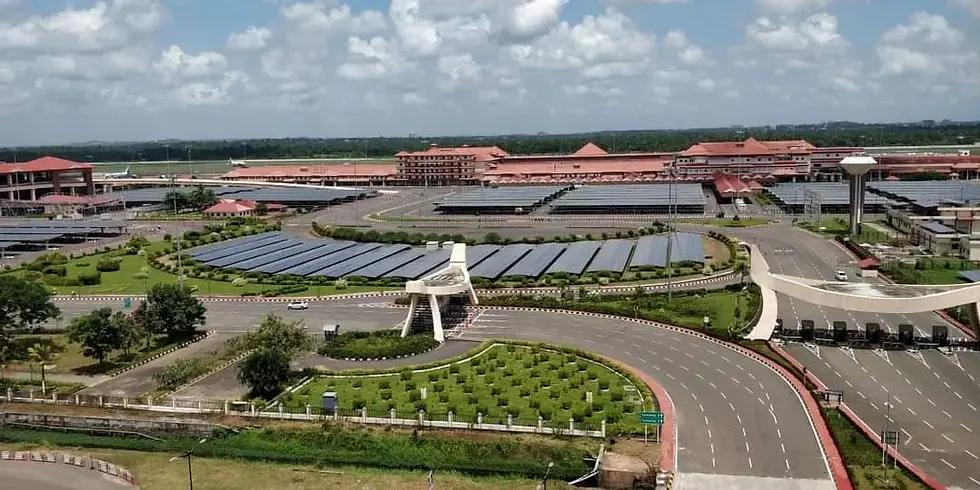
Today, with 50 MWp of installed solar capacity and over 250 million units of clean electricity generated since inception, CIAL stands as a living laboratory for renewable energy integration in high-demand environments. This case study examines exactly how they did it, what it costs, and why it works.
What is the First Solar Airport in World?
The first solar airport in world is Cochin International Airport (CIAL) in Kochi, Kerala, India, which achieved complete energy independence through solar power on August 18, 2015, by generating 100% of its daily electricity requirements from photovoltaic systems installed across 94 acres of airport land.
Located in Kerala's Ernakulam district, CIAL operates as a Public-Private Partnership (PPP) model—the world's first greenfield airport built entirely through private investment without government funding. This ownership structure proved critical for the solar project's success, allowing management to make rapid infrastructure decisions without bureaucratic delays.
The airport handles 10 million passengers annually, manages over 1,000 flights weekly, and supports 27 international and domestic airlines. Despite this operational intensity, every kilowatt consumed—from runway lighting to air conditioning systems—comes from the sun.
History of CIAL Solar Airport
The journey to becoming the first solar airport in world started modestly. In 2013, CIAL installed a small 100 kWp rooftop solar plant on the Arrival Terminal Block as a pilot project. The experiment worked. Management saw immediate electricity bill reductions and decided to scale rapidly.
That same year, they commissioned Kerala's first megawatt-scale solar project—a 1.1 MWp ground-mounted system near the CIAL Academy building.
But the real transformation began when Kerala State Electricity Board (KSEB) hiked commercial tariffs from Rs. 4 per unit to Rs. 7 per unit in 2014, increasing CIAL's annual electricity expenditure from Rs. 7 crore to Rs. 12 crore. Suddenly, solar wasn't just environmentally sound—it became economically essential.
Here's the timeline of CIAL's solar expansion:
Year | Capacity Added | Total Installed | Key Development |
2013 | 100 kWp | 100 kWp | Rooftop pilot project |
2013 | 1 MWp | 1.1 MWp | First ground-mounted plant |
2015 | 12 MWp | 13.1 MWp | Full solar-powered status achieved |
2018 | 27 MWp | 40 MWp | Major capacity expansion |
2020 | 5.1 MWp | 45 MWp | Solar carport inauguration |
2022 | 12 MWp | 50 MWp | Terrain-based installation |
By August 18, 2015, CIAL formally declared energy independence, making history as the first solar airport in world.
The achievement wasn't announced through press conferences—it was verified through net metering data showing that annual solar generation matched consumption.
Technical Architecture of CIAL Solar Power Project
The CIAL Solar Power Project represents sophisticated engineering scaled for institutional needs. With 50 MWp of installed capacity distributed across 94 acres, the system includes 92,150 solar panels manufactured with 265Wp capacity each.

System Components
The technical infrastructure includes:
Photovoltaic Modules: Monocrystalline and polycrystalline panels with 265Wp capacity, manufactured by Ammini Solar
Inverters: 1MW ABB inverters convert DC to AC power, synchronized with grid frequency
SCADA Systems: Supervisory Control and Data Acquisition enables remote monitoring, performance tracking, and fault detection in real-time
Grid Integration: Direct connection to 110 kV/11 kV substation for seamless power injection and withdrawal
Innovative Installations
CIAL pioneered two groundbreaking approaches:
Solar Carports: Inaugurated in December 2020, the 5.1 MW solar carport at Terminal 2 is Asia's largest airport solar carport, covering 2.25 lakh square feet with 8,500 panels. The structure provides shade for 2,500 vehicles while generating electricity—dual functionality that maximizes land utility.
Floating Solar Arrays: Using French technology, CIAL deployed 1,300 photovoltaic panels on high-density polyethylene floats across two artificial lakes in the airport's 130-acre golf course. This innovation addresses land scarcity while reducing water evaporation.
Terrain-Based Installation: The 12 MWp Payyannur plant in Kannur district employs terrain-adaptive mounting that follows natural land contours rather than leveling ground. This technique increased panel density by 35% compared to flat installations, reducing land requirements from 3.75 acres/MW to 2.75 acres/MW.
Daily Operations
CIAL generates approximately 160,000 to 200,000 units of electricity daily. Daily consumption averages 160,000 units, creating a balanced energy budget. The system doesn't use battery storage—instead, it relies on net metering with KSEB.
During high irradiation periods (10 AM to 4 PM), excess generation flows to the state grid. At night and during low-generation periods, CIAL draws equivalent power back from KSEB. This arrangement functions like a virtual battery, avoiding the Rs. 60-80 crore capital expense of physical storage systems.
Environmental Impact & Carbon Metrics
The environmental mathematics of CIAL's solar program are substantial. Since commissioning, the airport has generated over 250 million units of clean electricity, avoiding more than 160,000 metric tons of CO₂ emissions.
Annual Carbon Reduction
Current annual figures show:
CO₂ Avoided: Approximately 28,000 metric tons per year
Coal Equivalent: Eliminates the need for burning 70,000 metric tons of coal annually
Tree Planting Equivalent: Equal to planting 3 million trees (based on carbon sequestration rates of mature trees)
Vehicle Miles Equivalent: Removes emissions equal to 2,400 million miles driven by passenger vehicles
25-Year Environmental Projection
Over the system's anticipated 25-year lifespan, CIAL expects to:
Offset 900,000 metric tons of CO₂ emissions
Replace energy equivalent to 300,000 metric tons of coal-fired generation
Provide carbon offset equal to 30 million mature trees

Ancillary Environmental Benefits
Beyond carbon, solar energy eliminates:
Particulate Matter (PM): 1 gram per kWh of avoided grid electricity
Sulfur Oxides (SOx): 8 grams per kWh
Nitrogen Oxides (NOx): 5 grams per kWh
For an airport generating 73 million units annually, these reductions translate to 73 metric tons of particulate matter, 584 metric tons of SOx, and 365 metric tons of NOx annually—pollutants that directly affect local air quality around the airport.
Economic & Operational Benefits
Solar power transformed CIAL's economics. Initial resistance came from the high upfront costs—approximately Rs. 260 crore for the first major installation. However, operational savings quickly justified the investment.
Cost Savings Analysis
With tariffs at Rs. 7 per unit and consumption around 58.4 million units annually (at peak operations), CIAL's avoided electricity costs reach approximately Rs. 40 crore per year ($4.8 million USD).
Financial Metric | Amount |
Initial Investment (Phase 1-3) | Rs. 260 crore |
Annual Electricity Cost Savings | Rs. 40 crore |
Payback Period (newer systems) | 5-6 years |
Operational Lifespan | 25+ years |
Net Savings (25 years) | Rs. 740+ crore |

Revenue Generation Through Net Metering
CIAL doesn't just save money—it generates revenue. Under Kerala's net metering policy, surplus power fed into the grid earns credits at prevailing tariff rates.
During peak generation months (February-May), CIAL often exports 20-30% of daily generation, creating additional financial benefit.
Public-Private Partnership Success
The PPP model enabled aggressive solar expansion. As India's first airport built without government capital, CIAL operates with commercial efficiency. Management can reinvest operational savings into infrastructure without navigating public procurement regulations.
This ownership structure allowed CIAL to:
Secure competitive vendor contracts through streamlined bidding
Deploy capital for solar expansion from operational reserves
Make rapid decisions on new installations based on ROI calculations
Partner with private solar companies under Build-Own-Operate-Transfer (BOOT) arrangements
The PPP framework proved that private management of public infrastructure accelerates renewable energy adoption through flexibility, accountability, and profit-driven sustainability.
Performance Metrics & Energy Efficiency
Technical performance determines whether solar systems deliver promised benefits. CIAL's installations exceed industry benchmarks across key parameters.
Capacity Utilization Factor (CUF)
Capacity Utilization Factor measures how effectively a solar plant converts available sunlight into electricity.
It's calculated as:
CUF = (Actual Energy Generated / Maximum Possible Energy) × 100
CIAL's 12 MWp plant achieved a CUF of 20.12% during its first operational year (September 2015-September 2016).
This exceeds typical Indian solar installations (18-19%) due to Kerala's consistent irradiation despite monsoon seasons.
Performance Ratio (PR)
Performance Ratio indicates overall system efficiency, accounting for losses from temperature, inverters, cables, and soiling. It represents real-world output versus theoretical maximum under standard test conditions.
CIAL's systems achieved PR of 86.56%—exceptional performance considering:
Industry average: 75-80%
Degradation from dust and humidity in coastal Kerala
Age-related efficiency losses in older panels
This high PR reflects rigorous maintenance, including regular panel cleaning, prompt fault rectification, and optimal tilt angles for Kerala's 10° latitude.
Solar Yield
Annual solar yield at CIAL averages 1,984 hours of full-power equivalent generation. In practical terms, this means each installed kilowatt produces electricity equivalent to running at full capacity for 1,984 hours yearly—or about 5.4 hours daily at peak output.
For comparison, solar installations in Rajasthan achieve 1,900-2,000 hours, while installations in northern Europe struggle to reach 1,000 hours. Kerala's tropical location provides competitive yield despite monsoon cloud cover.
Why Location Matters
Kerala lies between 8°-13° North latitude, receiving 1,600-2,000 kWh/m² annually of solar irradiation. The airport's coastal proximity brings challenges:
Higher humidity reduces panel efficiency through moisture buildup
Salt spray accelerates corrosion on electrical components
Monsoon clouds (June-September) reduce generation by 40-50%
Yet CIAL's performance metrics prove that tropical installations with proper engineering deliver consistent returns.
Policy & Regulatory Enablement
CIAL's success didn't happen in a vacuum. National and state policies created the enabling environment for large-scale solar deployment.
National Renewable Energy Framework
India's Ministry of New and Renewable Energy (MNRE) established the National Solar Mission in 2010, targeting 100 GW of solar capacity by 2022 (later achieved in 2022). The program provided:
Capital subsidies for grid-connected solar systems (30% for commercial installations)
Accelerated depreciation allowing businesses to depreciate 80% of solar assets in Year 1
Net metering regulations mandating utilities to accept solar power
Renewable Purchase Obligations (RPO) requiring distribution companies to procure 10.5% of power from solar sources
Kerala State Solar Policy
Kerala's State Nodal Agency for renewable energy implemented progressive regulations:
Simplified net metering for installations up to 1 MW (later expanded)
Banking facility allowing consumers to store credits for 12 months
Wheeling charges waived for captive solar consumption
Third-party sale enabled through open access mechanisms
These policies made CIAL's model financially viable. Without net metering, the airport would need expensive battery storage. Without banking provisions, seasonal generation variations would create waste.
Aviation Sector Standards
CIAL's achievement influenced broader renewable energy aviation standards. The Airports Authority of India (AAI) mandated solar installation targets for 55 airports following CIAL's demonstration. The International Civil Aviation Organization (ICAO) cited CIAL in its Environmental Protection guidelines as a replication model for carbon reduction.
The Airports Council International (ACI) recognized CIAL with the Green Airports Recognition 2025 award in the 6-15 million passengers category, validating the technical and operational soundness of the solar program.
What Sets This Solar Airport Apart?
CIAL's distinction extends beyond being first. Multiple technical, operational, and recognition factors separate it from other solar airport initiatives.
United Nations Champions of the Earth Award
In September 2018, CIAL received the United Nations Champions of the Earth Award—the UN's highest environmental honor—in the Entrepreneurial Vision category.
UN Environment Programme Executive Director Erik Solheim stated:
"As the world's first fully solar-powered airport, you set an ambitious example that we hope many others will follow."
The award ceremony, held during the 73rd UN General Assembly in New York and hosted by Alec Baldwin and Dia Mirza, placed CIAL alongside Prime Minister Narendra Modi, President Emmanuel Macron, Impossible Foods, and Beyond Meat as environmental leaders.
This recognition elevated CIAL from a regional success story to an international benchmark, attracting delegations from Melbourne, Kuala Lumpur, Chattanooga, and George Airport (South Africa) to study replication strategies.
IGBC Net Zero Energy Rating
The Indian Green Building Council (IGBC) developed the Net Zero Energy Rating System in 2018 to certify buildings generating 100% of energy needs through renewables. CIAL pursued this certification to formalize its energy-independent status.
The IGBC rating validates:
Annual energy generation equals or exceeds consumption
Comprehensive energy efficiency measures implemented
Environmental impact minimized through sustainable operations
Three-year performance verification through metering data
Unique Technical Achievements
CIAL pioneered several firsts:
First airport globally to achieve complete solar energy independence
Largest solar carport in any Asian airport (5.1 MW)
Floating solar integration in commercial aviation infrastructure
Terrain-based installation demonstrating 35% capacity increase
Agrivoltaic farming combining solar generation with crop production underneath panels
Integrated Sustainability Beyond Solar
CIAL expanded renewable commitments through:
4.5 MWp hydroelectric project at Arippara, Kozhikode, under BOOT model
Biogas generation from organic waste
Rainwater harvesting systems
LED lighting throughout terminals
Organic farming in solar parks producing vegetables for airport catering
This holistic approach positions CIAL as a sustainability leader, not merely a solar showcase.
FAQ
Where is the first solar airport in world located?
The first solar airport in world is located in Kochi, Kerala, India. Cochin International Airport (CIAL) achieved full solar-powered status on August 18, 2015, and continues to operate entirely on renewable energy with 50 MWp of installed capacity across 94 acres.
How does Cochin International Airport manage its energy needs via solar?
CIAL uses a grid-tied net metering system connected to Kerala State Electricity Board (KSEB). During daylight hours, solar panels generate electricity that powers airport operations. Excess generation feeds into the state grid, creating credits. At night, CIAL draws equivalent power from the grid using accumulated credits, functioning like a virtual battery without physical storage costs.
What awards has the first solar airport in world received?
CIAL received the United Nations Champions of the Earth Award 2018 in the Entrepreneurial Vision category—the UN's highest environmental honor. Additionally, the airport earned the Airports Council International Green Airports Recognition 2025, Energy Conservation Awards from the Government of Kerala, and the JSW Earth Care Award 2016.
What are the environmental benefits of CIAL Solar Airport?
CIAL's solar installation has generated over 250 million units of clean electricity, avoiding more than 160,000 metric tons of CO₂ emissions since 2015. Annual carbon reduction reaches 28,000 metric tons, equivalent to planting 3 million trees or removing emissions from 2,400 million vehicle miles. Over 25 years, the system will offset 900,000 metric tons of CO₂.
Can solar airports be replicated globally?
Yes. CIAL demonstrated that airports in diverse climates can achieve solar energy independence through proper planning, grid integration, and net metering policies. Airports in Chattanooga (USA), George Airport (South Africa), Melbourne, Kuala Lumpur, and dozens of Indian airports have followed CIAL's model with successful solar installations ranging from 20-100% of energy needs.
Comparative Benchmarking
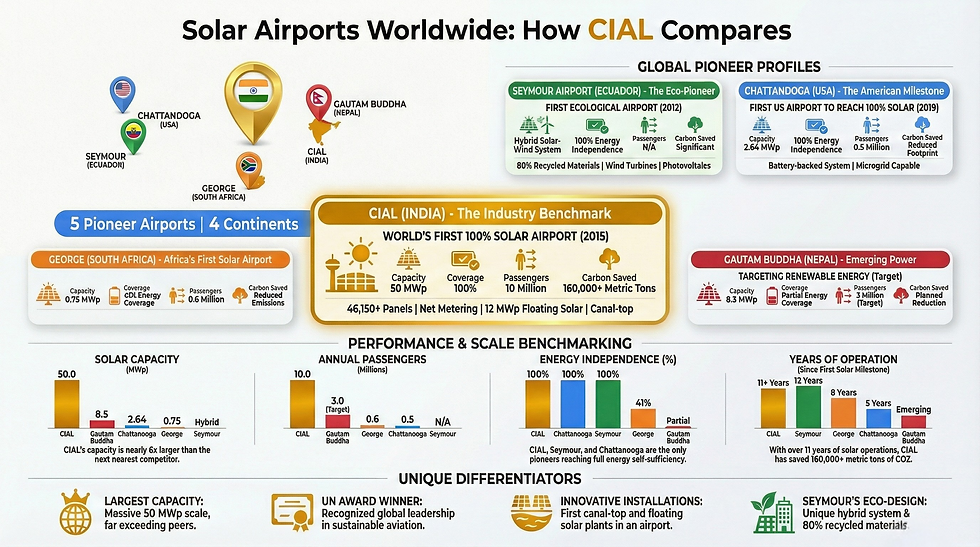
CIAL's achievement gains context when compared to other pioneering solar airport initiatives worldwide.
Global Solar Airport Comparison
Airport | Location | Capacity | Coverage | Year | Status |
CIAL | Kerala, India | 50 MWp | 100% solar | 2015 | First fully solar-powered |
Seymour Airport | Galapagos, Ecuador | Mixed (solar + wind) | 100% renewable | 2012 | First ecological airport |
George Airport | South Africa | 750 kWp | 41% solar | 2016 | Africa's first solar airport |
Chattanooga Airport | Tennessee, USA | 2.64 MWp | 100% solar | 2019 | First US 100% solar airport |
Gautam Buddha Airport | Nepal | 8.5 MWp | Partial | 2022 | South Asia's second |
Key Differentiators
Seymour Galapagos Airport claims "world's first ecological airport" status, inaugurated in 2012. However, it combines solar and wind energy (three large turbines), uses 80% recycled materials in construction, and serves a remote island with minimal passenger traffic (300,000 annually). While pioneering in sustainable design, it didn't achieve 100% solar-only operation.
George Airport in South Africa (opened 2016) installed 3,000 photovoltaic modules generating 750 kWp, meeting 41% of energy needs. As Africa's first solar airport, it validated the model for the continent but didn't reach energy independence.
Chattanooga Airport achieved 100% solar status in 2019 with a 2.64 MW installation covering 16 football fields. However, it serves 504,298 passengers annually—about half CIAL's traffic—with significantly lower operational energy demands.
Why CIAL Remains the Benchmark
CIAL's distinction rests on:
First to achieve 100% solar-only operation (no wind, hydro, or hybrid)
Larger scale: 50 MWp supporting 10 million passengers
Operational complexity: International hub with 24/7 cargo, maintenance, and passenger services
Sustained performance: 10+ years of verified energy independence
Replication influence: Direct model for 50+ Indian airports and international installations
Long-Term Strategic Implications
CIAL's success raises profound questions about infrastructure energy futures. Can the model scale to mega-hubs? What limits exist? How does this reshape airport development globally?
Scalability Analysis
Major international airports consume 50-200 MW during peak operations. Delhi Airport uses approximately 120 MW, Heathrow peaks at 90 MW, and Dubai International requires 150+ MW. CIAL's model works because:
Land availability: Regional airports control surrounding buffer zones suitable for solar farms
Net metering: Grid connection enables virtual storage without massive battery banks
Climate: Kerala's tropical location provides 1,600-2,000 kWh/m² annually
Mega-hubs face constraints:
Space limitations: Urban airports like Heathrow have minimal expansion land
Higher consumption: Larger terminals, more flights, expanded operations require 3-5x CIAL's generation
Grid capacity: Injecting 100+ MW intermittently strains distribution infrastructure
Hybrid Solutions for Large Hubs
Future large-scale implementations will likely combine:
On-site solar (rooftops, carports, perimeter land): 30-50% of needs
Off-site solar parks via wheeling agreements: Additional 20-40%
Grid renewable power through renewable purchase obligations: Remaining 10-30%
Battery storage for critical systems during grid failures
Delhi Airport is pursuing this model, targeting 10 MW on-site solar plus 40 MW off-site through power purchase agreements by 2026.
Green Airport Policy Development
CIAL's demonstration influenced India's Green Airports Policy requiring:
10% renewable energy for all airports by 2024 (achieved)
25% renewable energy by 2027
Carbon neutral operations by 2030
Solar carports at all new terminals
Globally, the International Air Transport Association (IATA) incorporated airport solar programs into its Net Zero 2050 roadmap, recognizing that ground infrastructure accounts for 40-60% of an airport's carbon footprint.
Economic Competitiveness
Solar costs have plummeted 89% since 2010 (from $2.70/W to $0.30/W). This transformation makes CIAL's model economically mandatory, not altruistic.
Airports choosing grid-only power now face:
Volatile electricity prices (rising 8-12% annually in India)
Carbon pricing mechanisms increasingly taxing fossil fuel consumption
Stranded asset risk as regulations mandate renewable transitions
New airport developments in India, Middle East, and Southeast Asia now include solar integration in initial designs—building the CIAL model into blueprints rather than retrofitting later.
Conclusion
The story of the first solar airport in world is ultimately about pragmatism meeting principle. Cochin International Airport didn't pursue solar power to win awards—it needed to control spiraling electricity costs. The environmental benefits, international recognition, and strategic influence emerged as byproducts of a sound business decision.
CIAL's 50 MWp solar installation generating 200,000 units daily proves that energy independence isn't theoretical for large institutions. It's achievable, financially viable, and operationally sustainable. The UN Champions of the Earth Award validated what Kerala's passengers already knew: their airport runs on sunshine.
For aviation globally, CIAL represents a global renewable aviation case study demonstrating that the sector's energy transition has already begun. Airports from Chattanooga to Kuala Lumpur are following the blueprint—net metering, phased expansion, terrain optimization, innovative installations.
The question is no longer whether airports can go solar. CIAL answered that a decade ago. The question now is how fast the rest will follow.
References & Citations
This article is backed by authoritative sources and research:
Cochin International Airport Limited (CIAL) Official Website - Green Energy Initiatives
United Nations Environment Programme (UNEP) - Champions of the Earth 2018
ScienceDirect Research Paper - "Fully solar powered airport: A case study of Cochin International airport" (2017)
https://www.sciencedirect.com/science/article/abs/pii/S0969699717300297
Ministry of New and Renewable Energy (MNRE), Government of India
Indian Green Building Council (IGBC) - Net Zero Energy Rating System
Department of Economic Affairs - PPP in India: Solarisation of Cochin International Airport
International Civil Aviation Organization (ICAO) - Environmental Report 2016
https://www.icao.int/environmental-protection/Documents/EnvironmentalReports/2016/
SDG Knowledge Hub - UN Environment Award Ceremony 2018
https://sdg.iisd.org/news/unep-award-ceremony-honors-champions-of-the-earth/
Down to Earth Magazine - "Cochin Airport: Powered by the Sun" (2019)
https://www.downtoearth.org.in/blog/energy/cochin-airport-powered-by-the-sun-67780
CIAL Infrastructure - Solar Power Projects
The Smart Ere - Case Study: Cochin International Airport Ltd (CIAL)
CNN Travel - "Africa gets its first solar-powered airport" (2016)
https://www.cnn.com/travel/article/george-airport-solar-south-africa/
Renewable Energy in India - Wikipedia (Verified with government sources)
Press Information Bureau (PIB), Government of India - The Solar Surge: India's Bold Leap Toward a Net Zero Future
India Brand Equity Foundation (IBEF) - India's Renewable Energy Growth
Legal Disclaimer:
This article provides informational content based on publicly available data from authoritative sources including government agencies, international organizations, peer-reviewed research, and official airport publications.
While every effort has been made to ensure accuracy and currency of information as of February 2026, readers should verify specific technical specifications, financial figures, and policy details directly with relevant authorities before making decisions.
The content does not constitute professional engineering, financial, or legal advice. Carbon emission calculations represent estimates based on standard conversion factors and may vary based on regional grid emission intensities.
Performance metrics cited reflect specific time periods and operational conditions that may differ from current operations.
For investment, engineering, or policy decisions related to solar airport installations, consult qualified professionals with expertise in renewable energy systems, aviation infrastructure, and local regulatory frameworks.
Read full disclaimer here.
© Green Fuel Journal Research Division | Published: February 2026


