


Indian Carbon Market 2026:The New Industrial Operating System

How carbon pricing is restructuring India's manufacturing economics, redefining trade access, and becoming the defining variable in industrial capital allocation for the next decade.
Executive Intelligence Synthesis
MODULE 1:
From PAT to Carbon Economics — The Strategic Pivot
India's Carbon Credit Trading Scheme (CCTS) is not a regulatory add-on to an existing environmental compliance framework. It is the restructuring of India's industrial operating logic. With ~740 entities across nine energy-intensive sectors now holding legally binding emission intensity targets for FY2026–FY2027, and the first Carbon Credit Certificate (CCC) trades expected by mid-2026, the transition from the Perform, Achieve and Trade (PAT) scheme to a full carbon pricing regime is entering its enforcement phase.
For Indian industry, this shift means carbon is no longer a disclosure metric — it is a balance-sheet variable, a trade-access credential, and increasingly, a credit-risk factor. The Indian Carbon Market (ICM) is the infrastructure layer on which India's industrial competitiveness will be assessed, financed, and globally positioned for the decade ahead.

Intelligence Briefing
5 Executive Signals: The PAT-to-Carbon-Economics Transition
01 From Energy Efficiency to GHG Pricing.
PAT measured energy savings in TOE (tonnes of oil equivalent). CCTS measures carbon intensity in tCO₂e per unit of output. The shift is conceptually decisive: PAT rewarded relative efficiency; CCTS prices absolute carbon risk. Industrial finance will reprice accordingly.
02 CBAM Synchronicity.
The EU's Carbon Border Adjustment Mechanism entered its definitive financial phase on January 1, 2026. India's CCTS is coming online at the exact moment that the world's largest trading bloc has placed a carbon tariff on Indian steel, aluminium, cement, and fertilisers. This is not coincidence — it is converging pressure that makes domestic carbon pricing a trade-access necessity, not a policy preference.
03~700 Mt CO₂e Under Compliance Jurisdiction.
The CCTS Phase 1 coverage — estimated at over 700 million tonnes of CO₂e — positions India among the world's three largest emissions trading systems by coverage volume, alongside the EU ETS and China's national ETS. Scale matters for market credibility and for carbon price signal strength.
04 Carbon-Adjusted Manufacturing Economics.
Early price estimates for CCCs range from ₹250 to ₹1,500 per tonne. For a blast-furnace steel plant emitting 2.1 tCO₂e per tonne of crude steel, compliance shortfalls translate directly into operating cost increases. At the upper end of CCC pricing, carbon could represent a meaningful percentage of per-unit production costs in high-intensity sectors.
05 Digital MRV as the New Compliance Infrastructure.
The ICM registry, managed by Grid Controller of India (GCI), and BEE-accredited verification agencies are the institutional spine of the scheme. Entities without robust digital Measurement, Reporting, and Verification (MRV) systems face not just regulatory risk but data credibility risk — EU buyers will demand verified emission data or apply punitive default values under CBAM.
MODULE 2:
The Macro-Economic Logic & Trade Geopolitics of Carbon Pricing
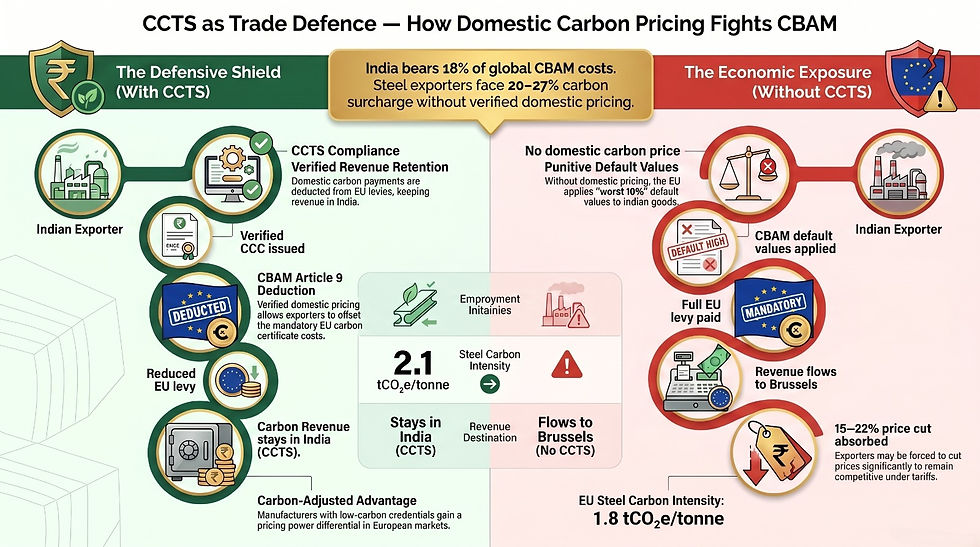
India's domestic carbon market is arriving at a moment of unprecedented external pressure. The EU's CBAM, now financially active from January 2026, imposes a carbon levy on Indian steel, aluminium, cement, and fertiliser exports. India is expected to absorb 18% of total CBAM costs globally — nearly double its share of EU import value — due to blast-furnace steelmaking dominance and the prior absence of domestic carbon pricing.
The Indian Carbon Market addresses this vulnerability directly: a credible domestic carbon price, once recognised under CBAM Article 9, can be deducted from the EU border levy, returning revenue to India rather than the EU. The CCTS is therefore both a decarbonisation instrument and a trade-defence mechanism. Its strategic value extends well beyond climate compliance.
Carbon Pricing as a Trade Defence Strategy
For the better part of a decade, India maintained a measured scepticism toward economy-wide carbon pricing. That position was not purely political. It reflected a considered assessment: without institutional readiness — robust MRV infrastructure, sector-level emissions baselines, a functional registry, and regulatory capacity — a carbon market launched prematurely would produce price signals that punished industry without delivering decarbonisation.
India watched the EU ETS's early-phase over-allocation problem, which collapsed carbon prices to near-zero between 2008 and 2013, and drew the appropriate lessons. The PAT scheme served as the incubation period — building measurement discipline, sector familiarity with tradeable certificates, and industry-level data integrity.
That calculation changed when the EU formally activated CBAM's financial phase on January 1, 2026. From that date, every Indian steel shipment to the EU carries an embedded carbon cost borne by the EU importer — and immediately passed back to the Indian exporter through price renegotiation. The Global Trade Research Initiative estimates Indian exporters may need to absorb price cuts of 15–22% to remain competitive. For steel specifically, where India's blast-furnace average carbon intensity of 2.1 tCO₂e per tonne of crude steel significantly exceeds the EU average of 1.8 tCO₂e, the structural cost disadvantage is material.
The arithmetic is blunt. With EU ETS prices currently ranging between €80–90 per tonne and projected by Fastmarkets to reach €130 per tonne by 2030, an Indian integrated steel mill exporting 1 million tonnes annually faces a CBAM liability escalating sharply over the next four years. According to Fastmarkets analysis, India bears approximately 18% of projected global CBAM costs — a disproportionate burden given its share of EU import volume. The iron and steel sector alone accounts for roughly 90% of India's CBAM-exposed exports.
Here is where the ICM's strategic geometry becomes clear. Under CBAM Article 9, a verified domestic carbon price paid by an Indian producer can be deducted from the CBAM certificate obligation. If India's CCTS generates a credible, verifiable CCC price that is formally recognised by the EU through a Mutual Recognition Agreement or bilateral equivalence decision, Indian exporters gain a direct financial offset. Carbon revenue that would otherwise flow to Brussels stays in the Indian economy. The CCTS is, in this sense, not just climate infrastructure — it is a fiscal defence mechanism.
India's Deliberate Institutional Sequencing
The sequencing of India's carbon market architecture reflects a sophisticated institutional logic that deserves more analytical attention than it typically receives. The Energy Conservation (Amendment) Act, 2022 provided the legal mandate. The CCTS notification in June 2023 established the governance architecture.
The GHG Emission Intensity Target Rules in 2025 set sector-level compliance obligations. The BEE's Detailed Procedure publications (July 2024 for compliance, March 2025 for offsets) delivered the operational rulebook. And the ICM Registry launch at Prakriti 2026 in March 2026 activated the transactional infrastructure.
Each step was load-bearing. India did not announce a carbon price and then figure out implementation. It built the infrastructure before activating compliance obligations. The result is a scheme that, while imperfect and still maturing, arrives with institutional credibility.
The Bureau of Energy Efficiency (BEE) as administrator brings a decade of PAT-era sector expertise. The Central Electricity Regulatory Commission (CERC) as trading regulator leverages its established power-market oversight function. The Grid Controller of India (GCI) as registry operator provides the transactional backbone. This is not a hastily assembled regulatory structure — it is an institutional stack assembled with deliberate sequencing.
Milestone | Year | Significance |
Energy Conservation (Amendment) Act | 2022 | Legal mandate for domestic carbon market established |
CCTS Notified by Ministry of Power | June 2023 | Governance architecture formalised; BEE designated administrator |
Offset Mechanism Amendment | Dec 2023 | Voluntary crediting pathway opened for non-obligated entities |
BEE Compliance Procedure Published | July 2024 | Operational rulebook for large industry released |
GHG Intensity Targets — 4 Sectors | Oct 2025 | Aluminium, Cement, Chlor-Alkali, Pulp & Paper notified |
GHG Intensity Targets — 5 More Sectors | Jan 2026 | Refinery, Petrochemicals, Textiles, Iron & Steel (pending), Fertiliser added |
ICM Portal Launch (Prakriti 2026) | March 2026 | Central platform for ICM administration officially activated |
First CCC Compliance Deadline | July 31, 2026 | Entities must submit verified FY2025–26 emissions reports |
First CCC Trading Expected | Mid-2026 | Power Exchange trading of CCCs on CERC-regulated markets |
The Embedded Emissions Economy and What It Means for Indian Industry
The concept of embedded emissions — the carbon dioxide generated in the production of a good, not merely its use — is central to understanding how CBAM and CCTS interact at the industrial level. India's heavy reliance on coal-based power and blast-furnace manufacturing means that embedded emissions in Indian industrial goods are structurally higher than EU equivalents. This is not a data problem; it is an energy infrastructure problem with a generational timeline to resolve.
The strategic implication is significant. Indian manufacturers who invest early in renewable power procurement, energy efficiency upgrades, or fuel switching — and who can demonstrate those reductions through verified MRV systems — gain a carbon-adjusted competitive advantage relative to peers still operating at sector average emissions. In a CBAM-active world, the gap between a manufacturer at 1.6 tCO₂e per tonne of steel and one at 2.5 tCO₂e is not merely a regulatory compliance difference; it is a pricing power differential that will increasingly determine EU market access.
The ICM creates the domestic pricing signal that makes this differentiation financially legible within India. Carbon credit certificates earned by overperformers become tradeable assets. Their value reflects not just domestic regulatory demand but the growing international premium for verified low-carbon industrial goods. This is the mechanism through which carbon pricing becomes an innovation incentive rather than a compliance tax — but it depends entirely on price signal integrity, which in turn depends on market liquidity and credible MRV.
MODULE 3:
Operational Architecture: The CCTS Deep-Dive
How the Indian Carbon Market Functions
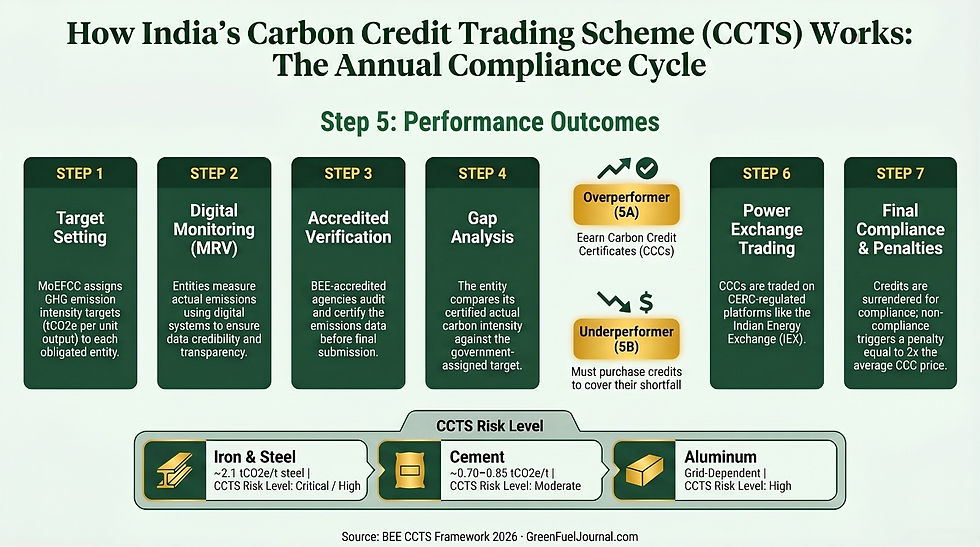
India's CCTS operates as an intensity-based baseline-and-credit system, not an absolute cap-and-trade scheme. Covered entities receive GHG emission intensity targets (tCO₂e per unit of output) rather than absolute emission caps. Entities that outperform their targets earn Carbon Credit Certificates (CCCs) — each representing 1 tonne of CO₂e reduction beyond target. Underperformers must purchase CCCs from the open market through CERC-regulated power exchanges. Non-compliance triggers penalties equal to twice the average CCC trading price for the compliance year. The compliance mechanism covers ~740 entities across nine sectors. A parallel voluntary Offset Mechanism allows non-obligated entities to earn CCCs through registered emission reduction projects.
Compliance vs. Voluntary: Two Distinct Market Mechanisms
The CCTS architecture distinguishes sharply between two participation pathways. The Compliance Mechanism is mandatory for obligated entities — large industrial installations across the nine notified sectors that meet minimum production thresholds. These entities carry legally binding GHG intensity targets for FY2025–26 and FY2026–27, using FY2023–24 as the baseline measurement year. Failure to meet targets and surrender the required CCCs triggers an environmental compensation order from the Central Pollution Control Board — effectively a fine calculated at twice the prevailing CCC market price.
The Offset Mechanism is voluntary and project-based, open to entities outside the compliance perimeter. Non-obligated entities — including those in agriculture, forestry, waste management, transport, and emerging sectors — can register emission reduction, removal, or avoidance projects under BEE-approved methodologies and earn CCCs. As of early 2026, nine methodologies have been notified, covering biogas, green hydrogen, pumped hydro storage, industrial energy efficiency, and mangrove afforestation.
Over 40 entities have already submitted or registered projects under the offset mechanism. This parallel voluntary track is strategically important: it extends market participation beyond heavy industry, builds liquidity, and creates an incentive pathway for sectors — including MSMEs, agriculture, and forestry — that sit outside the compliance perimeter.
The CCC Lifecycle and Registry Infrastructure
Carbon Credit Certificates are issued by BEE to overperforming entities and transacted through the ICM Registry managed by the Grid Controller of India. The registry tracks the full certificate lifecycle: issuance, transfer, banking, and surrender. CCCs are not currently classified as financial instruments under CCTS rules — a deliberate design choice that avoids triggering SEBI regulatory oversight in the scheme's initial phase, though this classification may evolve as the market matures.
Secondary market trading will occur through India's established power exchanges — the Indian Energy Exchange (IEX) and PXIL — under CERC market oversight. This is a structurally elegant design choice: it leverages existing exchange infrastructure, regulatory familiarity, and trading participant networks rather than constructing a greenfield carbon exchange.
In March 2026, CERC notified the formal terms and conditions for CCC purchase and sale, completing the final regulatory link in the trading chain. Early price estimates from sector analysts range from ₹250 to ₹1,500 per tonne, reflecting significant uncertainty around initial liquidity, sectoral demand concentration, and the pace of entity registration.
Sector Coverage and the PAT Transition
The nine Phase 1 sectors — Aluminium, Chlor-Alkali, Cement, Fertiliser, Iron & Steel, Pulp & Paper, Petrochemicals, Petroleum Refinery, and Textiles — represent approximately 16% of India's total GHG emissions. These sectors are being transitioned from the PAT energy-efficiency framework to the CCTS emissions-intensity framework through a deliberate phased migration. Entities that generated Energy Saving Certificates (ESCerts) under PAT are being onboarded into the CCTS compliance architecture.
A second phase of sector expansion is expected to include aviation, ports, railways, and data centres. The growth pathway of the ICM depends heavily on how quickly these expansion decisions are made and how effectively compliance is enforced in Phase 1.
Module 4
The Industrial Transition Shock: Sector Exposure Analysis
Sector | CBAM Exposure | Avg. Carbon Intensity | CCTS Risk Level | Strategic Pressure Point |
Iron & Steel | CRITICAL | ~2.1 tCO₂e/t steel | HIGH | BF-BOF dominance; EU market access at stake |
Aluminium | HIGH | Grid-intensity dependent | HIGH | Indirect emission scope expansion risk by 2030 |
Cement | MODERATE | ~0.70–0.85 tCO₂e/t cement | MEDIUM | Process emissions inherent; market diversification viable |
Petroleum Refinery | MODERATE | Sector-specific benchmarks notified Jan 2026 | MEDIUM | Downstream petrochemical linkage adds exposure |
Fertiliser | MODERATE | Gas-feedstock dependent | MEDIUM | Green ammonia transition pathway under review |
Petrochemicals | LOWER | Targets notified Jan 2026 | MEDIUM | Downstream CBAM expansion by 2030 could escalate |
Textiles | LOWER | Energy-intensity variable by sub-sector | LOW | MSME compliance burden; MRV capacity gap |
Chlor-Alkali | LOWER | Grid-electricity intensive | LOW | Membrane cell transition opportunity |
Pulp & Paper | LOWER | Biomass co-firing prevalent | LOW | Offset mechanism opportunity via forestry linkages |
Carbon-Adjusted Manufacturing Economics: Steel as a Case Study
The practical consequence of carbon pricing on industrial profit margins is most starkly visible in steel, India's highest-CBAM-exposure sector. Consider the arithmetic.
A typical Indian integrated steel plant using blast furnace–basic oxygen furnace (BF-BOF) technology emits approximately 2.1 tCO₂e per tonne of crude steel, against a EU BF-BOF average of around 1.8 tCO₂e and an electric arc furnace (EAF) average of 0.4–0.6 tCO₂e.
With EU ETS prices at roughly €80–90 per tonne in 2026, the carbon surcharge on an Indian BF-BOF shipment to the EU is approximately €168–189 per tonne of steel. Against a typical selling price of €700–850 per tonne, that represents a 20–27% embedded carbon cost increase.
The CBAM rules permit deduction of any verified domestic carbon price paid in the country of origin. Under CCTS, if an Indian steelmaker can demonstrate it has surrendered CCCs equivalent to its shortfall from target, and if that domestic carbon price is formally recognised by the EU, a portion of the CBAM certificate cost is offset.
The financial incentive for Indian steelmakers to engage with CCTS compliance is therefore not primarily domestic — it is a function of EU market access arithmetic. Plants with the lowest verified carbon intensity will hold a structural pricing advantage in European tender processes. The carbon credentials of a manufacturing facility are becoming as commercially relevant as its logistics cost or yield efficiency.
Aluminium: The Indirect Emission Time Bomb
Aluminium presents a distinctive risk profile. Unlike steel, where process emissions dominate, aluminium smelting is primarily an electricity-intensive operation. India's aluminium sector draws heavily from captive coal-based power, making its effective carbon intensity grid-dependent rather than process-dependent.
Current CBAM rules for aluminium focus on direct (Scope 1) emissions, but EU policymakers have flagged a future expansion to include indirect emissions from electricity use. If that expansion occurs — and the political and technical trajectory suggests it will, likely before 2030 — India's aluminium exporters face a step-change increase in CBAM liability.
Fastmarkets projects that including indirect emissions could push aluminium sector CBAM costs from approximately €1 billion to €4.7 billion by 2030 globally. India's share of that increase would be disproportionate given its coal-heavy grid.
For Indian aluminium producers, the strategic response is already visible in the market: accelerated renewable power procurement for smelter operations, captive solar and hybrid wind-solar installations, and exploration of round-the-clock renewable power purchase agreements. Carbon credentialing in aluminium is rapidly becoming an energy procurement decision rather than a process optimisation decision.
MODULE 5:
The Carbon Intelligence Stack: AI, MRV, and Digital Infrastructure
India's carbon market compliance infrastructure is accelerating the emergence of a specialised technology sub-sector — digital MRV (Measurement, Reporting, and Verification). For covered entities, accurate and verifiable emissions data is the foundation of both CCTS compliance and CBAM defence. Entities relying on manual, unverified, or inconsistent emissions reporting face two compounding risks: domestic regulatory non-compliance and EU CBAM default-value penalties, which are set at the worst 10% of EU producers and can impose carbon costs equivalent to ₹70 lakh to ₹1.6 crore per 1,000 tonnes above actual emissions.
What Role Will AI Play in Indian Carbon Compliance?
Digital MRV is evolving from a compliance function into a strategic intelligence layer. AI-driven emissions monitoring systems — integrating IoT sensor networks, energy metering data, production records, and fuel consumption logs — can provide near-real-time carbon intensity calculations at the facility level. This granularity is operationally valuable: it enables plant managers to identify emission hotspots, model compliance trajectories ahead of reporting deadlines, and optimise production scheduling to minimise carbon shortfalls.
Satellite-based emissions verification is adding an independent layer of scrutiny. High-resolution satellite imagery combined with atmospheric dispersion modelling can cross-validate facility-level methane and CO₂ emission reports. While still maturing as a CCTS verification tool, satellite MRV is already deployed in the EU ETS context and is being evaluated for integration with India's ICM framework. For sectors with historically inconsistent self-reporting — thermal power, refineries — satellite verification reduces the data credibility gap that currently constrains carbon market price discovery.
Blockchain-enabled carbon traceability represents the third layer of the emerging carbon intelligence stack. Distributed ledger systems that log the full provenance chain of a CCC — from emission reduction event to verification to issuance to trading to surrender — provide the audit-trail integrity that institutional carbon buyers and EU CBAM administrators require. Several Indian technology firms and international climate tech players are developing blockchain-native carbon registries specifically calibrated to CCTS and CBAM documentation requirements.
AI and Satellite Verification: The End of Greenwashing
The combination of AI-driven analytics, satellite monitoring, and blockchain traceability fundamentally changes the evidentiary standard for industrial emissions claims. In the pre-ICM environment, emissions reporting was largely self-certified, with periodic audits of uncertain rigour.
The CCTS framework mandates BEE-accredited third-party carbon verification agencies for all compliance mechanism entities — a requirement that is already generating a market for specialised carbon auditing services. BEE has been building its list of accredited Carbon Verification Agencies (CVAs) since 2025, with provisional lists published for stakeholder comment in January and February 2026.
The institutional signal is clear: carbon data quality is being treated as a regulatory matter with legal consequences, not a voluntary disclosure exercise. For industrial CFOs and ESG leadership teams, the implication is that emissions management systems are no longer optional infrastructure. They are compliance-grade systems with the same regulatory scrutiny applied to financial reporting.
Module 6
Capital Allocation & Transition Finance: How the ICM Reprices Industrial Assets
Carbon Intensity as a Future Credit-Risk Variable
The financial sector's engagement with carbon risk has moved from ESG disclosure frameworks to credit analysis. Rating agencies and institutional lenders are beginning to treat a borrower's carbon intensity trajectory — and their exposure to CCTS compliance costs and CBAM liabilities — as a material variable in credit risk assessment.
For an Indian steel company with significant EU export exposure and a BF-BOF emission profile, the combination of rising CBAM costs, potential CCTS compliance shortfall penalties, and accelerating EU ETS prices represents a structured long-term liability that affects free cash flow forecasts, covenant headroom, and refinancing risk.
Carbon-linked lending — where loan covenants include sustainability-linked provisions tied to verified emission intensity improvements — is gaining traction in Indian corporate banking. State Bank of India's green lending frameworks, international development finance institutions including the International Finance Corporation and Asian Development Bank, and foreign commercial banks with net-zero commitments are all developing carbon-adjusted credit products that price green capex investment more favourably than carbon-intensive asset maintenance.
Green Capex Reallocation and the CCC Asset Class
The emergence of CCCs as tradeable assets introduces a new dimension to industrial capital allocation. A plant that overachieves its CCTS emission intensity target does not just avoid a penalty — it generates CCCs that can be sold in the secondary market.
At projected CCC prices of ₹250–₹1,500 per tonne, the annual CCC revenue from a large overperforming cement plant or steel facility could be commercially meaningful relative to operating margins. This transforms emission reduction from a cost-avoidance exercise into a revenue-generating investment thesis.
The practical consequence is a gradual repricing of industrial assets based on their carbon balance-sheet position. A facility with demonstrated capacity to overperform its CCTS targets — through renewable energy procurement, process efficiency, or technology upgrades — commands a premium in acquisition and financing markets relative to a structurally under-performing peer. This dynamic is already visible in EU industrial M&A, where low-carbon manufacturing assets attract valuation premiums. India is approaching the beginning of that same repricing cycle as the ICM matures and CCC price signals strengthen.
Eight offset methodologies approved by BEE — covering green hydrogen, pumped hydro storage, biogas, industrial energy efficiency, and mangrove afforestation — create additional carbon revenue pathways for entities outside the compliance perimeter. For renewable energy developers, green hydrogen project sponsors, and agricultural landholders, the voluntary offset market represents an emerging revenue stream tied to verifiable decarbonisation activity.
MODULE 7:
Friction, Risk, and Systemic Bottlenecks
What Could Go Wrong
The ICM's institutional architecture is more carefully designed than most comparable emerging market carbon schemes. That does not make it immune to structural risk. The EU ETS experience — a decade of dysfunctional price signals from over-allocation, political interference, and institutional fragmentation — provides a cautionary baseline for any nascent carbon market.
India's CCTS faces several distinct friction points.
The first is target calibration risk. The scheme's intensity-based design means that rising industrial output — rather than falling absolute emissions — can satisfy compliance obligations. A cement sector growing production at 8% per annum could technically meet its tCO₂e per tonne target while increasing absolute emissions substantially. This is a structural feature of output-based intensity schemes, not a design flaw per se, but it creates a divergence between carbon market compliance and actual atmospheric outcomes. For institutional carbon buyers seeking credible decarbonisation signal, this ambiguity matters.
The second risk is market liquidity. With approximately 740 obligated entities across nine sectors, the initial CCTS compliance market is relatively narrow. CCC price discovery requires genuine trading depth — multiple buyers and sellers with divergent compliance positions transacting regularly. In the early trading cycles, thinly traded markets can produce volatile or distorted price signals that undermine the economic incentives the scheme is designed to create. The PAT scheme's ESCert market, a structural predecessor, suffered from exactly this liquidity problem.
Third is the SME compliance burden. While Phase 1 focuses on large industrial entities, the textiles sector in particular includes a significant tail of medium-scale units approaching but not exceeding minimum thresholds. As sector coverage expands, the compliance burden shifts toward entities without the internal capacity or resources to manage MRV systems, verification costs, and registry operations. BEE's accredited verifier list is still being constituted, and verification costs for smaller entities relative to their carbon compliance exposure could create compliance economics that discourage genuine engagement.

The Iron & Steel Target Delay: A Governance Signal
One specific governance friction deserves direct attention. As of February 2026, MoEFCC had not yet notified the GHG emission intensity targets for the iron and steel sector — the most economically significant sector in the entire CCTS framework and the one facing the most acute CBAM pressure.
The delay reflects the political and technical complexity of target-setting for a sector with significant variation in production processes, feedstock mixes, and technology vintages across India's steel industry.
But the delay also creates compliance uncertainty for exactly the entities with the highest carbon market exposure. Resolving this notification gap is an urgent governance priority.
MODULE 8:
Future Systems Forecast: Four Scenarios for the Indian Carbon Economy 2026–2035
Scenario A
Institutional Growth
CCTS operates as designed. CCC prices stabilise between ₹600–₹900/tonne by 2028. EU-India bilateral equivalence is achieved under the FTA framework by 2029, providing full CBAM Article 9 credit deduction for Indian exporters. Sector coverage expands to aviation, ports, and data centres by 2030. India's ICM becomes a reference point for Asian emerging market carbon scheme design. Probability: 35%
Scenario B
Industrial Acceleration
Steel, aluminium, and cement sectors front-run CCTS compliance with aggressive low-carbon technology investment — EAF transitions, renewable power procurement, green hydrogen-based DRI pilots. Carbon intensity improves faster than target trajectories. CCC oversupply emerges; prices remain low but credit volume supports voluntary market development. CBAM pressure drives EU market share gains for carbon-efficient Indian producers. Probability: 25%
Scenario C
Compliance Friction
MRV data quality problems undermine CCC credibility. Thin market liquidity distorts price signals. CERC oversight proves insufficient for market manipulation prevention. EU declines CBAM equivalence pending MRV standard convergence. Indian exporters face full CBAM certificate costs with no domestic offset. Industrial lobby pressure leads to target relaxation, undermining market integrity. Probability: 25%
Scenario D
Integrated Asian Market
India, China, Japan, South Korea, and Southeast Asian economies initiate carbon market linkage discussions under Article 6 of the Paris Agreement. India's CCTS becomes a foundational element of an Asian carbon trading architecture. International capital inflows through bilateral Article 6 frameworks accelerate adoption of advanced decarbonisation technologies in Indian industry. India's carbon market compliance period begins coinciding with India's carbon market compliance period. Probability: 15%
Timeframe | Market Size Est. (tCO₂e) | Sectors Covered | Key Milestone |
2026 | ~700 Mt (compliance phase 1) | 9 industrial sectors | First CCC trading; July compliance deadline |
2027 | ~750–800 Mt | 9 sectors + voluntary offset growth | Full annual compliance cycle operational |
2028–2029 | ~850 Mt–1 Gt | 11–12 sectors (aviation, ports potential) | EU-India CBAM equivalence negotiation outcome |
2030 | ~1–1.2 Gt | 13–15 sectors | India NDC compliance check point; CBAM full phase-in |
2035 | ~1.5–2 Gt (projected) | Economy-wide coverage aspiration | Potential Article 6 international linkage; net-zero pathway alignment |
Module 9
Strategic Recommendations & Conclusion
For Industry
The first priority is emissions data infrastructure. Before any decarbonisation investment decision, industrial entities must establish digital MRV systems capable of producing BEE-compliant, verifier-ready emissions reports at the facility level. The cost of poor data quality under both CCTS and CBAM — in penalties, CBAM default values, and lost CCC revenue — exceeds the cost of proper data infrastructure by a significant multiple. Commission a baseline GHG audit from a BEE-accredited verifier now, before the July 31, 2026 compliance deadline. Entities that complete this step early gain the data clarity needed for strategic carbon planning.
For steel and aluminium producers with EU market exposure, begin quantifying your CBAM liability today using actual verified emissions rather than sector averages. The financial gap between your actual carbon intensity and the CBAM default value is an unnecessary cost that verified data eliminates. Appoint a dedicated CCTS compliance lead with cross-functional authority over energy management, production planning, and procurement. Carbon compliance is not a regulatory affairs function — it is a manufacturing operations priority with P&L implications.
For Investors
Carbon intensity is becoming a material financial metric for Indian industrial equities and debt. The combination of CCTS compliance costs, CBAM liabilities on EU-exposed revenues, and the emerging premium for low-carbon manufacturing assets creates a carbon-adjusted valuation framework that conventional industrial analysis does not capture.
Build carbon exposure assessment into due diligence processes. Prioritise portfolio companies with credible, verified emission reduction trajectories and strategic engagement with CCTS compliance. The early movers in carbon-efficient industrial manufacturing will command structural competitive advantages as CCC prices mature and CBAM exemptions for domestically-priced carbon become negotiated realities.
For Policymakers
Three regulatory actions carry the highest near-term strategic value. First, accelerate the MoEFCC notification of iron and steel GHG intensity targets — the single largest gap in the current CCTS framework and the sector facing the most acute CBAM pressure. Second, initiate formal India-EU technical dialogue on CBAM Article 9 equivalence under the Free Trade Agreement framework currently under negotiation.
Every year that India's carbon price is not recognised by the EU is a year that carbon revenue flows to Brussels rather than supporting India's green industrial transition. Third, develop a dedicated MSME carbon compliance support programme — digital MRV tools, subsidised verification access, and advisory services — before sector expansion moves beyond the current Phase 1 entities.
Closing Intelligence
The Indian Carbon Market is not a cost centre. It is the new gatekeeper of global trade access. The industrial manufacturers who understand this earliest — who invest in carbon data infrastructure, who engage the CCTS compliance architecture as a strategic tool rather than a regulatory burden, and who position their emission intensity reduction as a commercial differentiator in EU markets — will find that carbon discipline and competitive advantage are converging rather than conflicting objectives. The ICM is the operating layer on which India's industrial future will be negotiated with the global economy. That negotiation has begun.
FAQ
Executive FAQ: India Carbon Market 2026
How will carbon pricing affect Indian manufacturing costs?
Carbon pricing under CCTS will add a compliance cost layer for entities that fail to meet their GHG intensity targets. At projected CCC prices of ₹250–₹1,500 per tonne, cost impact varies significantly by sector and facility-level performance. For BF-BOF steelmakers with significant EU export exposure, the combined effect of domestic CCTS compliance costs and EU CBAM tariffs could represent a 20–27% carbon surcharge per tonne of exported steel. Manufacturers who overachieve their targets earn CCCs — effectively generating a carbon revenue stream that offsets or exceeds compliance costs.
Can India's carbon market link with the EU ETS?
Direct market linkage is unlikely in the near term given the structural differences between CCTS (intensity-based) and EU ETS (absolute cap). However, formal equivalence recognition under CBAM Article 9 — which would allow Indian CCTS compliance costs to be deducted from CBAM certificate obligations — is a more achievable near-term policy objective. India and the EU are in active Free Trade Agreement negotiations, and carbon equivalence is a stated agenda item. The technical requirement is that India's CCTS demonstrates MRV standards comparable to EU verification requirements. Convergence toward Article 6 of the Paris Agreement provides an additional multilateral pathway for bilateral carbon credit recognition.
What role will AI play in Indian carbon compliance?
AI is emerging as the operational backbone of carbon compliance infrastructure. AI-driven emissions monitoring integrates IoT sensors, energy meters, production records, and fuel consumption data to provide near-real-time carbon intensity tracking. This enables facilities to identify compliance gaps before reporting deadlines, optimise production to minimise carbon shortfalls, and generate audit-ready emissions datasets for BEE-accredited verifiers. Satellite-based AI monitoring adds an independent verification layer. Blockchain-enabled traceability ensures CCC provenance integrity for EU CBAM documentation requirements. Together, these technologies are constituting India's emerging Carbon Intelligence Stack — a specialised tech sub-sector with significant growth prospects as ICM coverage expands.
Will Indian companies be required to buy carbon credits by 2026?
Yes. For the approximately 740 obligated entities across the nine notified CCTS sectors, carbon compliance is legally mandatory for FY2025–26 and FY2026–27. Entities that fail to meet their GHG emission intensity targets must purchase and surrender Carbon Credit Certificates (CCCs) equivalent to their shortfall. The first compliance reporting deadline is July 31, 2026. Non-compliance triggers an environmental compensation order equal to twice the average CCC market price for the compliance year. CCC trading is expected to commence on CERC-regulated power exchanges by mid-2026.
Legal Disclaimer:
This report is published for informational and strategic intelligence purposes only. It does not constitute legal, financial, investment, or regulatory compliance advice. Readers should consult qualified legal and compliance professionals before making decisions based on this content. Green Fuel Journal makes no representations regarding the completeness or accuracy of forward-looking projections or market estimates. For full terms, visit greenfueljournal.com/disclaimers.
References & Strategic Sources
This report is backed by authoritative research, institutional analysis, industry intelligence, and strategic data sources.
International Carbon Action Partnership (ICAP) — Indian Carbon Credit Trading Scheme ETS Map and Scheme Description · icapcarbonaction.com
Bureau of Energy Efficiency (BEE), Ministry of Power, Government of India — Carbon Credit Trading Scheme: Official Framework & Procedures · beeindia.gov.in
Ministry of Environment, Forest and Climate Change (MoEFCC) — GHG Emission Intensity Target Rules 2025 — Gazette Notifications for Nine Sectors
European Commission, DG TAXUD — Carbon Border Adjustment Mechanism: Definitive Phase Implementation from January 2026 · taxation-customs.ec.europa.eu
Carbon Market Network — India's Carbon Credit Trading Scheme (CCTS) Explained, 2026 Update · carbonmarketnetwork.com
Fastmarkets — Margins on the Line: CBAM Insights for Metals Suppliers and Buyers · fastmarkets.com
Osmosis Investment Management — The EU's CBAM: Impact on Emerging Market Steel Producers, December 2025 · osmosisim.com
Global Trade Research Initiative (GTRI) — CBAM Cost Estimates for Indian Exporters, 2026
Centre for Science and Environment (CSE) — CBAM: The Global South's Response to a Changing Trade Regime
CSEP (Centre for Social and Economic Progress) — Assessing the Distributional Implications of the EU's CBAM on India: A CGE Analysis · csep.org
Offset8 Capital — Indian Carbon Market: Key Insights on CCTS and Article 6, May 2026 · offset8capital.com
Indian Carbon Market Portal — Launched March 2026 at Prakriti 2026 under BEE leadership
Central Electricity Regulatory Commission (CERC) — Terms and Conditions for Purchase and Sale of Carbon Credit Certificates, March 2026
© 2026 GreenFuelJournal.com · Strategic Intelligence for the Global Energy Transition · Disclaimers


