


Renewable Energy Trends in 2026: Key Drivers, Growth Forecasts & Strategic Outlook

Renewable energy trends in 2026 mark an undeniable turning point: for the first time in modern history, electricity from wind, solar, hydro, and other clean sources is overtaking coal as the world's single largest generation source. This article delivers a research-backed, data-driven analysis of where the sector stands today, what is driving its acceleration, and what stakeholders across the value chain should prioritize right now.

Stand anywhere near a major electricity grid in early 2026 and you will sense a shift that charts had long predicted.
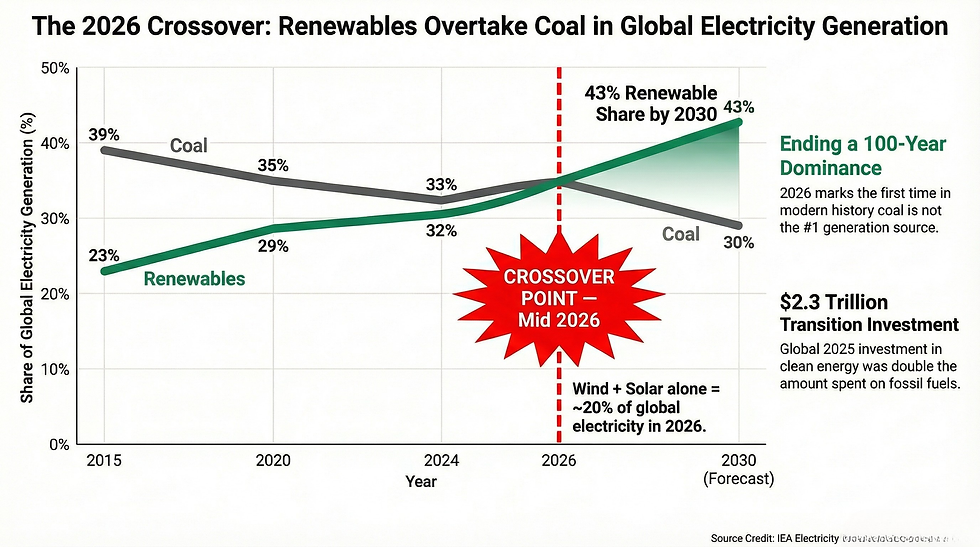
The International Energy Agency (IEA) confirmed that renewable energy trends in 2026 are not projections anymore — they are live events. Renewables are set to surpass coal as the top source of global electricity generation by mid-2026 at the latest, ending a dominance that coal held for more than a century. Wind and solar alone now supply nearly 20% of all electricity worldwide, up from just 4% a decade ago.
This is not the story of a sector still climbing toward relevance. It is the story of one that has arrived. In 2025, the world invested a record $2.3 trillion in the energy transition — more than double what went into fossil fuel supply (BloombergNEF, January 2026).
Solar and wind installations together exceeded 800 GW in a single year, a figure that was unimaginable just five years ago.
Yet the story has layers. Policy headwinds in the United States, market reform turbulence in China, stubbornly high offshore wind costs, and a widening green skills gap mean that the path ahead is not straight.
The question for 2026 is not whether renewables will grow — they will. The question is how fast, where, and who benefits.
This article draws on the most current data from the IEA, BloombergNEF (BNEF), the International Renewable Energy Agency (IRENA), and the U.S. Energy Information Administration (EIA) to answer exactly that.
$2.3T Global Energy Transition Investment 2025 (BNEF) | 800+ GW Solar + Wind Installed in 2025 — All-Time Record |
~20% Wind + Solar Share of Global Electricity 2026 (IEA) | $78/MWh 4-Hour Battery Storage LCOE — Record Low (BNEF, Feb 2026) |
Global Growth Forecasts for Renewable Energy in 2026
Renewables are forecast to account for 43% of global electricity generation by 2030, up from 32% in 2024, according to the IEA Renewables 2025 report.
Within this trajectory, 2026 functions as the first year where the scale of clean generation is broadly visible to consumers, utilities, and markets — not just in data tables but in actual dispatch patterns and power prices.
The global benchmark for cumulative renewable power capacity is tracking toward 9,530 GW by 2030 — a 2.6-times increase from the 2022 baseline.
Solar PV will account for roughly 80% of all new capacity additions between 2025 and 2030. Wind follows at roughly 15%.
Technology | 2024 Capacity | 2025 Additions | 2026 Projected | LCOE Trend 2026 |
Solar PV (Utility-Scale) | ~1,700 GW | ~600 GW | ~620 GW | $39/MWh (+6%) — supply chain pressure |
Onshore Wind | ~1,100 GW | ~170 GW | ~180 GW | $40/MWh (+2% globally) |
Offshore Wind | ~80 GW | ~25 GW | ~27 GW | $100/MWh (+12%); elevated to 2030 |
Battery Storage | ~42 GWh (US) | >87 GW (co-located) | >100 GW (global) | $78/MWh (–27%) — ALL-TIME LOW |
Hydropower | ~1,400 GW | ~30 GW | ~32 GW | Stable; generation +3% (EIA) |
Total Renewables | ~4,200 GW | ~800+ GW | ~810–830 GW | Surpassing coal in mid-2026 |
Sources: IEA Renewables 2025, BNEF LCOE 2026 (Feb 2026), EIA STEO Feb 2026.

The crossover moment — where renewables generate more electricity annually than coal — is happening right now, in 2026. The IEA Electricity 2026 report confirms that total generation from renewables is overtaking coal. This is not a forecast for 2030. It is a 2026 reality.
China continues to dominate volume, accounting for nearly 60% of global renewable capacity growth. India is on a steep climb, with renewable capacity set to rise 2.5 times between 2025 and 2030, making it the second-largest growth market globally (IEA).
In the United States, the EIA (February 2026) projects utility-scale solar generation rising 17% in 2026 and a further 23% in 2027, with 69 GW of solar capacity and 19 GW of wind connecting to the U.S. grid across 2026–2027 combined.
Driving Forces Behind Renewable Energy Trends
Technological Advancements
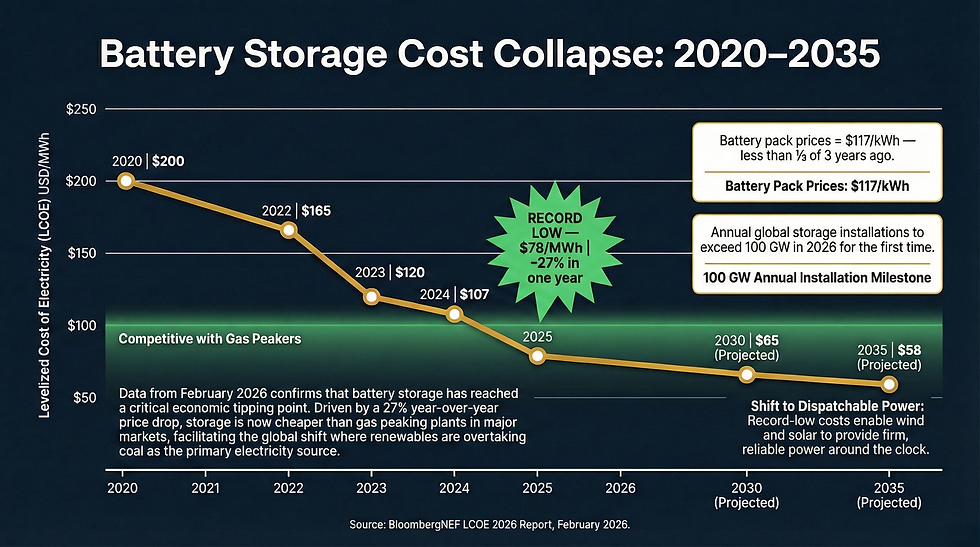
Battery storage is the standout story. BNEF's Levelized Cost of Electricity 2026 report (released February 18, 2026) found that the global benchmark cost for a four-hour battery storage project fell 27% year-on-year to a record-low $78/MWh. This is below $100/MWh in six major markets. Co-located solar-plus-storage projects are now cheaper than new gas peakers in California and parts of Texas.
Perovskite solar cells have surpassed 33% efficiency in tandem lab configurations, compared to 22–24% for standard commercial silicon. Offshore wind turbines from Vestas, Siemens Gamesa, and CSSC Haizhuang are now rated at 15 MW to 20 MW per unit. Floating offshore wind is advancing from prototype to early commercial status, opening vast new ocean areas in Japan, Norway, South Korea, and the U.S. West Coast.
Long Duration Energy Storage (LDES) — systems capable of storing electricity for 10 to 100+ hours — is getting serious commercial attention across iron-air, compressed air, gravity-based, and flow battery technologies. Artificial intelligence (AI) is also reshaping grid management, improving solar and wind forecast accuracy and enabling autonomous Virtual Power Plant (VPP) coordination.
Key Insight: Co-located solar and four-hour battery systems can now meet a substantial share of data-center electricity demand at a lower cost than gas in markets like California and parts of Texas. (BNEF LCOE 2026 Report, February 2026) |
Policy & Climate Targets
At COP28 in Dubai (December 2023), nearly 200 countries pledged to triple renewable capacity by 2030 and double efficiency gains. The EU's Carbon Border Adjustment Mechanism (CBAM) entered full operation in January 2026, placing carbon costs on imports of steel, aluminum, cement, fertilizers, hydrogen, and electricity.
Japan launched its GX-ETS carbon market in 2026. China is expanding its national ETS and planning absolute emissions caps. India's 500 GW non-fossil capacity target by 2030 remains on track, with the IEA noting it as one of the most significant upward forecast revisions of 2025.
Investment & Capital Flows
BloombergNEF's Energy Transition Investment Trends 2026 recorded $2.3 trillion invested in the energy transition in 2025 — an 8% increase over 2024. Breakdown: $893 billion electrified transport, $690 billion renewable energy, $483 billion power grid.

Corporate PPAs now account for 30% of global renewable capacity expansion to 2030 — double last year's share. Energy transition debt issuance hit a record $1.2 trillion in 2025, up 17%.
Investment Category | 2024 (USD Billion) | 2025 (USD Billion) | Change YoY |
Total Energy Transition | $2,100 | $2,300 | +8% |
Electrified Transport | $757 | $893 | +18% |
Renewable Energy | $728 | $690 | –5.3% |
Power Grid Infrastructure | ~$440 | $483 | +9.8% |
India (Total Clean Energy) | ~$59 | $68 | +15% |
EU (Total Clean Energy) | ~$385 | $455 | +18% |
China (Total Clean Energy) | ~$818 | $800 | –2.2% |
United States | ~$365 | $378 | +3.5% |
Source: BloombergNEF Energy Transition Investment Trends 2026 (January 26, 2026).
Sector-Specific Trends in 2026
Solar Energy Trends
Solar PV accounts for over half of the expected increase in renewable electricity generation between now and 2030 (IEA). Two formats are gaining mainstream traction in 2026:
Floating Solar (Floatovoltaics) — panels mounted on reservoirs and irrigation ponds — is expanding rapidly in India, China, South Korea, and the Netherlands. India's Omkareshwar Floating Solar Project (600 MW) is among the world's largest. Floating arrays also reduce water evaporation by up to 30% in water-stressed regions.
Building-Integrated Photovoltaics (BIPV) — solar cells embedded in roofing, facades, and glazing — is moving from niche product to mainstream specification in Europe and China, accelerated by EU policy mandates for solar-equipped new buildings.
On pricing: BNEF reports the benchmark fixed-axis utility solar LCOE rose 6% to $39/MWh in 2025. However, this remains far below the cost of any new-build fossil fuel plant. BNEF projects a further 30% LCOE reduction in solar by 2035.
Wind Power Trends
Onshore wind reclaimed its position as the cheapest new-build electricity source in the United States as gas turbine costs hit record highs. Globally, offshore wind LCOE reached $100/MWh in 2025 (+12% year-on-year), with costs in the UK now 69% higher than five years ago. BNEF expects these elevated costs to persist until at least 2030.
Despite cost pressure, turbine technology is advancing rapidly. Units rated at 15–20 MW are entering commercial orders. Floating offshore wind is graduating from demonstration phase to early commercial status. AI-powered predictive maintenance is reducing unplanned turbine downtime by 20–30% in offshore fleets, directly improving project economics.
Energy Storage & Grid Flexibility
Annual global storage installations are expected to exceed 100 GW in 2026 for the first time (BNEF) — ahead of most forecasts from just three years ago. Battery pack equipment prices now average $117/kWh — less than one-third of what they were three years ago. The U.S. commissioned a record 15.2 GW of utility-scale storage in 2025, a 35.4% increase over 2024.
Sodium-ion batteries are entering early commercial deployment in China (CATL, BYD). Vanadium and iron flow batteries are gaining ground in 4–12 hour applications.
Virtual Power Plants (VPPs) — which aggregate thousands of distributed batteries and smart loads — are scaling across California, Texas, Australia, and Europe.
Technology | Duration | 2026 Status | Key Advantage | Key Constraint |
Li-ion (LFP) | 2–6 hrs | Dominant, commercial | Lowest cost, fast deploy | Less cost-effective at long durations |
Sodium-ion | 2–4 hrs | Early commercial (China) | Cheaper materials | Lower energy density |
Vanadium Flow | 4–12 hrs | Growing commercial | Long cycle life | High capital cost |
Iron-Air (LDES) | 100+ hrs | Pilot/early deploy | Very low material cost | Low density, slow charge |
Pumped Hydro | 8–24+ hrs | Largest installed base | Proven, long life | Site-constrained |
Gravity / CAES | 8–20 hrs | Demonstration stage | Long duration potential | Geography-specific |
Electrification & End-Use Trends
Global electricity demand grew 3% year-on-year in 2025 and is forecast to accelerate to a 3.6% average annual growth rate from 2026 to 2030 (IEA). EV sales now represent more than 25% of global car sales (BNEF), with China leading at over 50% EV share. Data center investment reached ~$500 billion in 2025 — ahead of all solar investment combined. In the U.S., around half of electricity demand growth through 2030 is driven by data center expansion.
Sector coupling — using excess renewable electricity to produce green hydrogen for hard-to-abate industries — is becoming operational reality in Europe and the Middle East. BNEF projects clean hydrogen production to reach 5 Mtpa by 2030, a sixfold increase from current levels.
Challenges Shaping the Trajectory in 2026
Grid Congestion: The #1 Bottleneck
Interconnection queues in the United States contained more than 2,600 GW of proposed capacity at last count, with a median wait time of 5 years in many regions. In Europe, permitting for new transmission lines still takes 10–15 years in many member states — far longer than the 3–4 years needed to build the solar or wind projects the lines are meant to serve. BNEF tracked $483 billion in grid investment in 2025 — but the gap between available transmission capacity and the renewable build-out pipeline remains vast.
Supply Chain: Critical Mineral Pressures
China processes over 80% of global rare earth elements and dominates refining of lithium, cobalt, and manganese. Supply chain pressures in 2025–2026 contributed to rising costs for solar modules, offshore wind equipment, and electrolyzers. U.S. policies now require energy storage projects qualifying for the 30% Investment Tax Credit to meet stringent Foreign Entity of Concern (FEOC) sourcing rules, complicating procurement for projects reliant on Chinese battery components.
The Green Skills Gap
Solar installers, wind turbine technicians, electrical engineers, grid operators, and battery system integrators are in short supply in virtually every major deployment market.
The U.S. Bureau of Labor Statistics projects wind turbine service technician to be among the fastest-growing occupations — but training program growth is not keeping pace with deployment ambitions. In India and across sub-Saharan Africa, the gap is even more acute.
Regional Trend Snapshots
Region | Key Story | 2025 Investment | Standout Data Point |
Asia Pacific | China = 60% of global renewable growth. India = 2nd largest growth market. | $800B (China), $68B (India) | 47% of all global energy transition investment |
Europe (EU) | CBAM fully active. Offshore wind cost-challenged but long pipeline remains strong. | $455B (+18% YoY) | Germany, Spain, Italy, Poland leading corporate PPA-led solar |
Americas | US policy contracted; private capital still investing. Storage retrofits key growth vector. | $378B (US) | BNEF expects 336 GW wind/solar/storage in US market 2026–2030 |
MENA | Fastest-growing region by forecast revision. Saudi Arabia leading with GW-scale solar. | Rapidly rising | +25% upward forecast revision (IEA) |

Strategic Opportunities for Stakeholders
For Investors: Where Smart Capital is Flowing
▸Grid software and AI platforms — AutoGrid, Enbala, and others optimizing dispatch and demand response across complex grids.
▸Battery recycling and critical mineral recovery — Li-Cycle, Redwood Materials, Umicore: structurally positioned by FEOC rules and EU domestic content targets.
▸Transmission infrastructure — HVDC links, grid-forming inverters, smart transformer technology are in structural deficit.
▸Co-located solar-plus-storage — 87 GW added in 2025 at an average of $57/MWh (BNEF). Now the default model for new utility-scale solar.
▸Hydrogen infrastructure — European electrolysis projects and North Africa–EU hydrogen corridors are the most advanced near-term opportunities.
For Utilities: The Shift to Distribution Management
Distributed energy resources (DERs) — rooftop solar, home batteries, EV chargers, smart appliances — are proliferating faster than distribution grid management systems can handle. Utilities must build Distribution System Operator (DSO) capabilities, deploy advanced metering infrastructure, and develop market mechanisms to access flexibility from DERs. Utilities that ignore this transition risk asset stranding — fossil peaking plants and grid infrastructure sized for one-directional power flow.
Business Models: EaaS and Corporate PPAs
Energy-as-a-Service (EaaS) eliminates upfront capital expenditure for commercial and industrial adopters while giving the service provider a long-term contracted revenue stream. Corporate Power Purchase Agreements (PPAs) now account for 30% of global renewable capacity expansion to 2030 (IEA). Google, Microsoft, Amazon, Apple, and hundreds of industrial companies directly contract with wind and solar developers for multi-year, fixed-price electricity supply.
Actionable Insights for 2026
Stakeholder | Priority Action | Why It Matters |
Governments | Streamline grid interconnection permitting. Set time-bound review standards. | 2,600+ GW of projects are stranded in U.S. queues alone. |
Governments | Fund vocational green energy training at scale. | Skills gaps delay projects, raise costs, create safety risks. |
Investors | Diversify beyond generation into grid software and transmission assets. | Returns in pure-play generation are compressing. |
Investors | Prioritize battery recycling and critical mineral companies. | FEOC rules + EU domestic content targets = structural demand. |
Utilities | Build DSO capabilities and deploy advanced metering now. | DER proliferation will overwhelm traditional grid management. |
Utilities | Develop Virtual Power Plant programs. | VPPs offer the lowest-cost peak flexibility resource at scale. |
Businesses | Execute long-term corporate PPAs while pricing is favorable. | Fixed-price renewable supply hedges against fossil fuel volatility. |
Consumers / Prosumers | Invest in rooftop solar + home battery; enroll in VPP programs. | Bill savings, energy security, and potential VPP revenue. |
FAQs on Renewable Energy Trends 2026
Q1. What are the top renewable energy trends for 2026? |
The three biggest trends are: (1) Renewable electricity surpassing coal as the top global generation source for the first time; (2) Battery storage exceeding 100 GW of annual global installations at a record-low $78/MWh; and (3) Private capital and corporate PPAs replacing government subsidies as the dominant driver of new project finance, now accounting for 30% of global renewable expansion. |
Q2. Will renewable energy overtake fossil fuels in electricity generation by 2026? |
Yes — specifically, renewables are overtaking coal by mid-2026 at the latest. The IEA confirmed this in both its Renewables 2025 and Electricity 2026 reports. Wind and solar combined supply nearly 20% of global electricity in 2026. Renewables as a whole (including hydro and bioenergy) are surpassing coal's share. They have not yet overtaken all fossil fuels combined. |
Q3. How will battery storage shape renewables in 2026? |
Battery storage is solving the intermittency problem at scale. With the four-hour battery LCOE at a record-low $78/MWh (BNEF, Feb 2026) and global annual installations crossing 100 GW for the first time, storage is enabling solar and wind to deliver firm, dispatchable power — not just when the sun shines or the wind blows. |
Q4. Which countries are leading renewable energy growth in 2026? |
Top three: (1) China — nearly 60% of global capacity growth, on track to meet 2035 targets five years early; (2) India — capacity set to rise 2.5 times by 2030, world's second-largest growth market; (3) EU collectively — $455 billion invested in 2025, leading in offshore wind policy and CBAM carbon pricing. |
Q5. What challenges could slow renewable energy adoption in 2026? |
The two most critical bottlenecks are: (1) Grid congestion — interconnection queues in the U.S. alone hold over 2,600 GW of proposed projects waiting for grid access; and (2) Supply chain concentration — critical minerals are heavily dependent on Chinese processing. The green skills gap — a shortage of trained high-voltage technicians — is a growing third constraint. |
Conclusion: What 2026 Means for the Decade Ahead
Three things stand out from this analysis.
First, the crossover is real. Renewables overtaking coal in global electricity generation in 2026 is not a forecast — it is happening now. The fundamental shift in the power sector is no longer theoretical.
Second, the bottlenecks are the story. The constraint is not technology cost or capital availability. The real story of 2026 is grids, skills, and supply chains. Countries and companies that solve these will lead the next phase of deployment.
Third, private capital is taking over from government as the primary driver. Corporate PPAs and private debt markets now account for a growing share of what gets built. This is structurally positive for long-term resilience — private capital does not change with election cycles.
Looking toward 2027–2030, the IEA projects renewable electricity generation will reach 16,200 TWh by 2030 — a 60% increase from 2024. Renewables will supply 43% of global electricity.
Energy storage will continue its rapid cost decline, with BNEF projecting annual global installations to exceed 200 GW by the 2030s. The energy transition is the defining industrial shift of our era. 2026 is not its beginning — but it is clearly its acceleration point.
References & Data Sources
This article is backed by authoritative sources and research. All data points are drawn from the primary sources listed below.
[1] IEA — Renewables 2025 — Annual forecast for global renewable capacity and generation to 2030. https://www.iea.org/reports/renewables-2025
[2] IEA — Electricity 2026 (Executive Summary) — Analysis and forecasts for global electricity demand and supply, 2026–2030. https://www.iea.org/reports/electricity-2026/executive-summary
[3] BNEF — Energy Transition Investment Trends 2026 — Annual review of global energy transition investment. Published Jan 26, 2026. https://about.bnef.com/insights/clean-energy/
[4] BNEF — Levelized Cost of Electricity 2026 — Global benchmark LCOE across 28 technologies. Published Feb 18, 2026. https://about.bnef.com/insights/clean-energy/battery-storage-costs-hit-record-lows
[5] BNEF — Progress Despite Fragmentation: Energy Transition to 2030 — Strategic outlook on energy transition dynamics. Published Jan 2026. https://about.bnef.com/insights/clean-energy/progress-despite-fragmentation
[6] EIA — Short-Term Energy Outlook (STEO), February 2026 — Monthly U.S. energy supply, demand, and emissions outlook. https://www.eia.gov/outlooks/steo/
[7] IRENA — Renewable Capacity Statistics 2025 — Global renewable power generation capacity statistics, 2015–2024. https://www.irena.org/Publications/2025/Mar/Renewable-capacity-statistics-2025
[8] Carbon Brief — IEA: Renewables to be World's Top Power Source by 2026 — Analysis of IEA forecasts on renewable electricity generation. https://www.carbonbrief.org/iea-renewables-will-be-worlds-top-power-source-by-2026/
[9] BNEF — 2026 Sustainable Energy in America Factbook — Comprehensive U.S. energy market data and storage additions in 2025. https://www.ess-news.com/2026/02/20/bloombergnef-confirms-record-us-energy-storage-additions-in-2025/
[10] IEA — Global Renewable Capacity Set to Grow Strongly — Summary of IEA Renewables 2025 key capacity forecast findings. https://www.iea.org/news/global-renewable-capacity-is-set-to-grow-strongly-driven-by-solar-pv
Disclaimer This article is published for informational and educational purposes only. Data, forecasts, and analysis are sourced from publicly available reports by the IEA, BloombergNEF, IRENA, and EIA as of February 2026. Green Fuel Journal does not provide financial, investment, or legal advice. Readers should conduct independent due diligence before making investment or business decisions based on information in this article. All forecasts are subject to change based on policy, market, and geopolitical developments. Read complete disclaimer https://www.greenfueljournal.com/disclaimers |
© 2026 Green Fuel Journal | Published Feb 2026


