AI-Powered Solar Forecasting: Improving Grid Efficiency and Smart Energy Management

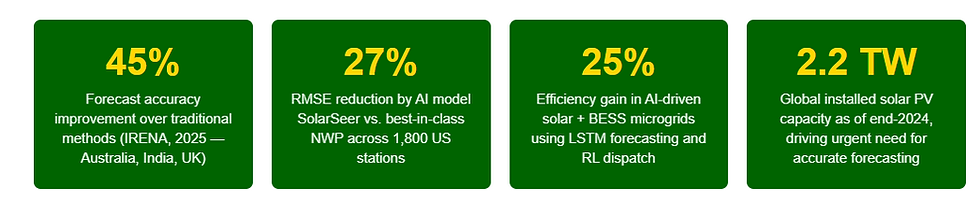
AI-powered solar forecasting is rapidly becoming one of the most important technical disciplines in the global energy sector. As solar photovoltaic capacity surpassed 2.2 terawatts (TW) worldwide by the end of 2024 — marking a 37.5% growth in a single year — grid operators, utility engineers, and energy planners face a growing challenge: solar power is abundant, but it does not flow on a fixed schedule. Clouds pass. Seasons shift. Panels underperform on hazy afternoons. Without reliable forecasting, that variability creates real operational pain: excess generation gets curtailed, expensive backup reserves stay on standby unnecessarily, and energy trading decisions become guesswork.
According to the International Energy Agency (IEA), solar PV accounted for 7% of global electricity generation in 2024, up from 5% in 2023 — and the share of variable renewable energy sources is projected to nearly double to 27% by 2030.
The International Renewable Energy Agency (IRENA) has noted that countries like Australia, India, and the United Kingdom are now achieving up to 45% greater forecast accuracy using AI methods compared with traditional approaches, directly reducing curtailment and improving grid reliability.

For grid operators managing thousands of distributed solar assets — rooftop systems, utility-scale farms, and community microgrids — the difference between a good forecast and a poor one is measured in megawatt-hours of wasted energy and millions of dollars in balancing costs.
This is where artificial intelligence has moved from being a research novelty to an operational necessity. This article examines what AI-powered solar forecasting is, how it works, why it outperforms older methods, and what the near-term future of this technology looks like across global and Indian energy systems.
AI-powered solar forecasting uses machine learning and deep learning algorithms to predict solar energy output by analyzing satellite imagery, weather data, and historical generation records. Its primary benefit to grid stability is reducing supply-demand imbalances caused by solar intermittency, enabling operators to plan energy dispatch, minimize reserve costs, and cut renewable curtailment by up to 45%.
What Is AI-Powered Solar Forecasting?
AI-powered solar forecasting is the application of machine learning, deep learning, and statistical AI models to predict the solar irradiance and power output of photovoltaic (PV) systems over time horizons ranging from minutes to days. It replaces older rule-based or numerical weather models with data-driven systems that learn from large, multivariate datasets and improve their accuracy over time.
Definition
At its core, solar forecasting is the process of estimating how much power a solar PV system will generate over a future period. AI-powered solar forecasting takes this further by applying algorithms — primarily from the fields of machine learning (ML) and deep learning (DL) — to detect complex, nonlinear patterns in historical solar generation data, meteorological records, and real-time sensor feeds.
Unlike simple regression models that assume a linear relationship between weather variables and output, AI models like Long Short-Term Memory (LSTM) networks are specifically designed to handle the temporal dependencies and sudden fluctuations that characterize solar irradiance behavior.
The forecasting horizon matters enormously in practice. Very short-term forecasting (0–60 minutes ahead) supports real-time grid balancing and automatic generation control. Short-term forecasting (1–48 hours) is essential for day-ahead electricity market bidding and BESS scheduling. Medium- to long-term forecasting (days to weeks) informs maintenance planning, fuel procurement decisions, and transmission system operations.
Why It Matters for Smart Grids
A smart grid is a modernized electricity network that uses digital communication technology to detect and react to local changes in usage. For such a grid to function effectively, it needs accurate information about what power will be available in the near future. When solar irradiance forecasting fails — even by a moderate margin — grid operators face cascading problems: they either dispatch too much fossil-fuel backup capacity (raising costs and emissions) or too little (risking blackouts or frequency deviation).
AI forecasting serves as the intelligence layer of the smart grid. It feeds into automated load dispatch systems, informs Battery Energy Storage System (BESS) charging and discharging schedules, and coordinates Distributed Energy Resources (DERs) like residential rooftop panels with utility-scale plants. In systems where Virtual Power Plants (VPPs) aggregate dozens or hundreds of distributed solar assets, accurate AI forecasting is not optional — it is the mechanism that makes the entire VPP architecture operationally viable.
Traditional vs. AI Methods
Before AI-based tools became practical, grid operators relied primarily on two approaches: Numerical Weather Prediction (NWP) models (which simulate atmospheric physics using large-scale computational solvers) and statistical time-series methods like ARIMA (AutoRegressive Integrated Moving Average). Both have well-known weaknesses. NWP models are computationally expensive — traditional systems can take hours to generate a 24-hour forecast — and they struggle to capture local cloud formation dynamics at the granularity a solar plant manager needs.
ARIMA and similar statistical tools work reasonably well under stable weather but fail during rapid transient events like fast-moving cloud cover or sudden fog.
A landmark demonstration of the AI advantage came with SolarSeer, a large-scale AI forecasting model that generates 24-hour solar irradiance forecasts for the entire contiguous United States at 5-kilometer resolution in under 3 seconds — more than 1,500 times faster than the state-of-the-art NWP system (HRRR) it was benchmarked against. SolarSeer reduced the RMSE of solar irradiance forecasting by 27.28% on reanalysis data. That kind of speed and accuracy gap illustrates exactly why grid operators are actively replacing legacy forecasting infrastructure with AI-native systems.
Data Sources: Satellite, IoT, and Weather Feeds
AI forecasting systems are only as good as the data they ingest. The primary input streams include:
Satellite imagery: Near-real-time cloud cover maps and solar irradiance estimates derived from geostationary satellites (e.g., GOES-16 in North America, INSAT-3DR in India). Cloud motion vectors derived from consecutive satellite images allow short-term irradiance forecasting without ground sensors.
IoT sensors and pyranometers: On-site instruments measuring global horizontal irradiance (GHI), direct normal irradiance (DNI), and diffuse horizontal irradiance (DHI) at the plant level. These provide the hyperlocal accuracy that satellite data cannot.
Numerical Weather Prediction outputs: Used as feature inputs to AI models rather than as standalone forecasts — a hybrid approach that combines NWP's atmospheric physics with AI's pattern recognition.
Historical generation records: Plant-specific output logs used to train LSTM and other sequence models on site-specific generation behavior under different weather regimes.
Auxiliary environmental data: Ambient temperature, humidity, wind speed (which affects panel cooling), aerosol optical depth, and dust accumulation indices — particularly important in desert solar zones like Rajasthan, India, and the MENA region.
How Does AI-Powered Solar Forecasting Improve Grid Efficiency?
AI-powered solar forecasting improves grid efficiency by giving operators accurate advance knowledge of solar generation, which reduces dependency on expensive spinning reserves, lowers curtailment of excess renewable power, and enables precise BESS dispatch. Studies show AI forecasting can improve forecast accuracy by up to 45% compared with traditional methods, directly translating to lower grid balancing costs.
The connection between forecast accuracy and grid efficiency is direct and quantifiable. When a grid operator does not know how much solar power will arrive in the next hour or the next day, they maintain large volumes of spinning reserve — fossil-fuel plants kept running at partial load, ready to ramp up instantly if solar generation drops unexpectedly.
These reserves are expensive. In markets where natural gas peakers are used as reserves, every percentage point of improvement in solar forecast accuracy translates to fewer hours of peaker operation and measurable reductions in both cost and carbon emissions.

Curtailment — the deliberate reduction of solar output because the grid cannot absorb it — is the other side of the inefficiency coin. When a utility misjudges how much solar will arrive during a low-demand period, it may be forced to curtail generation that could have been stored or exported.
IRENA's 2025 analysis specifically identifies AI-based forecasting as a key tool for reducing curtailment in high-solar-penetration grids. China, which raised its provincial curtailment threshold from 5% to 10% in June 2024 to manage excess solar output, is a stark example of what happens when forecasting and grid flexibility lag behind generation capacity growth.
Grid Balancing Workflow — AI-Powered Solar Forecasting Integration
1: Data Ingestion Satellite cloud maps, IoT pyranometer readings, NWP outputs, and historical plant data are collected and pre-processed in real time.
↓
2: AI Model Inference LSTM or CNN-LSTM model processes the multivariate time-series input and generates a probabilistic forecast — not just a single-point estimate, but a range of likely generation scenarios for the next 1–48 hours.
↓
3: Energy Management System (EMS) Decision The forecast output feeds into the grid's EMS or SCADA system. The EMS decides: how much BESS storage to charge now, which conventional plants to hold in reserve, and whether to pre-position DER dispatch.
↓
4: Automated Load Balancing Forecasts are sent to market scheduling systems for day-ahead bidding. Load balancing algorithms adjust plant dispatch in 15-minute intervals based on updated rolling forecasts.
↓
5: Feedback and Model Retraining Actual generation is compared with forecasted values. Residual errors (RMSE, MAE) are logged. The AI model is periodically retrained on new data to improve accuracy over time.
This five-step workflow, when running continuously across a grid with thousands of solar nodes, significantly reduces the uncertainty that drives costly operational decisions. A utility that previously kept 500 MW of gas peaker capacity on spinning reserve as a solar hedge might, with accurate AI forecasting, reduce that figure to 300 MW — a direct fuel cost and emissions saving achieved purely through better information.
What Technologies Power AI Solar Forecasting Systems?
AI solar forecasting systems primarily use Long Short-Term Memory (LSTM) networks, Convolutional Neural Networks (CNN), Random Forest, and hybrid CNN-LSTM models. LSTM is favored for time-series solar data because it retains information across long sequences, capturing seasonal and diurnal generation patterns with high accuracy. Edge AI and IoT integration enable real-time inference at the plant level.

Long Short-Term Memory (LSTM) Networks
LSTM is a specialized type of Recurrent Neural Network (RNN) that was designed specifically to learn from sequential data with long-range temporal dependencies. Solar irradiance data is inherently sequential — the irradiance at 2:00 PM today is influenced by the irradiance at 1:45 PM, the cloud cover trajectory over the past hour, the season, and hundreds of prior observations.
Standard neural networks forget earlier inputs quickly; LSTM networks maintain a memory across long sequences through a system of gated cells that decide what to remember, what to update, and what to discard.
Research benchmarks consistently demonstrate LSTM's superiority over classical approaches. One study using the DKASC Alice Springs dataset found that a Stacked LSTM model achieved an MAE of 1.1157 and RMSE of 2.3408, outperforming CNN, ANN, SVR, and XGBoost baselines. A separate study on short-term solar irradiance forecasting found that LSTM achieved a dramatically lower test MAE of 5.78 versus 31.71 for a standard Dense Neural Network — a performance gap that is operationally significant at scale.
The Bi-Directional LSTM (Bi-LSTM) variant, which processes input sequences both forward and backward in time, further improves accuracy. One benchmark study found Bi-LSTM achieved RMSE values as low as 0.0315 and MAPE of 0.1205 — among the lowest error rates reported for solar PV prediction tasks.
CNN-LSTM Hybrid Models
The hybrid CNN-LSTM architecture combines the spatial feature extraction capability of Convolutional Neural Networks with the temporal sequence modeling of LSTM. In practice, the CNN layer processes satellite imagery or multi-sensor spatial inputs to extract relevant meteorological patterns, while the LSTM layer handles the temporal evolution of those patterns.
Research published in 2025 found that hybrid CNN-LSTM models with self-attention mechanisms achieved test MAE as low as 0.0304 and RMSE of 0.0458 — among the most accurate results reported in recent literature.
Random Forest and Gradient Boosting Models
Random Forest and XGBoost (Extreme Gradient Boosting) are ensemble tree-based methods that are valued for their interpretability, computational efficiency, and strong performance on tabular weather-feature datasets. They are commonly used in medium-term forecasting (day-ahead to week-ahead) and in hybrid pipelines where their outputs serve as inputs to deeper neural network models.
Research on US solar data found Random Forest and XGBoost models "performing almost perfectly," making them practical choices for utility-scale operational planning where model transparency is important for regulatory compliance.
Edge AI and IoT-Enabled Inference
An important operational development is the movement toward Edge AI — deploying trained AI models directly on-site at solar plants or on embedded hardware near IoT sensor arrays, rather than requiring all data to travel to a central cloud server. Edge inference reduces latency (critical for very short-term, sub-minute forecasting), lowers data transmission costs, and improves resilience during network outages.
In a recent study conducted in Sitapura, Jaipur, India, an Edge AI-based CNN-LSTM system for solar tracking and forecasting demonstrated measurable improvements in energy yield over traditional MPPT-based approaches — a practical validation of edge deployment in a real Indian solar environment.
AI Model | Typical RMSE / Accuracy | Primary Use Case | Grid Benefit | Limitation |
Stacked LSTM | RMSE: 2.34 | R²: 0.90 | Very short-term & short-term forecasting (0–24 hrs) | Real-time dispatch, intraday BESS control | High training time; needs large sequential datasets |
Bi-LSTM | RMSE: 0.0315 | MAE: 0.0135 | Short-term irradiance & PV output prediction | Day-ahead market bidding accuracy | More computationally intensive than standard LSTM |
CNN-LSTM Hybrid | RMSE: 0.0458 | MAE: 0.0304 | Spatiotemporal forecasting with satellite/sensor fusion | Multi-plant VPP coordination | Complex architecture; requires data from multiple input types |
Random Forest | High reliability; low variance | Medium-term day-ahead planning (24–72 hrs) | Reserve planning, fuel procurement | Cannot capture temporal sequence dependencies natively |
XGBoost | Near-equal to Random Forest | Day-ahead PV output prediction, feature-rich datasets | Grid scheduling, storage dispatch | Similar to Random Forest; limited on pure time-series tasks |
NWP (Traditional Baseline) | RMSE ~27% higher vs. AI | Atmospheric physics simulation, regional forecasting | Baseline planning only | Slow (hours), poor at local cloud dynamics |
Table 1: Comparison of AI forecasting models for photovoltaic solar systems — accuracy, use case, and grid application. Sources: ScienceDirect, Nature Scientific Reports, NCBI/PubMed benchmarks (2023–2026).
AI-Powered Solar Forecasting vs. Traditional Solar Prediction Methods
AI-powered solar forecasting outperforms traditional methods on every key accuracy metric. AI models such as LSTM achieve RMSE values 27–80% lower than numerical weather prediction (NWP) baselines. Unlike NWP systems that take hours to generate a forecast, AI models deliver results in seconds, enabling real-time grid operations that traditional forecasting cannot support.
The performance comparison between AI and traditional forecasting methods is not marginal — it is substantial and operationally significant. The table below summarizes key accuracy and capability differences:
Criterion | Traditional Methods (NWP / ARIMA) | AI-Based Methods (LSTM / CNN-LSTM) |
Forecast Generation Speed | Minutes to hours (NWP solvers) | Seconds to milliseconds (inference only) |
RMSE (benchmark) | Baseline reference level | 15–27% lower RMSE vs. NWP (SolarSeer, 2025) |
Accuracy Under Cloud Transitions | Poor — ARIMA assumes stationarity | Strong — LSTM captures ramp events and transient cloud dynamics |
Spatial Resolution | Regional (~10–25 km grid) | 5 km or finer (AI models using satellite data) |
Adaptability | Static model; manual recalibration needed | Continuous online learning — model updates as new data arrives |
Multi-Source Data Fusion | Limited; typically one or two inputs | Native — satellite, IoT, NWP, historical data combined |
Probabilistic Output | Rarely; mostly deterministic | Standard in modern AI systems — confidence intervals provided |
Deployment Cost | High (supercomputing infrastructure) | Lower — cloud or edge deployment viable |
Table 2: AI-powered solar forecasting vs. traditional methods — key performance and operational differences.
One practical pain point that energy professionals on utility operations teams frequently raise is the challenge of fragmented data infrastructure. Many utilities still operate legacy SCADA systems that do not natively communicate with modern AI platforms.
Bridging this gap — ingesting heterogeneous data from multiple sensor generations, communication protocols, and data quality levels — is often the hardest part of deploying an AI forecasting system, not the model architecture itself.
This is why data preprocessing pipelines and standardized formats like CIM (Common Information Model) for smart grid data have become just as important as model selection in real-world deployments.
What Are the Benefits of AI-Powered Solar Forecasting for Renewable Energy Systems?
The core benefits of AI-powered solar forecasting include reduced energy waste through curtailment minimization, lower spinning reserve requirements, improved accuracy in energy market trading, faster fault and underperformance detection in PV plants, and more efficient BESS charging cycles — all of which reduce operational costs and improve the financial returns of solar investments.
Reduced Curtailment: Accurate day-ahead forecasts allow grid operators to pre-schedule storage charging and export capacity, reducing the fraction of solar generation that must be curtailed during low-demand periods. In high-penetration solar markets, this has direct revenue implications for plant operators selling under energy contracts.
Lower Reserve Margins: By replacing uncertain "worst-case" assumptions with probabilistic forecasts, utilities can reduce the volume of spinning reserve they maintain. Every megawatt of reserve removed from the schedule reduces fuel consumption and emissions at gas peaker plants.
Better Energy Trading Decisions: In deregulated electricity markets, accurate day-ahead forecasting allows solar generators to bid more confidently, reducing the financial penalties associated with generation shortfalls or surpluses against contracted volumes.
Faster Fault Detection: AI forecasting systems compare predicted output against actual measured output in real time. A significant deviation between the two — even on a sunny day — is a strong signal of panel soiling, inverter fault, or partial shading from vegetation growth. Early detection cuts maintenance response time and improves plant availability.
Optimized BESS Lifecycle: Unnecessary or poorly timed charge-discharge cycles accelerate battery degradation. AI forecasting allows BESS operators to charge during predicted generation peaks and discharge during predicted demand peaks — reducing cycle count for the same energy throughput and extending battery life.
Reduced Carbon Intensity: Less fossil-fuel reserve dispatch and lower curtailment both directly reduce the carbon intensity of grid electricity. This is particularly relevant for utilities reporting Scope 2 emissions or participating in carbon markets.
How AI-Powered Solar Forecasting Supports Smart Grids and Virtual Power Plants
AI solar forecasting supports smart grids by enabling automated, data-driven dispatch decisions across distributed energy resources. In Virtual Power Plants (VPPs), AI forecasts aggregate solar output predictions from multiple sites to optimize BESS charging, coordinate demand response, and manage EV charging loads — all at speeds and scales impossible with manual operations.
Virtual Power Plant (VPP) Integration
A Virtual Power Plant aggregates dozens to hundreds of distributed solar installations, battery storage systems, and flexible demand assets into a single coordinated entity that can participate in electricity markets or provide grid services. The operational challenge is that each asset behaves differently, and their combined behavior must be predicted with enough accuracy to make reliable commitments to grid operators or market platforms.
Research published in early 2026 in PLOS ONE demonstrated an AI-enhanced VPP dispatch framework using an attention-augmented Bi-LSTM model for load forecasting, combined with Model Predictive Control (MPC) for rolling 15-minute intraday optimization. The system performed day-ahead scheduling to minimize cost, then corrected that schedule every 4 hours based on updated solar and load forecasts. This multi-timescale approach — which mirrors how professional grid operators think about the problem — delivered measurably lower operating costs than single-stage optimization methods.
EV Charging Optimization
Electric vehicle (EV) charging is one of the fastest-growing sources of new grid load globally, and it creates a specific challenge: EV charging is largely flexible (users do not need their car charged the moment they plug in), but utilities need to know when solar generation will peak so they can align EV charging demand with available low-cost renewable supply.
AI solar forecasting makes this coordination possible. When a forecasting system predicts a solar generation surplus between 10 AM and 2 PM, an AI-enabled demand response platform can shift EV charging at commercial fleet depots or residential charging stations to that window — using excess solar directly rather than curtailing it or relying on grid storage.
AI-Based BESS Dispatching
Battery dispatch decisions — when to charge, how deeply to charge, when to discharge, and at what rate — are among the most consequential operational choices in a solar-plus-storage system. Poor dispatch shortens battery life and reduces energy arbitrage revenues.
AI forecasting improves this by giving the battery management system advance notice of what solar generation will look like over the next several hours. A reinforcement learning (RL) dispatch agent, trained with accurate LSTM-based solar forecasts as its primary state input, can make sequentially optimal charge-discharge decisions that a rule-based system cannot match.
Case data from a Malaysian hospital microgrid in 2025 showed a system using LSTM forecasting and RL dispatch achieved 86% renewable coverage and 30% less unplanned downtime compared with a conventional dispatch approach.
Real-World Applications of AI-Powered Solar Forecasting
Real-world applications of AI solar forecasting span utility-scale solar farms, residential smart home energy systems, industrial microgrids, and national grid balancing operations. In India, organizations like SECI and state utilities in Rajasthan and Tamil Nadu are actively integrating AI-based forecasting and smart grid tools to manage rapidly growing solar capacity.
Utility-Scale Solar Farms
Large solar farms — those above 50 MW — are the primary users of AI forecasting tools today, because even small percentage improvements in forecast accuracy translate to large absolute cost savings at scale. In the United States, which added a record 47.1 GW of solar capacity in 2024 (reaching 224 GW cumulative), utilities in California, Texas, and Arizona operate sophisticated AI forecasting systems integrated with Energy Management Systems (EMS) and market scheduling platforms.
These systems generate probabilistic 48-hour generation profiles that feed directly into the day-ahead and real-time electricity market clearing processes.
Residential and Commercial Distributed Solar
At the distributed scale, AI forecasting is increasingly embedded in smart inverters and home energy management systems (HEMS). A household with rooftop solar, a battery, and an EV charger can benefit from a local AI model that optimizes energy storage and usage based on a 24-hour solar forecast — automatically charging the battery when solar surplus is predicted and scheduling EV charging to overlap with peak generation.
This reduces grid export during midday peaks (a growing challenge in high-rooftop-solar areas like South Australia and California) and maximizes self-consumption.
Smart Cities
At the city scale, AI solar forecasting integrates with smart city energy management platforms to coordinate distributed generation across thousands of buildings, public charging stations, municipal facilities, and transit systems. Cities like Amsterdam, Singapore, and Shenzhen have piloted AI-driven energy platforms that use solar forecasts to dynamically price and schedule demand across public infrastructure, reducing peak loads and grid import costs.
🇮🇳 India Focus — SECI, Smart Grid Mission, and AI Adoption
India's solar energy landscape is expanding faster than any other major economy. As of March 2025, the Solar Energy Corporation of India (SECI) had commissioned 21.67 GW of solar capacity, with the IEA identifying India as the fastest-growing renewable energy market among large economies through 2030. India's target of 500 GW of non-fossil fuel capacity by 2030 makes intelligent grid management an immediate national priority.
In December 2025, SECI signed a Statement of Intent with the Global Energy Alliance for People and Planet, with AI-driven forecasting, modelling, and system studies identified as core technical priorities. Key focus states — Rajasthan, Tamil Nadu, Gujarat, and Karnataka — have seen solar and wind together contribute 14% to 29% of annual electricity generation, but lack comprehensive AI forecasting frameworks, creating documented grid management gaps.
India's National Smart Grid Mission (NSGM) has targeted the deployment of 250 million smart meters as the data infrastructure backbone for AI-based energy management. However, as noted in a July 2025 analysis in The Hindu, India's regulatory framework for AI in energy forecasting remains underdeveloped — with no comprehensive national guidelines yet established for AI deployment in grid operations. Addressing this policy gap is essential if India is to capture the full efficiency benefit of its rapidly growing solar fleet.
An AI-enhanced hybrid solar system tested in Sitapura, Jaipur (January 2024–January 2025) demonstrated that CNN-LSTM-based solar forecasting combined with reinforcement learning for dual-axis tracking could deliver measurable improvements in energy yield — providing direct evidence that AI forecasting architectures are operationally viable in India's dust-affected, high-irradiance solar environment.

What Are the Biggest Challenges in AI-Powered Solar Forecasting?
The main challenges in AI-powered solar forecasting include inconsistent data quality from legacy sensors and fragmented utility systems, high computational requirements for training deep learning models, cybersecurity vulnerabilities in connected IoT infrastructure, and the lack of regulatory frameworks for AI deployment in power sector operations — particularly in emerging markets like India.
Data Quality and Fragmentation
This is the challenge that operations engineers and grid planners consistently raise on industry forums: the data problem. Many utilities operate infrastructure that spans multiple decades of sensor generations, communication protocols, and data formats. Pyranometer readings may have gaps due to sensor fouling. SCADA data has known latency issues. Satellite imagery resolution varies by orbit and time of day.
AI models trained on clean, curated research datasets often encounter messy, heterogeneous real-world data that causes performance to degrade significantly from laboratory benchmarks. Building robust data preprocessing and validation pipelines — before any model architecture decision is made — is typically the most resource-intensive part of a real deployment.
Legacy Infrastructure Compatibility
Most AI forecasting tools are designed around modern cloud-native or edge computing architectures. But grid operators in older markets — including significant parts of India's distribution grid — still run legacy SCADA and EMS systems that were not designed to receive probabilistic AI forecast outputs or to act on them automatically. Integrating AI forecasting into these environments requires custom middleware, API development, and often significant operator training — costs that slow down adoption in markets where they are most needed.
Cybersecurity Risks
As solar forecasting systems become more deeply integrated with grid operations, their cybersecurity posture becomes critical. In early 2024, an espionage campaign targeting India's energy sector was uncovered, utilizing modified malware to exfiltrate sensitive grid operational data. AI forecasting platforms connected to IoT sensor networks and cloud servers represent a broader attack surface than traditional control systems. Securing these systems — particularly ensuring that AI model inference cannot be manipulated through data poisoning attacks on input sensor feeds — is an emerging research and operational priority.
Storage Optimization Complexity
One operational complexity that does not receive enough attention is the difficulty of jointly optimizing solar forecasting and battery storage dispatch. Even with an accurate 24-hour solar forecast, the optimal BESS dispatch strategy depends on electricity prices (which are uncertain), load demand (which is also uncertain), and battery state-of-health (which changes over time). AI systems that treat forecasting and dispatch as separate modules sometimes produce suboptimal combined outcomes.
Integrated forecast-and-optimize frameworks — where the forecasting model and the dispatch optimizer share information and objectives — are more effective but significantly more complex to design and validate.
Model Interpretability
Grid operators and regulatory bodies are accustomed to being able to explain why a generation forecast was made in a particular way. Deep learning models — particularly large LSTM and CNN architectures — are difficult to interpret. When a forecast is wrong, it is not always clear why, which makes it hard to build operator trust and harder to diagnose systematic failure modes.
Explainable AI (XAI) techniques, including attention mechanisms and SHAP (SHapley Additive exPlanations) value analysis, are being applied to solar forecasting models to address this — but XAI for time-series energy data remains an active research area.
Future Trends in AI-Powered Solar Forecasting
Future trends in AI solar forecasting include the application of generative AI for synthetic training data creation, quantum-enhanced optimization of forecasting models, autonomous smart grid architectures that act on forecasts without human intervention, and the deeper integration of Explainable AI to meet regulatory transparency requirements in grid operations.
Generative AI for Training Data Augmentation
One persistent limitation of AI forecasting models is the scarcity of labeled training data for rare weather events — extreme cloud formations, dust storms, monsoon-induced irradiance drops, or sudden aerosol events from wildfires. Generative AI models, including Generative Adversarial Networks (GANs) and Variational Autoencoders (VAEs), can produce synthetic solar irradiance time series that realistically simulate rare event distributions.
Augmenting training datasets with synthetic data for these edge cases improves AI model robustness under precisely the conditions where accurate forecasting matters most — during sudden, large generation swings that stress the grid.
Transformer-Based Architectures
Transformer models — originally developed for natural language processing — have demonstrated strong results on time-series forecasting tasks. Their self-attention mechanism is well-suited to capturing long-range dependencies in solar irradiance data without the sequential processing constraints of LSTM architectures.
Models like Temporal Fusion Transformers (TFT) and Temporal Convolutional Networks (TCN) are actively being benchmarked against LSTM baselines for solar forecasting, and early results suggest they may achieve higher accuracy on longer forecast horizons.
Autonomous Smart Grid Operations
The next stage beyond AI-assisted operations is autonomous smart grid management, where AI forecasting agents not only generate predictions but also execute dispatch, trading, and demand response decisions automatically within defined safety boundaries. Reinforcement learning agents trained on historical grid data are already performing automated BESS dispatch in research and pilot settings.
As regulatory frameworks catch up and confidence in AI decision-making grows, autonomous operations are expected to become standard in utility-scale and VPP contexts through the early 2030s.
Quantum Computing for Forecasting Optimization
While still in an early stage, quantum computing holds theoretical promise for solving the combinatorially complex optimization problems that sit behind grid dispatch decisions. Quantum-enhanced optimization could make currently intractable multi-asset, multi-timescale dispatch problems computationally feasible — particularly in large VPP contexts with hundreds of distributed solar and storage assets.
Organizations including NREL and several European grid research institutes are actively exploring quantum algorithms for renewable energy system optimization, with practical grid applications expected in the second half of this decade.
Federated Learning for Privacy-Preserving Forecasting
As AI forecasting systems aggregate data from millions of distributed solar assets — including residential systems — data privacy becomes a concern. Federated learning is an approach where AI models are trained collaboratively across many edge devices without raw data ever leaving the local site. Each device trains a local model update, and only the model weights (not the data itself) are shared with a central server.
This architecture is particularly relevant for aggregating distributed solar data across many residential customers while complying with data privacy regulations.
Frequently Asked Questions About AI-Powered Solar Forecasting
How accurate is AI-powered solar forecasting?
AI solar forecasting models achieve significantly higher accuracy than traditional methods. LSTM models have demonstrated R² values above 0.99 and RMSE reductions of 15–27% compared with state-of-the-art numerical weather prediction baselines. In regional deployments across Australia, India, and the UK, IRENA reported accuracy improvements of up to 45% over conventional methods.
Can AI solar forecasting operate in real time?
Yes. Modern AI forecasting systems — particularly those using trained LSTM or CNN-LSTM models deployed on edge hardware or cloud inference endpoints — generate updated forecasts in seconds. SolarSeer, for example, produces 24-hour US-wide irradiance forecasts in under 3 seconds. Real-time inference allows grid operators to update dispatch decisions on 15-minute or even sub-minute intervals.
Which AI model is best for solar forecasting?
For short-term and intraday forecasting, LSTM and CNN-LSTM hybrid models consistently deliver the highest accuracy across published benchmarks. For medium-term day-ahead planning, Random Forest and XGBoost provide strong performance with lower computational requirements. The best choice depends on the forecast horizon, available data types, and whether spatial (multi-site) or purely temporal modeling is needed.
How does AI forecasting reduce grid instability?
AI forecasting reduces grid instability by giving operators advance, accurate warning of solar generation changes. With reliable forecasts, operators can pre-position storage reserves, adjust conventional plant output, and activate demand response — all before a generation shortfall or surplus actually occurs. This proactive approach replaces reactive balancing, which is slower and more costly.
What does AI solar forecasting cost?
Costs vary widely by system scale and deployment model. Cloud-based AI forecasting-as-a-service (FaaS) platforms are commercially available and cost-competitive with traditional NWP services. For large utilities, the ROI typically comes from reduced reserve costs and curtailment losses — benefits that frequently exceed implementation costs within 12–24 months for utility-scale deployments.
How does AI improve battery energy storage efficiency?
AI forecasting improves BESS efficiency by enabling intelligent, forward-looking dispatch decisions. Instead of reacting to current generation levels, a BESS system with AI forecasting charges during predicted solar surplus periods and discharges during predicted demand peaks or grid stress events. This reduces unnecessary cycling, extends battery lifespan, and maximizes energy arbitrage revenue.
What is the difference between solar forecasting and load forecasting?
Solar (generation) forecasting predicts how much electricity a solar system will produce, primarily driven by irradiance, temperature, and weather conditions. Load forecasting predicts how much electricity consumers will demand, driven by factors including time of day, weather, economic activity, and behavioral patterns. Both types of forecasting feed into the same grid dispatch system, and their errors are additive — meaning a grid operator managing both uncertain supply and uncertain demand benefits from AI accuracy improvements in both domains simultaneously.
What are the limitations of AI-powered solar forecasting?
Limitations include dependence on high-quality input data (sensor failures or data gaps degrade AI accuracy), difficulty forecasting during rare or extreme weather events not well-represented in training data, interpretability challenges with deep learning models, cybersecurity risks in connected IoT deployments, and the need for continuous model retraining to avoid performance decay as climate patterns shift or plant configurations change.
Conclusion
The energy system is in the middle of a generation-scale transition. Solar PV capacity is now measured in terawatts, not gigawatts, and its share of global electricity generation crossed 7% in 2024 with a clear trajectory toward becoming the world's dominant power source by mid-century. That growth is something to welcome. But it also means that the grid of the future will be more variable, more distributed, and more dependent on accurate real-time and near-future information than any grid in history.
AI-powered solar forecasting is not a peripheral technology in this transition — it is load-bearing infrastructure. Without it, the curtailment problem grows, reserve margins stay inflated, battery storage systems operate sub-optimally, and the economic case for rapid solar expansion weakens. With it, utilities can manage a 30–50% variable renewable grid with the same reliability standards that customers expect from a coal-heavy baseload system — but at far lower long-run cost and carbon intensity.
The technical foundations are strong. LSTM, CNN-LSTM, and Bi-LSTM architectures have demonstrated accuracy levels that traditional NWP methods simply cannot match on the speed and resolution grid operations require. The data infrastructure — satellites, IoT sensors, smart meters — is expanding. The commercial ecosystem of AI forecasting platforms is maturing.
What remains to be built — particularly in fast-growing markets like India — is the regulatory, institutional, and human capital infrastructure to put these tools to work at scale. Organizations like SECI are moving in the right direction, but policy frameworks for AI in grid operations must keep pace with solar deployment rates. The 500 GW non-fossil fuel target India has set for 2030 will only be operationally achievable if the forecasting and grid management layer keeps pace with the generation layer.
The photons will keep arriving. Whether the grid is ready to receive them efficiently, reliably, and intelligently is now, more than ever, a matter of data science as much as engineering.
Legal Disclaimer:
The information provided in this article is intended for general informational and educational purposes only. It does not constitute financial, investment, legal, or professional engineering advice. GreenFuelJournal.com and its research team make every effort to ensure accuracy, but data, statistics, and policy information in the energy sector change frequently. Readers should independently verify information before making decisions based on this content.
For the full disclaimer, please visit greenfueljournal.com/disclaimers.
References & Data Sources
This article is backed by authoritative sources and research. All data, statistics, and technical findings cited above are drawn from the following peer-reviewed publications, intergovernmental reports, and institutional sources:
International Energy Agency (IEA). Renewables 2024: Analysis and Forecast to 2030. IEA, Paris, 2024. https://www.iea.org/reports/renewables-2024
International Energy Agency (IEA). Renewables 2025: Renewable Electricity Analysis. IEA, Paris, 2025. https://www.iea.org/reports/renewables-2025/renewable-electricity
International Energy Agency (IEA). Global Energy Review 2025 — Electricity Section. IEA, Paris, 2025. https://www.iea.org/reports/global-energy-review-2025/electricity
IRENA. Digitalisation and AI for Power System Transformation: Perspectives for the G7. International Renewable Energy Agency, October 2025. https://www.irena.org/publication/digitalisation-ai-power-systems-2025
Singh, P.K., et al. Deep Learning Prediction Models for Short-Term Solar Photovoltaic Power Generation Forecasting. ScienceDirect, February 2026. https://www.sciencedirect.com/science/article/pii/S2949821X26000219
Ali, et al. Neural Network Models for Solar Irradiance Forecasting in Polluted Areas: A Comparative Study. Energy Science & Engineering, Wiley Online Library, December 2025. https://scijournals.onlinelibrary.wiley.com/doi/full/10.1002/ese3.70393
Zhang, et al. SolarSeer: Ultrafast and Accurate 24-Hour Solar Irradiance Forecasts Outperforming Numerical Weather Prediction Across the USA. arXiv, 2025. https://arxiv.org/abs/2508.03590
Ahmed, I., et al. Optimizing Solar Energy Production in the USA: Time-Series Analysis Using AI for Smart Energy Management. Journal of Posthumanism, Vol. 5, No. 6, 2025. https://doi.org/10.63332/joph.v5i6.2457
Xu, G., et al. AI-Enhanced Multi-Timescale Optimization Strategy for Virtual Power Plants. PLOS ONE, January 2026. https://journals.plos.org/plosone/article?id=10.1371/journal.pone.0339606
MDPI. Artificial Intelligence for Optimizing Solar Power Systems with Integrated Storage: A Critical Review. MDPI Electronics / MDPI 2025. https://www.mdpi.com/2673-4826/6/4/60
Solar Energy Corporation of India (SECI). Solar Capacity and Schemes. seci.co.in, March 2025. https://seci.co.in/solar
Global Energy Alliance for People and Planet. SECI and Global Energy Alliance Partner to Fast Track India's Clean Energy Goals. December 2025. https://energyalliance.org/seci-alliance-partnership-2025
Drishti IAS. Empowering India's Energy Transition with AI. Based on article in The Hindu, July 2025. https://www.drishtiias.com/daily-updates/daily-news-editorials/empowering-india-s-energy-transition-with-ai
Belge, A.T., et al. Advancements, Challenges, and Future Prospects of Smart Grid Technology in India. Frontiers in Artificial Intelligence, November 2024. https://www.ncbi.nlm.nih.gov/pmc/articles/PMC11586363/
Nature Scientific Reports. Artificial Intelligence Based Hybrid Solar Energy Systems with Smart Materials and Adaptive Photovoltaics. May 2025 (Sitapura, Jaipur study). https://www.nature.com/articles/s41598-025-01788-4
Nature Scientific Reports. Short-Term and Long-Term Solar Irradiance Forecasting with Advanced Machine Learning Techniques in Zafarana, Egypt. November 2025. https://www.nature.com/articles/s41598-025-24853-4
pv magazine USA. Solar Supplied Over 10% of Global Electricity Consumption in 2024. April 2025. https://pv-magazine-usa.com/2025/04/15/solar-supplied-over-10-of-global-electricity-consumption-in-2024/
NREL (National Renewable Energy Laboratory). Solar Energy Research and Forecasting Resources. nrel.gov. https://www.nrel.gov/solar/
This article is backed by authoritative sources and research. Data cited from the IEA, IRENA, NREL, SECI, Nature Scientific Reports, ScienceDirect, and PLOS ONE — all accessed and verified as of May 2026. For the most current data, readers are encouraged to consult the primary sources directly via the links above.
© 2026 GreenFuelJournal.com | Research Team — Green Fuel Journal