Perovskite Solar Cell Revolution 2026: Efficiency Records, Stability Breakthroughs & Market Growth Explained

Updated: Sep 1
In February 2026, something rare is happening in the world of energy technology. A material discovered in the Ural Mountains of Russia in 1839 is now at the center of the most serious challenge to silicon's 70-year dominance in solar power generation.
The perovskite solar cell — once dismissed as a fragile laboratory curiosity — has crossed the threshold from academic promise to commercial reality, with certified efficiencies surpassing 35% in tandem configurations and pilot-scale modules already shipping to utility customers in the United States, Germany, and South Korea.
This is not incremental progress. When silicon photovoltaics were first commercialized in the 1950s, researchers spent four decades improving efficiency from roughly 6% to the mid-20s. Perovskite materials have covered comparable ground in under 15 years. The trajectory is steep, the investment is enormous, and the implications for global solar deployment — particularly for energy-hungry emerging economies like India, Brazil, and Indonesia — are profound.
This comprehensive guide from the GreenFuelJournal Research Division breaks down everything that matters about the perovskite revolution as of early 2026 — from the crystal-level physics to the billion-dollar market forecasts.
Whether you are a researcher, a renewable energy investor, a policy analyst, or simply someone trying to understand where solar technology is heading, this article will give you the clearest picture available today.
What Is a Perovskite Solar Cell?
A perovskite solar cell (PSC) is a photovoltaic device that uses a hybrid organic–inorganic lead or tin halide-based material as the light-absorbing layer.
These materials share the perovskite crystal structure — a specific arrangement of atoms with the general formula ABX₃ — that gives them exceptional light-absorption and charge-transport properties, enabling power conversion efficiencies (PCE) now exceeding 27% for single-junction cells at lab scale.
The Crystal Structure That Changes Everything
The word "perovskite" refers to a crystal architecture, not a single compound. It was named after Russian mineralogist Lev Perovski following the 1839 discovery of calcium titanate (CaTiO₃) in the Urals.
The defining feature of this structure is its atomic arrangement: a large cation occupies the A-site, a smaller metal cation occupies the B-site, and a halide or oxide anion occupies the X-site — written as ABX₃.
In modern solar cells, the most commonly used composition is methylammonium lead iodide (MAPbI₃), where methylammonium sits at the A-site, lead at the B-site, and iodide at the X-site. What makes this arrangement so attractive to photovoltaics researchers is a combination of properties that silicon simply cannot match in a thin-film format.
The material has a direct bandgap, which means it absorbs photons far more efficiently per unit thickness. It also displays high charge-carrier mobility, long carrier diffusion lengths, and critically, a tunable bandgap — meaning researchers can shift the material's absorption window just by swapping out elemental components in the crystal. This tunability is the foundation of the tandem cell concept that is now dominating efficiency records.
How the Device Works: From Photon to Electron

A standard perovskite solar cell is a thin-film multilayer device. Sunlight enters through a transparent conductive electrode, passes through an electron transport layer (ETL) — typically titanium dioxide (TiO₂) or tin oxide (SnO₂) — and reaches the perovskite absorber layer.
Here, incoming photons knock electrons loose, creating electron-hole pairs (excitons). These pairs are separated at the interfaces and migrate to the respective charge-collecting electrodes: electrons to the ETL and holes to the hole transport layer (HTL), often spiro-OMeTAD or newer polymeric alternatives. The charge flow through an external circuit generates usable electrical current.
The entire absorber stack is typically 300–600 nanometers thick — a fraction of a human hair — compared to the 180–200 micrometers needed for a standard silicon wafer. This dramatic difference in material volume is one reason why perovskite manufacturing holds the potential to be far cheaper than silicon at scale.
A Brief History: 2009 to 2026
The solar application of perovskites began in earnest in 2009, when Japanese researcher Tsutomu Miyasaka and his team at Toin University of Yokohama first used MAPbI₃ as a sensitizer in a dye-sensitized solar cell, achieving a modest 3.8% efficiency. The academic community paid little attention.
By 2012, teams at EPFL (Switzerland) under Michael Grätzel and at Korea's SKKU under Nam-Gyu Park had pushed this to roughly 10% with solid-state cell architectures. The efficiency curve then turned nearly vertical. Within three years, values above 20% were published.
By 2023, the certified single-junction record surpassed 26%. As of early 2026, the National Renewable Energy Laboratory (NREL) certifies the single-junction record at 27.3%, while tandem configurations with silicon have crossed 35.0% — numbers that are rewriting what solar technology can achieve.

📌 Key Term — Perovskite Structured Compound
The term "perovskite" refers to the crystal architecture (ABX₃), not to a single substance. The photovoltaic community works primarily with hybrid organic–inorganic perovskites, where the organic cation (such as methylammonium or formamidinium) provides structural flexibility and the inorganic lead-halide framework provides electronic performance.
This hybrid nature is both the source of their remarkable properties and their key stability vulnerability.
Power Conversion Efficiency — Record Trends & Breakthroughs (2026)
Direct Answer: As of early 2026, the certified PCE for a single-junction perovskite solar cell stands at 27.3% (NREL, 2025). LONGi Solar holds the perovskite-silicon tandem world record at 35.0% on a 1 cm² device.
For large-area cells (260.9 cm²), LONGi achieved 33.0% at SNEC 2025. These figures exceed the Shockley-Queisser limit of single-junction silicon cells (~32%), marking a historic milestone in photovoltaic device engineering.
The Race Past Silicon's Theoretical Ceiling
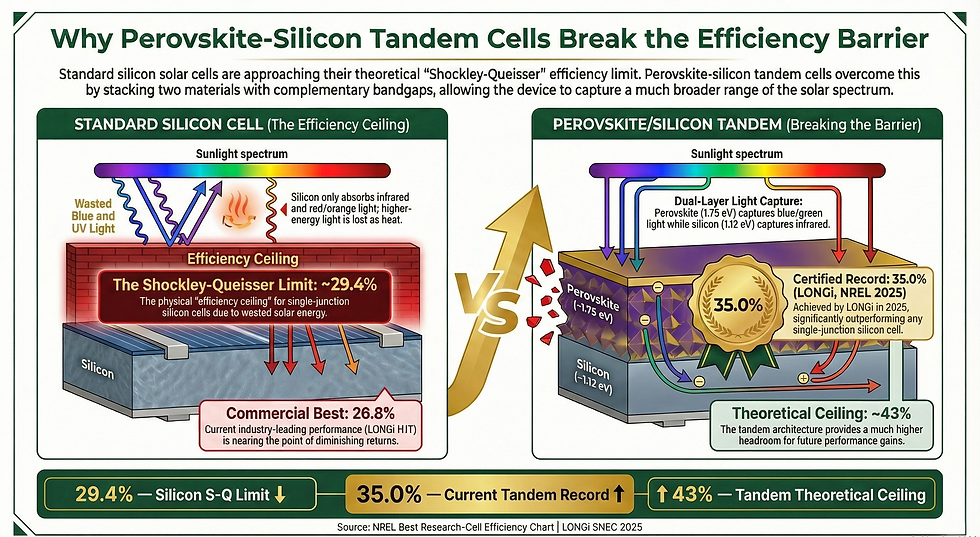
To appreciate what these numbers mean, it helps to understand the physics. Every single-junction solar cell faces a fundamental ceiling known as the Shockley-Queisser (S-Q) limit, derived in 1961 by William Shockley and Hans Queisser.
For a single p-n junction with silicon's bandgap of 1.12 eV, this limit is approximately 32–33% under ideal conditions. In practice, the best commercial silicon heterostructure (HJT) cells achieve around 26.8%. The industry has been approaching, but unable to breach, this ceiling for over a decade.
Tandem solar cell architecture is the method researchers developed to escape this constraint. By stacking two sub-cells with complementary bandgaps — a perovskite layer with a tuned bandgap of ~1.75 eV on top, and silicon with its 1.12 eV bandgap below — the combined device captures a wider slice of the solar spectrum.
High-energy (blue) photons are absorbed in the perovskite layer, and lower-energy (red/infrared) photons pass through and are captured by silicon. The theoretical efficiency ceiling for this two-terminal tandem configuration rises to approximately 43%.
In April 2025, LONGi Solar achieved a NREL-certified 34.85% on a 1 cm² device. By June 2025, at the SNEC 18th International PV Conference in Shanghai, the company announced they had pushed a 260.9 cm² large-area cell — a size close to commercially viable dimensions — to a certified 33.0%. Shortly after, Ossila's updated NREL tracking confirmed a new small-area peak of 35.0%.
These are not theoretical extrapolations; they are certified measurements included in NREL's Best Research-Cell Efficiency Chart.
On the commercial deployment side, Oxford PV shipped its first batch of 72-cell tandem panels achieving 24.5% efficiency to U.S. utility customers in September 2024. South Korea's Hanwha Qcells reached 28.6% efficiency on a full M10-sized cell (330.56 cm²) in December 2024 — a milestone because this is a mass-producible format.
As of 2026, commercial modules are in the 24–29% efficiency range, with targets pushing toward 30%+ modules by 2027–2028.
Comparison Table: Silicon vs. Perovskite vs. Tandem (2026)
Cell Technology | Best Lab PCE | Commercial Module PCE | Theoretical Limit | Cost Trend | Maturity Level |
Crystalline Silicon (c-Si) | 26.8% (LONGi, HJT) | 20–24% | ~29.4% (practical) | Declining (mature) | Commercial |
Single-Junction Perovskite | 27.3% (NREL, 2025) | N/A (pre-commercial) | ~31% | Rapidly declining | Pilot Stage |
Perovskite/Silicon Tandem | 35.0% (LONGi, 2025) | 24.5–28.6% | ~43% | Declining (early stage) | Early Commercial |
All-Perovskite Tandem | 30.1% (Nanjing Univ., 2023) | Not yet | ~45% | R&D phase | Lab Stage |
CdTe (Thin-Film) | 22.1% | 18–21% | ~29% | Stable | Commercial |
CIGS (Thin-Film) | 23.6% | 16–20% | ~28% | Stable | Commercial |
Flexible PSC (Tandem) | 33.6% (Nature, 2026) | Not yet | ~43% | R&D phase | Lab Stage |
Table 1: PV Technology Efficiency Comparison — Lab and Commercial (Sources: NREL Best Research-Cell Efficiency Chart 2025; Oxford PV; LONGi; Hanwha Qcells; Nature Energy)
The Flexible Tandem Milestone of 2026
One of the most significant results published in early 2026 comes from a paper in Nature by Wang, Li, Yu et al.: a certified 33.6% efficient flexible perovskite-silicon tandem solar cell.
What is remarkable here is not just the efficiency — which rivals rigid counterparts — but the mechanical resilience. This cell retained 91% of its initial PCE after 5,000 bending cycles at a radius of 17.6 mm, and maintained 90% of initial performance after 1,000 hours of damp-heat testing.
This achievement opens the door to curved rooftops, vehicle-integrated photovoltaics, and lightweight building-integrated installations where rigid glass panels have no place.
Under Indoor Light: A New Application Frontier
In mid-2025, researchers at University College London (UCL) and National Yang Ming Chiao Tung University (Taiwan) demonstrated a perovskite cell achieving 38.7% efficiency under standard office lighting conditions (2,000 lux).
This is nearly three times the performance of amorphous silicon cells used in solar-powered calculators. This particular breakthrough points toward a massive emerging application: self-powered IoT sensors, wireless environmental monitors, wearable devices, and smart building automation systems that could eliminate batteries entirely.
"The era of photovoltaics as a dominant energy source has arrived, yet challenges like energy storage and grid integration remain. Only through collaborative innovation can clean energy truly benefit everyone."— Li Zhenguo, Founder & CTO, LONGi Green Energy, SNEC 2025, Shanghai
Key Material Innovations in Perovskite Solar Cells
Direct Answer: The most consequential material advances as of 2026 involve formamidinium lead iodide (FAPbI₃) replacing the less stable methylammonium composition, tin-halide perovskites as lead-free alternatives, precision interface engineering to suppress recombination at grain boundaries, and 2D/3D heterojunction architectures that significantly improve operational stability without sacrificing power conversion efficiency.
From Methylammonium to Formamidinium: Stability Through Composition
The original champion material, methylammonium lead iodide (MAPbI₃), has a significant weakness: the methylammonium cation is volatile and escapes the crystal lattice at elevated temperatures, causing rapid degradation.
The research community largely moved to formamidinium lead iodide (FAPbI₃) between 2015 and 2020. FA-based perovskites have a more stable crystal structure at operating temperatures, a slightly smaller bandgap (~1.48 eV versus ~1.55 eV for MA), and better light absorption into the near-infrared region.
The downside is that FAPbI₃ can adopt an undesirable non-perovskite "yellow phase" (δ-phase) at room temperature. Solving this phase stability issue through mixed-cation, mixed-halide compositions — typically abbreviated as FAMACs (formamidinium, methylammonium, cesium, with iodide and bromide) — became a major research thrust from 2017 onward and remains the dominant absorber chemistry in high-efficiency cells today.
The Interface Engineering Imperative
Efficiency losses in perovskite cells do not primarily happen inside the bulk of the absorber. They happen at interfaces — the boundaries between the perovskite layer and the charge transport layers, and at grain boundaries within the polycrystalline perovskite film.
These interfaces are littered with structural defects (dangling bonds, vacancies, ionic impurities) that act as non-radiative recombination centers: places where photo-generated electrons and holes meet and lose their energy as heat instead of flowing through the circuit as useful current.
The state-of-the-art approach in 2026 involves a toolkit of passivation strategies. Self-assembled monolayers (SAMs) — ultra-thin organic molecules that anchor to the perovskite surface and passivate defects — have become standard in high-efficiency devices.
Molecules like MeO-2PACz and similar carbazole-based SAMs deliver excellent hole-selective contact while smoothing the energetic landscape for charge extraction.
At the ETL interface, new SnO₂ formulations with chlorine surface treatment have replaced the earlier TiO₂-based ETLs in many champion cells, offering better electron mobility and lower hysteresis.
The IMDEA Nanoscience group in Madrid published results in September 2025 showing a certified efficiency of 25.2% with a 25 cm² module retaining 95% of efficiency after 3,600 hours under stress conditions — largely credited to a novel hole transport layer using a PTZ-Fl polymer that dramatically reduced interfacial degradation.
This level of module-scale stability, representing approximately 10 months of equivalent operation, is the kind of data the commercial world needs to see more of.
Lead-Free Alternatives: Tin Halide Perovskites
The lead content in perovskite solar cells is one of the technology's most discussed liabilities. Lead is classified as a heavy metal toxin under environmental regulations in the European Union, the United States, and increasingly in Indian and Chinese regulatory frameworks.
The most mature lead-free alternative is the tin halide perovskite family — specifically formamidinium tin iodide (FASnI₃) and related mixed tin-lead compositions.
The challenge with tin-based perovskites is the ease with which Sn²⁺ oxidizes to Sn⁴⁺ in the presence of oxygen or moisture. This oxidation process creates p-type self-doping that severely reduces carrier lifetime and efficiency.
As of 2026, the highest efficiencies for tin-only perovskites remain in the 14–16% range — well behind lead-based cells.
However, mixed lead-tin compositions like (FASnI₃)₀.₆(MAPbI₃)₀.₄ have achieved efficiencies above 21%, with improved stability through antioxidant additives such as tin fluoride (SnF₂) and phenyl-C₆₁-butyric acid methyl ester (PCBM). This is an active area of research, with several groups pursuing antimony, bismuth, and copper-based perovskite-inspired structures as fully lead-free routes.
Transport Layer Innovations: Beyond Spiro-OMeTAD
The hole transport layer (HTL) has long been a bottleneck. Spiro-OMeTAD, the dominant HTL material for a decade, requires chemical doping with lithium bis(trifluoromethanesulfonyl)imide (LiTFSI) — a hygroscopic salt that itself absorbs moisture and degrades the device.
In 2026, the trend is clearly toward dopant-free hole transport materials: polymer-based HTLs, carbazole-based SAMs, and inorganic alternatives such as copper thiocyanate (CuSCN) and nickel oxide (NiO) nanoparticles. These materials not only reduce the moisture uptake issue but also simplify the manufacturing process, since the delicate doping step can be eliminated.
Materials Comparison Table
Material Category | Example Compound | Best PCE (2026) | Key Advantage | Primary Challenge |
Lead Halide (FA-based) | FAPbI₃ / FAMACs | 27.3% | High PCE, tunable bandgap | Lead toxicity, moisture instability |
Lead Halide (MA-based) | MAPbI₃ | ~25% | Easy synthesis, well-understood | Thermal instability, MA volatility |
Tin Halide (Lead-free) | FASnI₃ | ~16% | Non-toxic, tunable bandgap | Sn²⁺ oxidation, low stability |
Mixed Tin-Lead | (FASnI₃)₀.₆(MAPbI₃)₀.₄ | ~21% | Near-IR absorption, reduced Pb | Sn oxidation, complex processing |
Double Perovskite | Cs₂AgBiBr₆ | ~7% | Fully Pb-free, stable | Low PCE, indirect bandgap |
2D/3D Hybrid | BA₂MA₃Pb₄I₁₃ | ~22% | Superior moisture stability | Lower PCE vs. 3D, complex deposition |
Table 2: Perovskite Absorber Materials — Efficiency and Characteristics (Sources: NREL; Nature Energy; Advanced Materials, 2025)
Crystallography: Why Crystal Quality Defines Performance
The perovskite film in a working solar cell is not a single crystal. It is a polycrystalline thin film grown from solution, and the quality of that crystallization — grain size, orientation, boundary passivation — has an enormous influence on device performance.
Larger grains mean fewer boundaries, fewer defects, longer carrier diffusion lengths. Modern deposition protocols targeting large-grain, preferentially oriented (100) crystal films have become the standard for high-efficiency cells.
A 2025 paper in Nature Materials by Liu et al. showed that all-perovskite tandem cells achieving >29% efficiency depended critically on achieving improved (100) orientation in wide-bandgap perovskite sub-cells, reducing non-radiative recombination at grain boundaries by over 40%.
Stability & Durability Breakthroughs — Addressing the Core Challenge
Direct Answer: Stability remains the most critical barrier for perovskite solar cell commercialization. As of 2026, however, significant milestones have been reached.
Encapsulated modules have passed the IEC 61215 damp-heat test (1,000 h at 85°C/85% RH), with some devices retaining over 95% of initial PCE after 1,500+ hours. Companies such as GCL and Utmo Light (China) have achieved certification, and Oxford PV is targeting 25-year operational warranties for its tandem modules.
Understanding Why Perovskites Degrade
To understand why the stability problem has been so hard to solve, you need to look at the atomic structure of the perovskite crystal itself. The organic-inorganic hybrid nature that gives these materials their exceptional optoelectronic properties is also the source of their fragility.
There are four primary degradation mechanisms that researchers must contend with simultaneously:
Moisture degradation is the most widely studied. Water molecules intercalate into the ABX₃ crystal lattice, break the hydrogen bonds holding the organic cation (methylammonium or formamidinium) in place, and cause the perovskite structure to dissolve into its precursor components — essentially PbI₂, MAI, and water. This process can begin in minutes under ambient humidity without protection.
Thermal degradation becomes significant above approximately 85°C, a temperature easily reached on a rooftop panel in summer in regions like Rajasthan (India), Texas (USA), or the Middle East. At elevated temperatures, the organic cation volatilizes and escapes, leaving behind a defect-rich, non-photoactive PbI₂ film. This is why the IEC 61215 standard's damp-heat test at 85°C/85% relative humidity for 1,000 hours is considered the primary gatekeeping challenge for any new solar technology.
Photodegradation (light-induced instability) arises from two sources: UV light can decompose the perovskite absorber directly, and prolonged illumination drives ion migration — the movement of halide ions (I⁻, Br⁻) through the crystal lattice under the electric field of the operating device. Ion migration causes phase segregation, shifts the bandgap, and leads to slow efficiency loss even in well-sealed devices.
Oxygen degradation is less severe than moisture but still relevant in imperfectly sealed modules. Oxygen oxidizes the Sn²⁺ in tin-based perovskites, and in lead-based cells, it can oxidize the spiro-OMeTAD hole transport layer dopants, disrupting charge extraction.

The Encapsulation Revolution
The good news is that advanced encapsulation is proving highly effective at addressing all four of these mechanisms simultaneously. The key insight, validated in multiple studies published in ACS Applied Materials & Interfaces and Science Advances, is that perovskite cells are not inherently more fragile than silicon — they are simply far more sensitive to their environment. Seal them properly, and their intrinsic properties are sufficient for decades of operation.
The state of the art in 2026 involves glass-glass encapsulation using advanced polymeric interlayers. Polyisobutylene (PIB) edge seals have been demonstrated to prevent moisture ingress effectively for over 200 days in shelf-life tests, while also passing IEC 61215 damp-heat tests at 85°C/85% RH.
A Science Advances study using an epoxy polymer (EP) encapsulant with self-healing properties showed remarkable results: devices retained 95.17% of initial PCE after 1,500 hours of damp-heat exposure, and 93.53% efficiency after 300 thermal cycling tests — exceeding the IEC 61215 requirement of maximum 5% loss after 200 cycles.
Oxford PV's pilot line in Brandenburg, Germany, uses a proprietary glass-glass encapsulation stack with advanced edge-sealing and moisture-barrier films specifically designed to meet both IEC 61215 and IEC 61730 (safety qualification) standards, targeting 25-year operational lifetimes.
In China, Utmo Light has reported that their single-cell module passed an IEC-equivalent UV bath test at 1,000 W/m² and 60°C for 2,300 hours, projecting 12 years of degradation-free operation. Most remarkably, GCL's perovskite panel has fully passed IEC 61215 and IEC 61739 certification tests — the same standards applied to silicon modules — and carries a warranty of 90% output after 10 years, declining to 80% after 25 years.
The 2D/3D Passivation Strategy for Intrinsic Stability
Beyond encapsulation, researchers are also building stability directly into the material.
The 2D/3D perovskite heterojunction architecture places a thin layer of two-dimensional (Ruddlesden-Popper phase) perovskite on top of the conventional three-dimensional absorber.
This 2D layer acts as a chemical shield: it is highly hydrophobic (water-repelling), resists ion migration, and passivates surface defects. The trade-off has been a modest efficiency loss compared to pure 3D devices, but this gap is closing rapidly. In 2025, the inverted (p-i-n) device architecture using SAM-based hole contacts and 2D capping layers demonstrated cells with 25.6% PCE maintaining 90% efficiency after 1,200 hours of continuous illumination at 65°C.
The outdoor data, while still limited in duration compared to the silicon benchmark of 25+ years, is becoming credible.
The Belgian-Cypriot outdoor study mentioned earlier showed performance loss rates of 7–8% per month for unprotected minimodules — but critically, the best encapsulated module retained 78% of initial efficiency after one year of outdoor exposure in diverse climate conditions.
These numbers are still behind the silicon benchmark but show a clear and steep improvement curve.
95% PCE retained after 1,500h damp-heat (EP encapsulant, Science Advances)
2,300h UV bath stability (Utmo Light, IEC-equivalent, 60°C)
2,000h T80 lifetime — flexible tandem (Nature, 2026, continuous illumination)
25 yr Target warranty — Oxford PV tandem modules (under IEC 61215/61730)
📌 Key Term — Degradation Mechanisms
The four primary degradation pathways for perovskite solar cells are:
(1) moisture ingress dissolving the crystal lattice;
(2) thermal stress volatilizing organic cations above ~85°C;
(3) photo-induced ion migration causing halide phase segregation under illumination; and
(4) oxygen oxidation of charge transport layers.
Addressing all four simultaneously — through composition engineering, 2D/3D passivation, advanced encapsulation, and dopant-free transport layers — is the defining challenge of perovskite commercialization in 2026.
Certification Standards: The New Frontier
The International Electrotechnical Commission (IEC) is currently adapting its IEC 61215 standard to include perovskite-specific protocols. Enhanced damp-heat testing procedures and new light-soaking protocols tailored to perovskite degradation pathways are under development.
Organizations such as TÜV Rheinland and Bureau Veritas have begun offering pre-certification services for perovskite modules. The industry consensus is that full IEC-based certification for commercial perovskite modules — including bankability for utility-scale project financing — will be achievable between 2026 and 2028, depending on the rate of field data accumulation.
Scalability & Manufacturing Techniques — From Lab to Gigafactory
Direct Answer: The transition from spin-coated lab cells to commercially viable large-area perovskite modules requires industry-compatible deposition methods. As of 2026, slot-die coating is the leading industrial process, favored for its roll-to-roll compatibility, material efficiency, and ability to deposit uniform films over large areas.
Blade coating and vapor deposition are complementary approaches, each with specific advantages. The key remaining challenge is maintaining high PCE as device area scales from 0.1 cm² to 1 m² formats.
The Fundamental Problem with Spin Coating
Almost every high-efficiency perovskite cell in the academic literature was fabricated using spin coating. It is the workhorse of laboratory-scale PV research for good reason: it produces exceptionally uniform, pinhole-free thin films with precise thickness control, and the centrifugal force helps remove excess solvent rapidly.
The problem is that spin coating is categorically unsuitable for industrial production. The technique works by spinning a substrate at 1,000–6,000 RPM while depositing the perovskite precursor solution — which means it only works on small, rigid, disk-shaped substrates.
The vast majority of the precursor solution is thrown off the substrate and wasted. Scaling to a 1 m × 2 m module format is physically impossible with spin coating.
This is why the research community and industry have been developing scalable alternatives for the past decade. In 2026, three techniques dominate the field: slot-die coating, blade coating, and vapor deposition. Each has distinct trade-offs.
Slot-Die Coating: The Industrial Standard of 2026
A comprehensive review published in Advanced Energy Materials (2024) analyzing all 115 published slot-die coating studies for perovskite cells concluded that slot-die coating represents the most commercially viable pathway for scaling perovskite solar cells.
The technique works by pumping a precisely metered volume of perovskite precursor ink through a narrow slot onto a moving substrate. The film thickness is controlled by adjusting the flow rate, coating speed, and gap between the die head and substrate.
Slot-die coating's key advantages are its roll-to-roll (R2R) compatibility — meaning it can be integrated into a continuous web-based manufacturing line analogous to newspaper printing — its high material utilization (waste is minimal compared to spin coating), and its ability to deposit uniform films over large areas at production speeds.
In practice, industrial PSM manufacturers like GCL and Microquanta in China already use slot-die coating as their primary deposition method for p-i-n structured modules.
The remaining challenge with slot-die coating is crystallization control. In spin coating, the rapid solvent removal driven by centrifugal force creates a specific crystallization dynamic that has been extensively optimized for high efficiency.
In slot-die coating on a moving web, the drying and crystallization kinetics are entirely different — and harder to control. Researchers have developed several strategies to compensate: gas-flow-assisted quenching (blowing nitrogen across the wet film to force rapid solvent evaporation), near-infrared (NIR) heating for rapid and uniform substrate warming, solvent additive engineering using substances like methylammonium thiocyanate (MASCN) to regulate nucleation timing, and dual-blade sequential deposition for more precise precursor application.
Blade Coating: Bridging Lab and Industry
Blade coating (or doctor-blade coating) occupies the middle ground between spin coating and slot-die coating.
A fixed blade is drawn across the substrate while the perovskite solution is deposited ahead of it, spreading a uniform thin film. It is simpler than slot-die, can be done in ambient air with suitable solvent engineering, and is genuinely scalable to large areas.
Researchers at EPFL and multiple Chinese universities have demonstrated efficiencies above 20% on blade-coated modules with areas above 100 cm². In the Nano-Micro Letters 2026 review, blade coating with vacuum flash evaporation post-treatment has emerged as one of the most promising approaches for maintaining high-quality crystallization at large scale.
Vapor Deposition: Precision at Scale
Thermal co-evaporation and chemical vapor deposition (CVD) of perovskite layers represent the highest-precision manufacturing route. Unlike solution-based techniques, vapor deposition does not use solvents at all — lead halide and organic ammonium precursors are evaporated under vacuum and condense on the substrate as a thin film.
This approach produces exceptionally uniform, dense, pinhole-free films even on textured silicon surfaces (critical for tandem fabrication) and offers a high degree of compositional control. It is also well-understood from decades of thin-film silicon manufacturing.
The downside is cost and throughput. Vapor deposition equipment is expensive, energy-intensive, and more challenging to scale to gigawatt production volumes than solution-based web coating. The approach is most practical for tandem cells on silicon wafers, where the textured silicon surface requires conformal deposition that solution processes struggle to provide.
Oxford PV uses a vapor-assisted process for some layers in its tandem modules, and several academic-industry partnerships are developing hybrid vapor-assisted solution processes (VASP) that combine the compositional control of vapor deposition with the cost efficiency of solution processing.
The Efficiency-Area Trade-Off: The Core Manufacturing Problem
One hard truth about perovskite manufacturing is that efficiency and area are in a fundamental tension. The record 27.3% PCE cell has an active area of roughly 0.052 cm². A 100 cm² module typically achieves around 20–22%.
A 260.9 cm² module (LONGi's large-area record) reaches 33% in tandem format but far lower for single-junction standalone designs. As area scales toward commercial module formats (1,640 cm² or larger), additional losses arise from sheet resistance in the transparent electrode, dead zones from laser scribing during module interconnection, and statistical increases in film non-uniformity.
Bridging this gap is one of the central engineering challenges of 2026. The ScienceDirect review on large-area PSMs (August 2025) notes that while sub-100 cm² modules regularly exceed 20% PCE in lab settings, achieving this at >100 cm² at industrial scale remains the key gap between research and commercial competitiveness with silicon.
Manufacturing Methods Comparison Table
Technique | Scalability | Best Module PCE | Material Waste | R2R Compatible | Primary User |
Spin Coating | ❌ Lab only | >27% (small area) | Very High (~90%) | No | Academic research |
Slot-Die Coating | ✅ Industrial | ~20% (60 cm²) | Low (<10%) | Yes | GCL, Microquanta, industry |
Blade Coating | ✅ Semi-industrial | ~20% (100+ cm²) | Low–Medium | Partial | Pilot lines, R&D |
Thermal Co-evaporation | ✅ Industrial (limited) | ~22% (module) | Very Low | Limited | Oxford PV, tandem lines |
Vapor-Assisted Solution (VASP) | Emerging | ~23% (research) | Medium | Partial | Academic-industry hybrid |
Inkjet Printing | Emerging | ~18% (small area) | Very Low | Yes (in development) | Research / BIPV |
Table 3: Perovskite Manufacturing Technique Comparison (Sources: Advanced Energy Materials 2024; ScienceDirect 2025; Nano-Micro Letters 2026)

Cost Projections: The $0.29/W Possibility
One of the most compelling economic arguments for perovskite technology is manufacturing cost. According to analysis cited by the Energy Solutions commercial assessment (January 2026), manufacturing costs for tandem perovskite-silicon modules achieving 25–30% efficiency are projected at $0.29–$0.42/W.
For comparison, current high-efficiency silicon HJT modules manufacture at approximately $0.20–$0.28/W at gigawatt scale. The higher initial cost of tandem modules is expected to be more than offset by their superior power output per unit area — directly reducing balance-of-system costs (land, racking, wiring, installation) in utility-scale projects.
Perovskite Solar Cell Market Growth & Deployment Forecasts
Direct Answer: The global perovskite solar cell market was valued at approximately USD 264–318 million in 2024–2025 and is projected to grow at a CAGR ranging from 37% to 72% depending on the analysis firm, reaching between USD 1.68 billion and USD 7.02 billion by 2030. Asia-Pacific — led by China — holds over 52% of the current market share. Commercial module shipments began in earnest in 2024, with full mass-market deployment expected between 2026 and 2029.
From USD 265 Million to Billions: The Growth Trajectory
The numbers from market research firms vary significantly — a reflection of genuine uncertainty about how quickly stability certification and manufacturing scale-up will progress — but they agree on direction.
The perovskite solar cell market is at an inflection point. After years of laboratory-stage development, commercial modules are now shipping. Early adopters are gaining field experience. Investment from both the public sector and industrial giants is accelerating.

Grand View Research projects the market reaching USD 7.02 billion by 2030 at a CAGR of 72.2% from 2025. Research and Markets offers a more conservative estimate of USD 1.68 billion by 2030 at a CAGR of 37.3%. Precedence Research places the 2026 market value at USD 370.7 million, growing to USD 3.6 billion by 2034 at a 34.1% CAGR.
Across all analyses, the common thread is exponential growth driven by efficiency improvements, falling manufacturing costs, and expanding applications in BIPV, flexible electronics, and utility-scale solar.
Regional Market Dynamics
Asia-Pacific dominates with a 52–54% market share as of 2024, driven overwhelmingly by China. Chinese companies — LONGi, GCL, Microquanta, Hanergy, Utmo Light — hold the most advanced manufacturing positions in perovskite technology globally.
China's government has designated perovskite photovoltaics as a strategic technology under its 14th Five-Year Plan, and the country has around 757 GW of operating wind and solar capacity with an additional 750 GW under construction. The scale of China's solar manufacturing ambition provides a ready platform for perovskite technology absorption.
Europe is the second-largest region, with a projected market value of approximately USD 39 million in 2026 growing at a 40.45% CAGR through 2032.
The European Climate Law, the European Green Deal, and 8th Environment Action Programme collectively mandate carbon neutrality by 2050, driving demand for next-generation PV.
Key players include
Oxford PV (operating its manufacturing line in Brandenburg, Germany),
Saule Technologies (Poland, specializing in BIPV applications), and
Meyer Burger Technology (Switzerland).
The UK market alone is projected to reach USD 8.92 million by 2026.
The United States market is growing rapidly, aided by the Inflation Reduction Act (IRA) incentives for domestic clean energy manufacturing. Oxford PV shipped its first commercial tandem modules to U.S. utility customers in September 2024. Swift Solar and CubicPV are among U.S.-based startups building domestic perovskite manufacturing capability, with backing from the Department of Energy's Solar
Energy Technologies Office (SETO).
For India, the context is particularly compelling. India's installed solar capacity reached approximately 123 GW by 2025, with a target of 280 GW solar by 2030. R&D in perovskite-silicon tandem cells is projected to deliver efficiencies above 30% by 2030 and above 32% by 2035 for next-generation cells.
Given India's high solar irradiance and land constraints in urban areas, the space-efficiency advantage of higher-PCE perovskite panels is directly economically relevant. Indian institutions including IIT Delhi, IIT Bombay, IARI, and the National Chemical Laboratory (NCL) in Pune are active in perovskite research, and the government's PLI Scheme for solar manufacturing could eventually extend to perovskite module production.
Commercial Readiness Timeline
Timeline | Development Stage | Key Milestone | Leading Organizations |
2009–2019 | Laboratory Discovery | PCE grows from 3.8% → 25%+ | Miyasaka, Grätzel (EPFL), Park (SKKU) |
2020–2023 | Pilot-Scale Prototyping | First pilot lines; PCE >26%; tandem cells >33% | Oxford PV, LONGi, Saule Tech, GCL |
2024 | Early Commercial | Oxford PV ships 24.5% modules to U.S.; Qcells reaches 28.6% | Oxford PV, Hanwha Qcells, LONGi |
2025–2026 | Active Commercial | LONGi 35% tandem record; GCL passes IEC 61215; modules 24–29% | LONGi, GCL, Utmo Light, Oxford PV |
2027–2028 | Mass Production Target | IEC certification widespread; Qcells mass production; 30%+ commercial | Qcells (H1 2027), LONGi, JinkoSolar |
2029–2032 | Grid-Scale Deployment | Utility bankability achieved; LCOE parity with premium silicon | Multiple players globally |
2035+ | Technology Maturity | 25-year warranties standard; >32% commercial modules possible | Industry-wide |
Table 4: Perovskite Solar Cell Commercialization Timeline (Sources: Oxford PV; Hanwha Qcells; GCL; Energy Solutions 2026; GreenFuelJournal Research)
"Silicon panels are guaranteed to last decades. The 'bankability' question — whether lenders and insurers will back perovskite projects — hinges on 2–3 more years of field data. But that data is now accumulating fast."— Energy Solutions Market Intelligence Report, January 2026
Environmental Impact & Lifecycle Considerations
Direct Answer: Lifecycle assessment (LCA) studies show that perovskite solar cells generate significantly less CO₂ per kWh than fossil fuels — with energy payback times of 0.2–0.5 years in high-irradiance regions, comparable to or better than silicon PV.
The primary environmental concern is lead content (typically 0.4–1.5 g/m² in lead-based cells), which requires robust recycling and encapsulation protocols. Lead-free tin alternatives are advancing but have not yet reached competitive efficiency levels.
The Carbon Calculus: How Clean Is Perovskite PV?
A lifecycle assessment (LCA) traces the full environmental footprint of a technology from raw material extraction through manufacturing, operation, and end-of-life disposal.
For perovskite solar cells, the LCA picture is distinctly positive compared to fossil energy, and generally competitive with silicon PV. The primary inputs of concern are the energy consumed in manufacturing and the environmental fate of lead.
On energy consumption, perovskite manufacturing has a fundamental advantage over silicon: no high-temperature processes. Silicon wafer manufacturing requires energy-intensive purification (Siemens process at ~1,500°C) and crystal growth.
Perovskite films are deposited at room temperature to ~150°C from solution or low-temperature vapor processes. This dramatic difference in processing temperature translates directly into lower embodied energy.
Several published LCA studies have estimated the energy payback time (EPBT) for perovskite modules at 0.2–0.5 years in regions receiving around 1,700 kWh/m² annual irradiance — meaning a module pays back the energy used to manufacture it in under six months of operation. Silicon modules in comparable analyses typically show EPBT of 1.0–2.5 years.
The greenhouse gas (GHG) emission intensity of perovskite electricity generation — expressed in grams of CO₂ equivalent per kWh (gCO₂eq/kWh) — is estimated at approximately 10–25 gCO₂eq/kWh across the full lifecycle, compared to 20–50 gCO₂eq/kWh for silicon PV and 400–900 gCO₂eq/kWh for coal-fired power.
This is a meaningful climate advantage, particularly for emerging economies that are currently most dependent on coal and natural gas.
The Lead Problem: Risk and Mitigation
No honest environmental discussion of perovskite solar technology can avoid the lead question. Standard lead-halide perovskite cells contain approximately 0.4–1.5 grams of lead per square meter of active area. This is far less than the lead in a car battery or in older lead-based paints, but it is a non-trivial quantity when projected across gigawatt-scale deployment.
Lead is a neurotoxin with no safe lower threshold for human exposure according to the World Health Organization (WHO), and its potential environmental release — particularly during extreme weather events like hailstorms that could shatter panels, or improper end-of-life disposal — is a legitimate concern.
The industry's primary response is encapsulation as a containment strategy. Advanced encapsulants, including the fluorosilicone polymer gel system referenced in Science Advances, have demonstrated a 99% lead leakage inhibition rate in simulated rain tests.
A polyphenol-based encapsulant kept lead content within the safe drinking water threshold while maintaining 90%+ PCE retention. These results suggest that well-encapsulated perovskite modules can manage lead risk effectively throughout their operational lifetime.
End-of-life management is the harder challenge. The recycling infrastructure for perovskite modules does not yet exist at scale. Proposed protocols involve solvent dissolution (using DMF or similar solvents to dissolve the perovskite layer and recover lead salts), acid leaching of decommissioned modules, and closed-loop lead recovery from manufacturing waste streams.
Several research groups and startups are developing closed-loop recycling systems specifically designed for perovskite panel decommissioning, and the European Union's Battery Regulation framework is being watched closely as a potential model for mandatory lead recovery mandates on perovskite modules.
⚠️ Environmental Consideration
Lead leakage risk from perovskite modules is real but manageable. The key is robust encapsulation during operation and mandatory closed-loop recycling at end-of-life. Researchers and regulators agree that lead-free tin-based alternatives remain the long-term goal, but lead-based perovskites with proper containment can be environmentally responsible in the near term. Under no circumstances should perovskite modules be disposed of in general waste streams.
Lead-Free Progress and the Tin Halide Route
The entirely lead-free route — using tin (Sn), bismuth (Bi), antimony (Sb), or copper (Cu) at the B-site of the perovskite structure — remains an active area of intense research. Tin-based perovskites (FASnI₃, MASnI₃) are the most direct replacement candidates, sharing the crystal structure and offering similar bandgap tunability.
Their main problem — the rapid oxidation of Sn²⁺ to Sn⁴⁺ in ambient air — is being tackled through several approaches: antioxidant additives such as tin fluoride (SnF₂), operating in inert atmospheres during fabrication, and using reducing gas treatments during deposition.
As of 2026, tin-only cells remain at 14–16% PCE, but the rate of improvement has been accelerating, with groups at Cambridge, Kyushu University, and KAUST all reporting incremental gains.
Double perovskites (like Cs₂AgBiBr₆) are entirely lead-free and highly stable, but their indirect bandgap severely limits light absorption efficiency, keeping PCE below 8%. Unless a fundamentally new material design unlocks higher performance, double perovskites appear more relevant for niche applications (indoor light harvesting, printed sensors) than for mainstream solar panels.
The practical reality of 2026 is this: lead-based perovskites will dominate the commercial market for the next decade, with proper encapsulation and recycling as the mitigation strategy. Lead-free alternatives will gradually improve in efficiency and capture specialized markets. A true lead-free replacement at silicon-competitive efficiencies likely remains a 2030+ achievement.
Lifecycle Assessment Summary
Environmental Parameter | Perovskite PSC | Crystalline Silicon | CdTe Thin-Film | Coal Power |
Energy Payback Time | 0.2–0.5 years | 1.0–2.5 years | 0.5–1.0 years | N/A (ongoing) |
GHG Intensity | 10–25 gCO₂eq/kWh | 20–50 gCO₂eq/kWh | 15–30 gCO₂eq/kWh | 820+ gCO₂eq/kWh |
Toxic Material Content | 0.4–1.5 g/m² Pb | Low (Si, Al, Ag) | Cadmium (toxic) | Heavy metals in ash |
Manufacturing Temperature | <150°C | ~1,500°C | ~500–600°C | ~1,400°C (combustion) |
Recycling Status | Developing (R&D) | Established (EPD) | Established (First Solar) | Partial (ash) |
End-of-Life Protocol | Closed-loop (proposed) | Mechanical + chemical | Manufacturer take-back | Landfill (ash) |
Table 5: Lifecycle Environmental Comparison — PV Technologies vs. Fossil Fuel (Sources: Nature Energy LCA studies; IEA PVPS Task 12; Science Advances 2025)
The Solar PV LCOE Trajectory
The levelized cost of electricity (LCOE) from solar PV has fallen more steeply over the past two decades than any energy technology in history. The International Energy Agency (IEA) projects that residential rooftop perovskite systems could reach sub-retail electricity pricing in most global markets within the next five years, particularly as module efficiencies rise above 25% and manufacturing costs decline toward the $0.30/W range.
For India specifically, where the current utility-scale solar tariff is around ₹2.44/kWh (~$0.03/kWh) — among the lowest in the world — the question is not just about making solar cheaper but about making it more space-efficient and flexible for urban, industrial, and off-grid applications where perovskite technology shines.
CONTINUE READING PART II: https://www.greenfueljournal.com/post/part-ii-perovskite-solar-cell-revolution-2026