


Renewable Energy Jobs in 2026: Global Market Growth, Skills Gap & Career Pathways (With Data + Forecasts)

Introduction
Renewable energy jobs are no longer a niche topic reserved for environmental economists or policy circles. They are now at the centre of a global workforce shift that is reshaping economies, communities, and career trajectories across every continent.

As of 2024, the world counted at least 16.6 million people employed in the renewable energy sector — a figure confirmed by the International Renewable Energy Agency (IRENA) and the International Labour Organization (ILO) in their January 2026 joint report. That number, while large, tells only part of the story. Behind it lies a workforce under pressure: growing too slowly in some regions, too unevenly across gender lines, and not fast enough to meet the pace of clean energy deployment.
In 2026, solar panels are going up faster than trained technicians can install them. Wind farms are being commissioned in regions where qualified maintenance engineers are scarce. Grid modernisation projects are stalled — not for lack of funding, but for lack of skilled workers. This is not a forecast. It is happening right now.
This article is written for students exploring green careers, professionals considering a switch, investors tracking workforce dynamics, researchers studying the energy transition, and policymakers designing workforce development programmes.
Whether you are asking "what jobs exist in renewable energy?" or "is there a skills shortage that affects my business?" — this guide answers both.
We draw on verified data from IRENA, the IEA, the ILO, the US Bureau of Labor Statistics (BLS), and industry surveys. Every figure cited here is traceable. Every insight is grounded in what the data actually shows — not what we hope it will show.
Let us start with the basics.
What Are Renewable Energy Jobs?
🟩 Renewable energy jobs — also called green-collar jobs — are positions across the value chain of clean energy production. They include both direct roles (solar panel installer, wind turbine technician) and indirect roles (supply chain, manufacturing, R&D). In 2024, 16.6 million people held such jobs globally, with Solar PV as the single largest employer at 7.3 million jobs.
[Source: IRENA/ILO Annual Review 2025]
Defining the Green-Collar Worker
The term "green-collar worker" was coined to describe people whose jobs directly contribute to reducing environmental harm or improving ecological health. In the energy sector, this means everyone from the electrician wiring a rooftop solar panel to the data scientist optimising a wind farm's output using predictive analytics.
But the definition runs broader than most people expect. The ILO classifies renewable energy employment into three distinct layers:
1. Direct Jobs These are roles that exist specifically because of renewable energy projects and operations. Think of a solar PV installer climbing a rooftop in Rajasthan, a wind turbine technician servicing a turbine off the coast of Denmark, or a hydropower plant operator managing water flow in Brazil's Itaipu facility. Direct jobs are the most visible and the most commonly counted.
2. Indirect Jobs These positions exist in the supply chain that supports renewable energy. A factory worker manufacturing solar modules in Shandong, China, holds an indirect job. So does a logistics coordinator shipping wind turbine blades from a port in Tianjin, or a steel worker producing towers for onshore wind projects in Germany. These roles often go uncounted in casual estimates but form the economic backbone of the sector.
3. Induced Jobs These are jobs created when renewable energy workers spend their wages in local economies. When a solar technician spends their salary at a local restaurant or grocery store, that spending sustains jobs in those establishments. Induced employment is harder to measure but is a real and significant economic multiplier — particularly in rural areas where large-scale solar and wind projects are often located.
Why the Distinction Matters
Most published figures — including IRENA's widely cited 16.6 million — primarily reflect direct and some indirect employment. The true economic footprint of the renewable energy sector is considerably larger when induced employment is included.
The IEA's World Energy Employment 2025 report places total global energy sector employment at 76 million people in 2024 — covering all energy types. Within this, clean energy and renewables represent the fastest-growing share, with the power sector now the single largest energy employer, overtaking fuel supply for the first time.
This context matters. When we talk about renewable energy jobs, we are not talking about a narrow slice of technical roles. We are describing a sprawling, multi-layered global workforce that spans manufacturing floors, engineering offices, research labs, policy departments, and remote field sites.
A Snapshot of Job Types by Category
Job Category | Examples | Education Level Required |
Installation & Construction | Solar PV Installer, Wind Tower Erector | Vocational / Diploma |
Operations & Maintenance (O&M) | Wind Turbine Technician, Plant Operator | Technical Certification |
Engineering & Design | Electrical Engineer, Civil Engineer | Bachelor's / Master's |
Research & Development | Materials Scientist, Energy Analyst | Postgraduate / PhD |
Project Development | Project Manager, Environmental Assessor | Bachelor's + Experience |
Policy & Finance | Energy Policy Advisor, Green Finance Analyst | Bachelor's / Postgraduate |
Digital & Smart Grid | SCADA Engineer, AI/ML Specialist | Bachelor's / Technical |
Supply Chain & Manufacturing | Component Manufacturer, Logistics Coordinator | Varies |
[Source: Compiled from IRENA, IEA, ILO, and US Bureau of Labor Statistics data, 2025–2026]
The Policy Context Behind Job Creation
Renewable energy jobs do not emerge in a vacuum. They are shaped — accelerated or constrained — by energy policy. Countries that set binding renewable energy targets, offer tax incentives for clean energy investment, and fund vocational training programmes see faster job growth. Those that do not, fall behind.
The European Union's Green Deal, India's National Solar Mission, and the US Inflation Reduction Act (which committed $370 billion to clean energy over a decade) are three major policy drivers currently stimulating job creation. On the other side of the ledger, policy uncertainty — such as the rollback of federal clean energy incentives in the United States under the Trump administration in 2025 — caused US renewable energy investment to fall by 36% in the first half of 2025 compared to the same period in 2024.
[Source: World Resources Institute, November 2025]
This bidirectional relationship between policy and employment is one of the defining features of the renewable energy job market. Understand the policy, and you understand where the jobs are headed.
Renewable Energy Job Market Overview — Global Employment Trends
🟩 Global renewable energy employment reached 16.6 million jobs in 2024, up from 16.2 million in 2023 — a 2.3% growth rate, the slowest in recent years despite record clean energy capacity additions. China dominates with 7.3 million jobs (44%) of the global total. Solar PV remains the top employer at 7.3 million jobs worldwide. The Asia-Pacific region hosts over 75% of all solar PV jobs globally.
[Source: IRENA/ILO Annual Review 2025, January 2026]
The Big Picture: A Sector Growing, But Unevenly
Here is something that catches most people off guard: in 2024, renewable energy installations hit a record high worldwide.
More solar panels were installed, more wind turbines commissioned, and more capacity added to the grid than in any previous year. Yet job growth in the sector slowed to its lowest rate in over a decade — just 2.3%.
How does that happen?
The answer lies in three converging forces: automation, economies of scale, and geopolitical tension. As manufacturing processes become more efficient — particularly in China — fewer workers are needed to produce the same amount of equipment.
A solar panel factory that employed 500 workers five years ago may now produce twice the output with 320 workers, thanks to robotics and process automation. At the same time, trade frictions between major economies, particularly US tariffs on Chinese clean energy imports in 2025, are creating supply chain disruptions that slow deployment and, by extension, hiring.
This is not cause for alarm — it is context. The sector is still adding jobs. It is still growing. It is simply maturing. And that maturity brings its own workforce challenges.
Global Employment Figures at a Glance (2024)
Technology / Sector | Global Jobs (2024) | Year-on-Year Change |
Solar PV | 7.3 million | Modest growth |
Liquid Biofuels | 2.6 million | Stable |
Hydropower | 2.3 million | Slight decline in new projects |
Wind Energy | 1.9 million | Growing, esp. offshore |
Other Renewables | ~0.5 million | Emerging |
Total Renewable Energy | 16.6 million | +2.3% |
[Source: IRENA/ILO Renewable Energy and Jobs: Annual Review 2025]

Regional Snapshot: Where the Jobs Are
🌏 Asia-Pacific — The Undisputed Powerhouse
Asia is not just leading the renewable energy job market — it is defining it. The region accounts for the vast majority of global clean energy employment, driven overwhelmingly by China, and supported by strong growth in India, Vietnam, and Japan.
China alone created an estimated 7.3 million renewable energy jobs in 2024 — representing 44% of the entire global workforce in the sector. This is a staggering concentration. Chinese dominance stems from its integrated, large-scale supply chains that cover everything from raw material extraction to finished panel manufacturing to installation.
The China Renewable Energy Society estimates the country's total renewable energy workforce at 7.29 million in 2024, slightly below the 7.4 million recorded in 2023 — a reflection of rising labour productivity through automation and AI adoption in O&M roles rather than any slowdown in deployment. [Source: IRENA Annual Review 2025]
India is the region's second-largest employer, with approximately 1.3 million renewable energy jobs in 2024, up from around 1 million in 2023. India's growth is driven by its ambitious target of 500 GW of non-fossil fuel capacity by 2030 under its National Energy Plan, supported by the Ministry of New and Renewable Energy (MNRE). Hydropower alone employs close to half a million workers in India, making it the country's single largest renewable employer.
Asian countries collectively host 75% of the world's Solar PV jobs, with China accounting for the bulk — approximately 4.2 million of those positions. Vietnam and South Korea are emerging as manufacturing hubs, adding indirect employment in panel and component production.
🌍 European Union — Stable but Strained
The EU held steady at 1.8 million renewable energy jobs in 2024 — the same figure as 2023 — suggesting the bloc is in a period of consolidation rather than expansion. [Source: IRENA 2025]
This stability masks underlying tension. Europe's renewable energy ambitions — including a target of 42.5% renewables in final energy consumption by 2030 under the REPowerEU plan — require a significantly larger and more skilled workforce than currently exists.
The continent faces a dual pressure: an ageing energy workforce retiring faster than new entrants can replace them, and a shortage of workers with the specialised skills needed for offshore wind, grid modernisation, and battery storage.
Germany, traditionally Europe's clean energy leader, has doubled its green jobs since 2019, but continues to face staffing shortages — particularly in electrical engineering, grid integration, and heat pump installation roles.
Spain and the Netherlands are seeing strong offshore wind growth but are recruiting internationally to fill technical gaps. Meanwhile, the EU's broader goal of tripling renewable capacity by 2030 — in line with the COP28 global pledge — will require a significant scale-up in training and workforce development within the next four years.
🌎 North America — Growth Under Policy Pressure
North America presents a divided picture in 2026.
The United States employed approximately 1.1 million workers in renewable energy in 2024, a figure that grew modestly from the previous year. The US Bureau of Labor Statistics projects wind turbine technicians to see 60% employment growth between 2023 and 2033 — making it one of the fastest-growing occupations in the country. Solar PV installers are projected to grow 27% between 2022 and 2032.
[Source: US BLS]
However, the policy environment has introduced serious uncertainty. The Trump administration's rollback of key clean energy incentives in 2025 contributed to a 36% decline in US renewable energy investment in the first half of 2025 compared to the same period in 2024.
Source: World Resources Institute, November 2025]
State-level policies — particularly in California (which leads the nation with over 554,000 clean energy jobs) and Texas (with more than 283,000) — are providing a counterweight, but the federal pullback has created genuine uncertainty for developers and hirers alike.
Canada and Mexico are also expanding their clean energy workforces, with Canada actively promoting Indigenous community participation in renewable energy development and Mexico scaling up solar and wind capacity along its Pacific coast and in the Yucatán Peninsula.
Brazil stands out as the largest renewable energy employer in the Americas after the US, with 1.4 million jobs in 2024.
Brazil's bioethanol sector — the world's second-largest — alone supports hundreds of thousands of workers, and the country is also expanding rapidly in wind and solar.
🌍 Africa — Vast Potential, Urgent Gap
Africa's renewable energy employment story is one of the most pressing — and most underreported — in the global energy transition.
The continent holds extraordinary renewable energy potential. It receives more solar irradiation per square metre than almost any other region.
Its wind corridors in East and Southern Africa are world-class. And it has a young, growing population that could supply the labour needed to build a clean energy future — for itself and potentially for export.
Yet in 2023, Africa recorded just 324,000 renewable energy jobs — a number that has barely moved despite years of policy ambition. [Source: IRENA Annual Review 2024]
More than 600 million Africans still live without reliable electricity access. The gap between potential and reality is staggering.
Why is Africa lagging?
Several factors compound each other.
First, the continent receives a disproportionately small share of global clean energy investment relative to its potential. Sub-Saharan Africa attracts less than 2% of global clean energy financing despite holding some of the world's richest renewable resources.
Second, local skills shortages are severe. Companies operating in the region — such as BBOXX, an off-grid solar provider working across East and West Africa — report that local technical competency shortages are among their primary barriers to expansion.
[Source: Renewable Energy Institute, June 2025]
Third, grid infrastructure gaps mean that even where renewable capacity is being built, curtailment — electricity generated but not used due to grid bottlenecks — is reducing the economic case for further investment and the jobs that come with it.
Decentralised Renewable Energy (DRE) solutions — stand-alone solar home systems, community micro-grids — offer a practical pathway. They create local installation and maintenance jobs that do not depend on national grid expansion.
IRENA and the ILO have highlighted DRE as one of the most effective job creation tools for rural Africa, particularly when women-led entrepreneurship in the solar distribution space is actively supported.
The skills gap in Africa is not just an African problem. It is a global transition risk. If the continent cannot build a workforce capable of deploying clean energy at scale, the world's collective net-zero ambitions become significantly harder to achieve.
The Workforce Diversity Question
No discussion of global renewable energy employment is complete without addressing who holds these jobs — and who does not.
Women represent just 32% of the total renewable energy workforce globally, despite making up roughly half the world's working-age population. [Source: IRENA 2025]
Their representation is highest in administrative and policy roles and lowest in field-based technical positions.
Programmes like Women in Wind, Solar Sister (active across Africa), and the ILO's Women in Clean Energy initiative are working to shift this balance. The evidence is clear: more diverse teams produce better project outcomes, safer worksites, and stronger community relationships.
People with disabilities are only beginning to see more formal inclusion in renewable energy workforce planning, as flagged in the IRENA/ILO 2025 joint report.
LO Director-General Gilbert F. Houngbo noted in January 2026 that accessible training systems and inclusive hiring practices must be "built into every stage of policy design and implementation" — not treated as afterthoughts.
[Source: IRENA Press Release, January 2026]
The demographic composition of the renewable energy workforce will shape not just the sector's social equity outcomes but its operational capacity. A broader talent base means more people solving problems, more innovation, and a stronger pipeline of future workers.

Sector Breakdown: Solar, Wind, Bioenergy & Emerging Segments
🟩 Solar PV is the dominant employer in renewable energy with 7.3 million jobs globally in 2024, followed by Liquid Biofuels at 2.6 million, Hydropower at 2.3 million, and Wind Energy at 1.9 million. Emerging sectors — including green hydrogen, battery storage, and offshore wind — are creating entirely new job categories and are projected to grow rapidly through 2030.
[Source: IRENA/ILO Annual Review 2025]
Solar PV — The Undisputed Jobs Leader
If you want to understand where most renewable energy jobs are today, start with the sun.
Solar photovoltaics (PV) has been the single largest employer in the renewable energy sector for several consecutive years, and 2024 was no different.
The industry employed 7.3 million people worldwide — almost 44% of total global renewable energy employment in one technology alone.
[Source: IRENA/ILO 2025]
That number is built on a foundation of continuous cost reduction and deployment growth. The levelised cost of electricity (LCOE) from solar PV has fallen by over 90% in the last decade, making it the cheapest source of new electricity generation in most parts of the world. As the technology gets cheaper, more gets installed. As more gets installed, more workers are needed — to manufacture panels, transport and store them, design systems, install arrays, connect them to the grid, and maintain them over a 25–30 year operational life.
Where are these jobs?
Asia accounts for 75% of the world's Solar PV jobs, with China holding the largest share at approximately 4.2 million positions — concentrated in manufacturing (module production, inverter assembly, mounting structure fabrication) and large-scale installation.
India is rapidly expanding its installation workforce as the country pushes toward its 500 GW renewable capacity target. Vietnam, South Korea, and Malaysia contribute significantly to the manufacturing side of the supply chain.
In the United States, the Solar PV sector employed over 255,000 workers in installation and maintenance roles in 2024, with California leading nationally. Solar PV installer is among the fastest-growing occupations in America, with the US Bureau of Labor Statistics projecting 27% job growth between 2022 and 2032. [Source: US BLS]
What does a Solar PV career actually involve?
The solar sector is far more varied than most people assume. The full value chain spans:
Solar PV Role | Key Responsibilities | Typical Salary Range (USD) |
Solar PV Installer | Rooftop and ground-mount panel installation | $42,000 – $65,000 |
PV System Designer | System layout, shading analysis, inverter sizing | $60,000 – $85,000 |
Solar O&M Technician | Routine inspection, fault diagnosis, cleaning | $48,000 – $70,000 |
Solar Project Manager | Permitting, procurement, contractor coordination | $80,000 – $120,000 |
PV Manufacturing Engineer | Quality control in module production facilities | $70,000 – $100,000 |
Solar Energy Analyst | Performance monitoring, yield forecasting | $65,000 – $95,000 |
[Source: US BLS, Solartechonline Career Guide 2025, industry salary surveys]
One trend worth tracking closely: automation is beginning to affect solar manufacturing more than solar installation. Panel-making is increasingly robotised, which is moderating job growth on the factory floor. Meanwhile, installation — which requires physical adaptability to diverse rooftop and ground conditions — remains largely manual and continues to add jobs at a healthy rate.
Wind Energy — Technical Depth, Growing Offshore
Wind energy employed 1.9 million people globally in 2024, making it the fourth-largest renewable employer after solar, biofuels, and hydropower. [Source: IRENA 2025]
But its growth trajectory — particularly in the offshore wind segment — is among the most significant in the entire energy transition.
Wind Turbine Technician is consistently ranked among the fastest-growing occupations in major renewable energy markets. In the United States, the BLS projects 60% job growth for wind turbine service technicians between 2023 and 2033 — faster than almost any other occupation in the country.
The median annual salary for a wind turbine technician in the US sits around $57,000–$72,000, with senior technicians in high-demand regions earning above $80,000.
[Source: US BLS; Solartechonline 2025]
The Onshore vs. Offshore Divide
Onshore wind remains the larger employer in absolute terms, particularly in China, the United States, Germany, Spain, and India. Turbines are larger than they were a decade ago — modern onshore turbines now regularly exceed 5 MW in capacity — which means fewer units are needed for the same power output, partially moderating job growth per MW of capacity added.
Offshore wind is a different story. It is more complex, more capital-intensive, and — critically — far more labour-intensive per unit of capacity. Installing and maintaining a turbine 30 kilometres out to sea requires specialist marine operations crews, diving technicians, helicopter transfer logistics, advanced SCADA monitoring capabilities, and corrosion management expertise that simply does not exist at scale in most countries.
The EU is the current leader in offshore wind employment, with the North Sea acting as the sector's primary hub. The United Kingdom, Denmark, the Netherlands, and Belgium are all scaling offshore capacity aggressively, creating strong demand for offshore wind technicians, marine logistics coordinators, subsea cable engineers, and port infrastructure specialists.
The top ten wind energy employing countries in 2024 included China, the United States, Germany, Brazil, India, the United Kingdom, Spain, Denmark, Vietnam, and South Africa — though China's share remains dominant at over 40% of global wind employment.
[Source: IRENA 2025 citing Wood Mackenzie 2025]
Transferable Skills from Other Industries
One of wind energy's most practical workforce characteristics is its accessibility to skilled workers from adjacent industries. Offshore oil and gas workers — who already understand working at height, in remote locations, with heavy rotating equipment — have successfully transitioned into offshore wind roles with relatively short upskilling programmes.
Maria Rodriguez, a former oil rig maintenance worker profiled in the Renewable Energy Careers Guide 2025, completed her Global Wind Organisation (GWO) basic safety certification in just 3 months and is now earning $72,000 annually as a senior wind technician in Texas. [Source: Solartechonline Career Guide 2025] Her story is not unique — it is a template that workforce planners are actively scaling.
Bioenergy — The Often-Overlooked Giant
Ask most people to name the second-largest renewable energy employer in the world, and they will likely guess wind. The correct answer is liquid biofuels — and the gap is not close.
Liquid biofuels employed 2.6 million people globally in 2024, making it the second-largest renewable energy employer after solar PV. Asia hosts 46.5% of those jobs, with Brazil — the world's second-largest bioethanol producer — contributing a further significant share through its sugarcane-based ethanol industry.
[Source: IRENA 2025]
Why does bioenergy create so many jobs?
The answer lies in the fact that bioenergy is fundamentally an agricultural and processing industry as much as it is an energy industry. Growing feedstocks — whether sugarcane, corn, palm, jatropha, or agricultural residues — requires substantial farm labour.
Collecting, transporting, and processing those feedstocks into liquid fuels or biogas adds further layers of employment. Operating biogas plants, maintaining fermentation equipment, and managing biofuel blending logistics all contribute to a job count that looks very different from solar or wind.
The bioenergy sector also encompasses:
Solid biomass (wood chips, pellets) used in heat and power generation — a significant employer in Scandinavia, Germany, and rural India
Biogas and biomethane — rapidly growing in the EU as a substitute for natural gas, with Germany alone operating over 9,500 biogas plants as of 2025
Sustainable Aviation Fuel (SAF) — an emerging biofuel segment with significant job creation potential as aviation decarbonisation targets kick in through the 2030s
Advanced biofuels from agricultural waste and algae — still largely in the R&D and pilot phase, but generating research and engineering roles in leading universities and national laboratories
One important caution: bioenergy employment in developing countries often overlaps with informal agricultural labour, making job quality — not just quantity — a legitimate policy concern.
The ILO has consistently called for decent work standards to be embedded in bioenergy supply chains, particularly where feedstock farming involves smallholder farmers and seasonal workers with limited formal labour protections.
Hydropower — Steady, Concentrated, Constrained
Hydropower employed 2.3 million people in 2024, ranking third among renewable technologies. [Source: IRENA 2025]
China is the dominant employer, accounting for approximately 30% of the global hydro workforce. India follows with around 22% — close to half a million jobs —
while Brazil, Pakistan, and Vietnam each contribute meaningfully.
Despite its scale, hydropower job growth has moderated. New large hydro project development has slowed in many regions due to financing challenges, environmental permitting complexity, and social displacement concerns associated with large dam construction. The sector is increasingly focused on refurbishing and upgrading existing facilities rather than building new ones — a maintenance-oriented employment profile rather than a construction-driven one.
Small hydropower and run-of-river projects offer more sustainable job creation pathways, particularly in South and Southeast Asia and across Sub-Saharan Africa, where they can deliver electricity access without the ecological costs of large dam infrastructure.
Emerging Segments — Where Tomorrow's Jobs Are Being Created
Three sectors deserve particular attention as job creation frontiers for the late 2020s:
1. Green Hydrogen Green hydrogen — produced by electrolysis of water powered by renewable electricity — is one of the most discussed topics in the global energy transition. Employment in hydrogen-related roles is beginning to grow, particularly in Europe, Australia, Chile, and India.
The IEA notes that while total hydrogen employment remains relatively small today, the pipeline of announced projects suggests rapid scaling through 2030.
New roles include electrolyser engineers, hydrogen storage technicians, pipeline safety inspectors, and fuel cell systems designers — all requiring specialised training not yet widely available.
2. Battery Storage The explosive growth of grid-scale battery storage — driven by the need to balance variable solar and wind generation — is creating an entirely new employment sub-sector. In the United States alone, jobs in EV manufacturing and batteries surged by nearly 800,000 in 2024. [Source: IEA World Energy Employment 2025]
Battery storage engineers, grid integration specialists, and battery safety technicians are among the most actively recruited roles in clean energy.
3. Smart Grid & Digital Energy Modern power grids require sophisticated digital management. SCADA engineers, AI and machine learning specialists focused on demand forecasting, cybersecurity professionals protecting energy infrastructure, and IoT systems integrators are in high demand across every advanced energy market.
The PwC 2025 Workforce Report found that skills required in occupations most exposed to AI are changing at a rate 25% higher than in other occupations — meaning the digital energy workforce must continuously upskill just to remain effective.
Skills Gap in Renewable Energy Workforce — What Employers Report
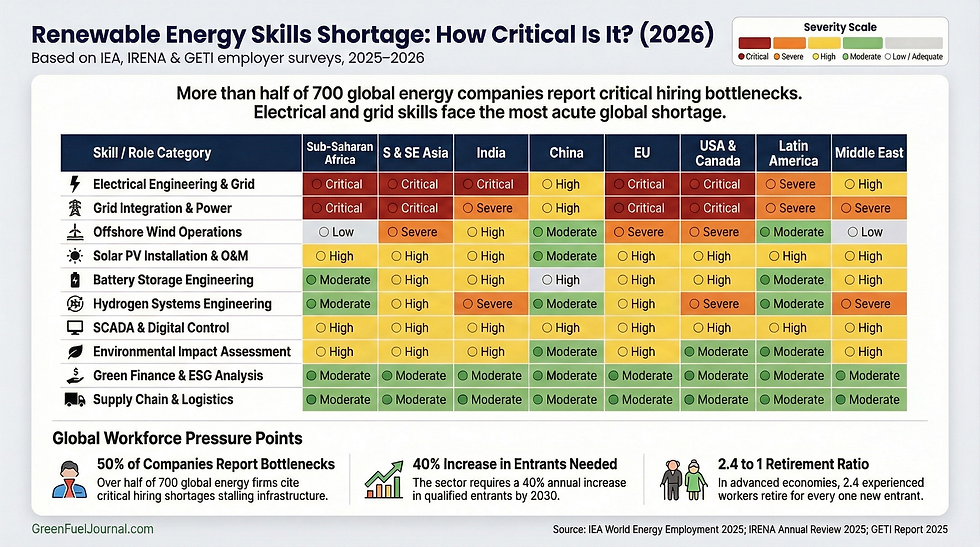
🟩 The renewable energy skills gap refers to the growing mismatch between the technical expertise employers need and what the current labour market supplies. More than half of 700 surveyed energy companies report critical hiring bottlenecks threatening project timelines. Applied technical roles — electricians, grid engineers, plant operators — are in the sharpest shortage. The energy sector needs 40% more qualified entrants annually by 2030 to prevent the gap from widening further.
[Source: IEA World Energy Employment 2025]
The Gap Is Real — And It Is Growing
Let us be direct about something: the skills gap in renewable energy is not a theoretical future risk. It is a present-day operational problem that is slowing project deployment, raising costs, and threatening the pace of the global energy transition.
The IEA's World Energy Employment 2025 report surveyed 700 energy-related companies, unions, and training institutions across the globe. The findings were unambiguous. More than half of respondents reported critical hiring bottlenecks — not minor inconveniences, but structural shortages that are actively delaying infrastructure construction, stalling grid upgrades, and raising the cost of clean energy delivery.
[Source: IEA, World Energy Employment 2025]
This is the same sector that added 5 million jobs between 2019 and 2024. The problem is not that the sector is not hiring — it is that the pipeline of qualified workers is not keeping pace with what the energy transition demands.
To close the gap by 2030, the IEA estimates the world needs to increase the number of newly qualified energy sector entrants by 40% — requiring an additional $2.6 billion per year in training investment globally. That figure sounds large, but compared to the trillions being invested in renewable energy infrastructure, it is remarkably small. The bottleneck is not capital. It is human capacity. [Source: IEA 2025]
Where the Shortages Are Sharpest
Not all skill shortages are equal. The data points to three distinct areas where the gap is most severe:
1. Applied Technical Roles
This is where the crisis is most acute. Electricians, pipefitters, line workers, plant operators, and specialist engineers sit at the heart of every renewable energy project — and they are in critically short supply.
These applied technical occupations have added 2.5 million positions since 2019 and now represent over half of the entire global energy workforce. That is more than double their share of total employment in the broader economy — meaning the energy sector is drawing on a pool of technical talent that is already being competed for by construction, manufacturing, telecoms, and utilities simultaneously.
[Source: IEA World Energy Employment 2025]
In practical terms, this means:
Solar installation projects in India and Southeast Asia are delayed because qualified electricians and safety-certified rooftop workers are not available in sufficient numbers in target regions
Offshore wind farms in the North Sea are recruiting across five or six countries simultaneously because no single nation has enough qualified marine turbine technicians
Grid upgrade projects in the United States — critical to connecting new solar and wind capacity to demand centres — are running months to years behind schedule partly due to shortages of power line workers and substation engineers
2. The Ageing Workforce Crisis
There is a demographic reality sitting beneath these shortages that does not get enough attention.
In advanced economies, the ratio of energy workers nearing retirement to new entrants under the age of 25 stands at 2.4 to 1. For every young person entering the energy workforce, 2.4 experienced workers are approaching the exit.
[Source: IEA 2025]
The situation is even more pronounced in specific sub-sectors. Nuclear-related professions face a retirement-to-new-entrant ratio of 1.7 to 1. Grid-related professions — the backbone of any electrified clean energy system — face a ratio of 1.4 to 1. These are not sectors where institutional knowledge can be quickly replaced.
A substation protection engineer or a grid stability specialist carries decades of system-specific experience that cannot be replicated through a six-week bootcamp.
This demographic pressure is compounding the skills gap in ways that are slow-moving but structurally significant. The problem builds quietly — and then arrives all at once when a large cohort of experienced workers retires within the same five-year window.
3. Digital & Data Skills
The third dimension of the skills gap is arguably the most rapidly evolving. Renewable energy systems are becoming smarter, more interconnected, and more data-dependent every year. A solar farm in 2026 is not just a collection of panels and inverters — it is a networked digital asset that generates continuous performance data, requires predictive maintenance algorithms, and must communicate with grid operators in real time.
The workforce needed to manage these systems is fundamentally different from the workforce that built them. SCADA engineers, data analysts, cybersecurity specialists, AI/ML practitioners, and digital twin modellers are in demand across every advanced energy market — and the supply is severely constrained because these professionals are simultaneously competed for by every technology-intensive industry.
The LinkedIn Global Green Skills Report found that job postings requiring green skills grew at 9% per year between 2018 and 2023, while the supply of workers with those skills grew at only 5% annually — meaning the gap is widening, not closing, even as awareness increases.
[Source: LinkedIn Green Skills Report, cited in Renewable Energy Institute 2025]
Meanwhile, the PwC 2025 Workforce Report found that occupations most exposed to AI are seeing their required skill sets change at a rate 25% faster than other occupations. In energy, this primarily affects grid operations, asset management, and energy trading — areas where AI-driven tools are being adopted rapidly but trained practitioners remain scarce.
What Employers Are Actually Saying
Beyond the macro-level data, employer voices on the ground provide the clearest evidence of where the skills gap creates real-world friction.
The 2025 Global Energy Talent Index (GETI) Report — one of the most comprehensive industry workforce surveys produced annually — revealed several consistent employer concerns:
47% of respondents identified the lack of clear career pathway information as a primary barrier to attracting new talent into the sector
38% called for more accessible, industry-specific training programmes that equip candidates with practical skills before they enter the workforce
35% said that pay and benefits for entry-level positions need to improve to remain competitive with other sectors competing for the same technical profiles
76% of hiring managers expected to increase pay in 2025, driven partly by inflation but also by the competition for scarce talent that the skills gap is intensifying [Source: GETI Report 2025 / Airswift]
One structural barrier the GETI report also highlighted: while 58% of employers now offer cross-regional transfer opportunities — up from 48% in 2022 — the proportion of professionals willing to relocate has fallen sharply, from 85% in 2021 to 73% in 2025. Workers, particularly those with families, are less mobile than they were — making local training and local hiring more important than ever.
[Source: Airswift / GETI 2025]
The Specific Skills Employers Cannot Find
Based on a synthesis of employer surveys, IRENA workforce analyses, and IEA findings, the following skill categories represent the most persistent and severe shortages in 2026:
Skill / Role Category | Shortage Severity | Key Affected Markets |
Electrical engineering & wiring | Critical | Global — especially India, Africa, Southeast Asia |
Grid integration & power systems | Critical | EU, USA, Australia |
Offshore wind marine operations | Severe | UK, Netherlands, Denmark, Taiwan |
Solar PV installation & O&M | High | India, Africa, Latin America |
Battery storage systems engineering | High | USA, EU, South Korea |
Environmental impact assessment | Moderate–High | Emerging markets globally |
Energy data analytics & SCADA | High | All advanced energy markets |
Hydrogen systems engineering | Emerging–Severe | EU, Australia, India |
Project finance & green investment | Moderate | Africa, South Asia |
Supply chain & logistics management | Moderate | Asia-Pacific, North America |
[Source: Compiled from IEA World Energy Employment 2025, IRENA 2025, GETI Report 2025, Renewable Energy Institute 2025]
A Note on Soft Skills
It would be a mistake to frame the skills gap purely in technical terms. Employers across the sector consistently report that communication skills, project coordination ability, safety culture awareness, and cross-cultural collaboration are increasingly important — and often missing — in candidates from both technical and non-technical backgrounds.
Renewable energy projects are inherently multi-disciplinary and multi-stakeholder. A solar project in Rajasthan involves engineers, community liaison officers, environmental assessors, financial analysts, and local government representatives — all working in parallel. The ability to communicate clearly across disciplines is not a nice-to-have. It is a core operational competency — and the sector is beginning to treat it as one.
Why the Skills Gap Matters for Renewable Energy Jobs
🟩 Quick Answer Block (AEO / Featured Snippet) The renewable energy skills gap directly slows clean energy deployment, raises project costs, and delays grid modernisation. When qualified workers are unavailable, solar and wind projects are postponed — pushing back national climate targets. In developing markets, it deepens energy poverty. Without urgent workforce investment, the world risks missing its 2030 tripling of renewable capacity goal set at COP28.
[Source: IRENA, IEA, ILO 2025]
It Is Not Just About Jobs — It Is About the Pace of the Transition
Most conversations about the skills gap focus on workers — who is available, who is not, and what training they need. That framing is correct but incomplete. The skills gap is not just a human resources challenge. It is a climate challenge.
Here is why. Every delayed solar project means more fossil fuel generation running in its place. Every wind farm held up by a shortage of qualified marine technicians means more carbon emitted per megawatt-hour of electricity delivered. Every grid upgrade stalled by a shortage of power line workers means renewable energy that has been generated but cannot reach the consumers who need it.
The IEA has been clear: the pace of the energy transition is now as dependent on workforce readiness as it is on technology costs or policy ambition. Both of those — technology and policy — have improved dramatically in the last decade. Workforce development has not kept pace.
The COP28 global agreement committed the world to tripling renewable energy capacity by 2030 — from approximately 3.4 TW in 2023 to over 11 TW.
Achieving that target requires not just financing and equipment, but an enormous volume of skilled human labour to plan, build, connect, and operate that capacity. The IEA estimates that achieving the tripling goal would require the global clean energy workforce to grow by tens of millions of workers within this decade — far beyond current trajectory.
[Source: IEA World Energy Employment 2025]
The Policy–Workforce–Deployment Triangle
There is a triangular dependency at the heart of every successful renewable energy market: policy creates investment, investment creates projects, and projects require workers. Break any side of that triangle and the whole structure weakens.
Countries that have understood this — and acted on it — show what is possible:
Germany integrated green skills into its dual vocational education system decades ago, combining classroom instruction with paid on-the-job training. This approach helped Germany double its green jobs since 2019.
Even so, the country continues to face staffing shortages in electrical trades and heat pump installation — a reminder that even the best-designed systems can be overwhelmed by rapid deployment scale. [Source: Renewable Energy Institute, June 2025]
Singapore launched its Green Skills Committee — a cross-sectoral body that coordinates curriculum development, industry certification, and funding for workforce reskilling across public and private institutions. The committee ensures that training programmes are directly linked to what employers actually need, rather than what educators assume they need.
India's Skill India Mission — run under the Ministry of Skill Development and Entrepreneurship — has specifically targeted solar installation, LED lighting, biogas plant operation, and energy auditing as priority green skill categories. India's national target of training 10 million green energy workers by 2030 is ambitious, and the gap between ambition and delivery remains wide, but the policy architecture is in place.
South Africa, dealing with one of the world's most severe electricity crises, has accelerated its Renewable Energy Independent Power Producer Procurement Programme (REIPPPP) and paired it with local content requirements that mandate a percentage of project value be sourced from domestic suppliers and workers. This forces skills development to happen alongside deployment, rather than after it.
The Developing Market Challenge
The skills gap hits developing markets hardest — and in the most vicious cycle. These are the countries that most need affordable, reliable electricity to power economic development. They also tend to be the countries with the least developed training infrastructure, the smallest pool of qualified technical workers, and the greatest dependence on external expertise that is expensive and often unavailable.
In Sub-Saharan Africa, companies like BBOXX — which deploys off-grid solar across East and West Africa — report that local technical competency shortages are among their primary barriers to expansion. They cannot scale their operations because they cannot find enough locally trained installation and maintenance technicians. This is not a complaint about local talent — it is a systems failure. The training infrastructure to produce those technicians does not yet exist at the scale required.
In South and Southeast Asia, rapid solar deployment is creating similar pressures. Projects move faster than training programmes. Employers hire what is available, then invest in on-the-job training — which is better than nothing, but slower and less consistent than formal qualification pathways. Safety incidents on poorly supervised installations are a real consequence of this gap.
The ILO has consistently emphasised that closing the skills gap in developing markets is not optional for a just transition — it is definitional. A transition that leaves the Global South without the skilled workforce to participate in clean energy deployment is not just economically inefficient. It is inequitable. [Source: ILO Director-General Gilbert F. Houngbo, January 2026]
How to Close the Skills Gap — Pathways & Certifications
🟩 Closing the renewable energy skills gap requires a combination of vocational training, industry certifications, government-funded upskilling programmes, and fossil fuel worker transition pathways. Key certifications include GWO Basic Safety Training (wind), NABCEP Solar PV Certification (solar), and LEED AP (sustainability systems). Governments, universities, and private employers must partner to build training pipelines that match actual project demand.
[Source: IEA, IRENA, GETI 2025]
Vocational & Technical Training — The Foundation
No amount of university degrees will close the skills gap in renewable energy if the vocational and technical training system is not functioning well. The majority of the jobs that are hardest to fill — electricians, solar installers, wind turbine technicians, plant operators — do not require a four-year degree.
They require structured technical training, hands-on experience, and recognised certification.
The most effective models combine classroom instruction with supervised field work. Germany's dual system is the global benchmark, but it is far from the only model.
In Australia, the Clean Energy Council runs nationally recognised training packages for solar installation and battery system design, mapped directly to employer requirements and updated regularly as technology evolves.
In the United Kingdom, City & Guilds and EAL offer accredited qualifications in renewable energy installation that are widely recognised by employers across the construction and utilities sectors.
In the United States, the Interstate Renewable Energy Council (IREC) has developed the ISPQ (Institute for Sustainable Power Quality) credentialing framework, which sets standards for solar and storage installer training programmes nationwide. Community colleges — particularly in California, Texas, and Colorado — are increasingly offering dedicated renewable energy technology programmes at the associate degree level, providing a two-year pathway into well-paid technical careers.
Key Certifications That Open Doors
For individuals looking to enter or advance within renewable energy jobs, certifications are often the most direct pathway to employment. Here are the most recognised credentials in the sector:
Certification | Sector | Issuing Body | Avg. Salary Impact |
NABCEP Solar PV Installation Professional | Solar PV | North American Board of Certified Energy Practitioners | +$10,000–$20,000/yr |
GWO Basic Safety Training (BST) | Wind Energy | Global Wind Organisation | Entry requirement for most wind roles |
LEED Accredited Professional (AP) | Sustainability Systems | US Green Building Council | Avg. salary $76,000 |
Certified Energy Manager (CEM) | Energy Management | Association of Energy Engineers | Avg. salary $85,000–$110,000 |
ESG Analyst Certification | Finance & Reporting | Various issuers | Avg. salary $95,000 |
IEC 62446 PV System Commissioning | Solar O&M | International Electrotechnical Commission | Widely required in EU markets |
CompTIA Green IT | Digital Energy / IT | CompTIA | Entry-level digital roles |
Project Management Professional (PMP) | Project Management | PMI | $80,000–$130,000 range |
[Source: Compiled from NABCEP, GWO, USGBC, AEE, PMI official certification data and salary surveys 2025]

Industry–Education Partnerships: The Most Scalable Model
Individual training programmes are necessary but not sufficient. The fastest and most cost-effective way to close the skills gap at scale is through structured partnerships between industry, governments, and educational institutions.
Some examples of what this looks like in practice:
Siemens Gamesa — one of the world's largest wind turbine manufacturers — runs apprenticeship programmes in partnership with technical colleges in Spain, Germany, and the United Kingdom, creating a direct pipeline from classroom to wind farm. Graduates are effectively pre-hired before they complete their qualifications.
Suzlon Energy in India partners with Industrial Training Institutes (ITIs) across Rajasthan, Gujarat, and Maharashtra to train local technicians for its wind farm operations. This reduces recruitment costs, builds community goodwill, and creates jobs in the regions where projects are actually located.
In the United States, the Department of Energy's Solar Energy Technologies Office (SETO) funds workforce development programmes that link community colleges with solar industry employers, providing curriculum support, equipment funding, and employment placement assistance.
In Africa, the African Development Bank's Desert to Power initiative includes a skills development component specifically designed to build the technical workforce needed to deploy 10,000 MW of solar capacity across the Sahel region — targeting countries including Niger, Chad, Mali, Ethiopia, and Senegal.
Fossil Fuel Worker Transition — A Ready Talent Pool
One of the most underused resources for closing the renewable energy skills gap is already employed — in the fossil fuel industry.
Workers in coal mining, oil and gas extraction, and thermal power plant operations carry substantial transferable skills. Mechanical aptitude, electrical systems knowledge, rotating equipment experience, safety culture, and remote site logistics expertise are all directly applicable in renewable energy operations — particularly in wind and battery storage.
The evidence supports the transition. Maria Rodriguez's career switch from oil rig maintenance to senior wind technician — profiled earlier — took just 3 months of GWO certification. The US Bureau of Labor Statistics notes that oil and gas extraction employment is projected to decline by 6% over the next decade, and coal mining jobs are at high long-term risk of decline. These workers need a destination. Renewable energy jobs — with comparable pay, familiar technical environments, and growing demand — are that destination.
Effective transition programmes share three characteristics: they start with skills mapping (identifying what a coal miner or offshore driller already knows), they provide targeted upskilling only for the gap (not a full retraining from scratch), and they offer income support during the transition period so workers do not have to choose between retraining and paying their bills.
Scotland's Just Transition Commission has produced one of the most detailed policy frameworks for fossil fuel worker transition in the context of North Sea oil and gas decommissioning and offshore wind expansion. It is increasingly referenced as a model for other jurisdictions managing similar industrial transitions.
Future Outlook: Renewable Energy Jobs by 2030 & 2050
🟩 Quick Answer Block (AEO / Featured Snippet) Global renewable energy jobs are projected to exceed 30 million by 2030 — nearly doubling from 16.6 million in 2024 — as countries accelerate net-zero commitments. By 2050, the ILO projects 100+ million green jobs across the full clean economy. Solar PV and wind energy will drive the bulk of near-term growth, while green hydrogen, battery storage, and smart grid roles will define the post-2030 job market.
[Source: IRENA, IEA, ILO 2025–2026]
The Road to 30 Million Jobs by 2030
The trajectory for renewable energy employment between now and 2030 is steep — but achievable, provided the workforce development investments happen in parallel with deployment.
IRENA's modelling under its 1.5°C Pathway scenario projects global renewable energy jobs reaching over 30 million by 2030 — a near doubling of the 16.6 million employed in 2024. That means the sector needs to create, on average, roughly 2 to 3 million new jobs every year for the remainder of this decade. [Source: IRENA World Energy Transitions Outlook]
For context, the sector added approximately 400,000 net new jobs in 2024 — growing at 2.3%. To hit 30 million by 2030, it needs to average growth more than four times that rate annually over the next six years. This is why workforce development is not a background concern — it is the central constraint on whether climate targets are met.
The growth will not be evenly distributed:
Sector | Estimated Jobs (2024) | Projected Jobs (2030) | Growth |
Solar PV | 7.3 million | 14–16 million | ~100% |
Wind Energy | 1.9 million | 4–5 million | ~150% |
Green Hydrogen | < 0.1 million | 1.5–2 million | Exponential |
Battery Storage | < 0.5 million | 2–3 million | Exponential |
Bioenergy | 2.6 million | 3.2 million | ~23% |
Hydropower | 2.3 million | 2.5 million | ~9% |
Smart Grid / Digital | < 0.3 million | 1–2 million | Exponential |
Total Renewables | 16.6 million | ~30+ million | ~80% |
[Source: IRENA World Energy Transitions Outlook; IEA World Energy Employment 2025; author projections based on published scenarios]

What 2050 Looks Like
The 2030 projections are ambitious. The 2050 picture is transformational.
Under a net-zero by 2050 scenario — modelled by both IRENA and the IEA — the global clean energy economy could sustain more than 100 million jobs when the full scope of the green economy is included.
This covers not just renewable power generation, but also energy efficiency retrofitting, electric mobility, green hydrogen production and distribution, sustainable agriculture, circular economy manufacturing, and climate adaptation infrastructure.
Within the renewable energy sector specifically, IRENA projects that annual renewable energy capacity additions by 2050 will need to be three to five times current levels to maintain a net-zero pathway. That sustained deployment level implies a permanent, large, and continuously upskilling workforce — not a construction boom followed by a plateau.
Three structural shifts will define what the 2050 renewable energy workforce looks like:
Shift 1 — From Construction-Heavy to O&M-Heavy As the installed base of solar panels and wind turbines grows, the balance of employment will shift from installation-dominated to operations and maintenance (O&M)-dominated.
A 25-year-old solar farm needs different workers than a new one. Predictive maintenance engineers, digital performance analysts, and component replacement specialists will become the largest occupational categories.
This is already happening in Europe and parts of North America, where large solar installations commissioned in the early 2010s are now entering mid-life maintenance phases.
Shift 2 — AI and Automation Reshape Roles, Not Replace Them One of the most common concerns about the future of renewable energy jobs is whether automation will eliminate them. The evidence suggests a more nuanced outcome. Automation is replacing specific tasks within jobs — not entire jobs.
A wind turbine technician who previously spent 20% of their time manually reviewing performance logs now has that task handled by an AI-driven monitoring system. But the same technician now spends that freed time on more complex fault diagnosis and predictive interventions that AI cannot yet handle independently.
The PwC 2025 Global Workforce Report found that in energy occupations most exposed to AI, required skill sets are evolving at a 25% faster rate than in less-exposed roles. Workers who embrace continuous learning — treating their career as an ongoing upskilling journey — will find AI to be an amplifier of their capabilities rather than a threat to their employment. Those who do not may find their specific task sets diminishing over time.
Shift 3 — Geography of Jobs Diversifies Today, China accounts for 44% of all renewable energy jobs. By 2050, that concentration is projected to moderate as more countries build domestic manufacturing capacity, driven by industrial policy, supply chain resilience concerns, and the local content requirements increasingly embedded in national renewable energy programmes.
India, Southeast Asia, Africa, Latin America, and the Middle East are all expected to grow their share of global renewable employment significantly over this period.
This geographic diversification is not automatic. It requires deliberate investment in workforce development, manufacturing capacity, and policy frameworks in each of those regions. The countries that invest in those foundations now will capture a disproportionate share of the 2050 job market.
Hottest Renewable Energy Roles in Demand — Skills & Salary Insights
🟩 The most in-demand renewable energy jobs in 2026 include Solar PV Installers ($42K–$65K), Wind Turbine Technicians ($57K–$80K+), Battery Storage Engineers ($85K–$120K), Grid Integration Specialists ($90K–$130K), Hydrogen Systems Engineers ($95K–$140K), and Renewable Energy Project Managers ($80K–$130K). Roles combining technical expertise with digital skills command the highest salaries and face the sharpest shortages.
[Source: US BLS, GETI 2025, industry salary surveys]
The Roles Employers Are Fighting Over
Some renewable energy jobs are straightforward to fill. Others are creating genuine bidding wars between employers across multiple countries. The table below maps the hottest roles in 2026 against the skills they require, the salary ranges available, and the trajectory through 2030:
Role | Key Technical Skills | Key Soft Skills | Salary Range (USD) | 2030 Outlook |
Solar PV Installer | Electrical wiring, panel mounting, inverter setup | Safety awareness, physical fitness | $42,000–$65,000 | Strong growth |
Wind Turbine Technician | Mechanical systems, hydraulics, GWO certified | Problem-solving at height, remote work | $57,000–$80,000+ | Very strong growth |
Battery Storage Engineer | Electrochemistry, BMS systems, grid interface | Analytical thinking, documentation | $85,000–$120,000 | Explosive growth |
Grid Integration Specialist | Power systems, SCADA, load flow analysis | Systems thinking, cross-team collaboration | $90,000–$130,000 | Critical demand |
Hydrogen Systems Engineer | Electrolyser tech, pressure systems, fuel cells | Innovation mindset, safety culture | $95,000–$140,000 | Emerging, high growth |
SCADA / Control Systems Engineer | PLC programming, real-time data, cybersecurity | Attention to detail, rapid response | $85,000–$120,000 | High demand |
Renewable Energy Project Manager | Permitting, procurement, contract management | Leadership, stakeholder communication | $80,000–$130,000 | Consistent demand |
Energy Data Analyst | Python/R, data visualisation, ML basics | Curiosity, business communication | $65,000–$100,000 | Rising rapidly |
Environmental Impact Assessor | Ecology, GIS, regulatory frameworks | Report writing, community engagement | $60,000–$90,000 | Steady demand |
Green Finance Analyst | ESG reporting, carbon accounting, project finance | Financial modelling, client communication | $80,000–$120,000 | Growing strongly |
Offshore Wind Marine Technician | Subsea systems, marine safety, turbine O&M | Risk management, team resilience | $70,000–$100,000 | Severe shortage |
[Source: US BLS Occupational Outlook Handbook 2025; GETI Report 2025; Solartechonline Career Guide 2025; industry salary data]
The Skills Mix That Commands the Highest Pay
Across the salary data, one pattern stands out with remarkable consistency: the roles that pay the most are those where deep technical knowledge meets digital fluency.
A wind turbine technician who can also analyse SCADA performance data and programme basic predictive maintenance alerts earns substantially more than one who cannot. A solar project manager who understands both the engineering side and the financial modelling of a project's IRR has a salary ceiling that is far higher than a specialist in only one discipline.
Green skills — defined as technical and conceptual capabilities that directly support environmental sustainability — command a 15–25% salary premium over comparable roles without that specialisation, according to research compiled by The Interview Guys citing McKinsey consumer and workforce data from 2025. That premium is being driven by scarcity. When supply is low and demand is high, compensation rises.
[Source: The Interview Guys / McKinsey 2025]
The practical implication for career planning is clear: the workers who will thrive most in the 2026–2030 renewable energy job market are those who invest in T-shaped skill profiles — deep in one technical discipline, broad across adjacent digital, communication, and project management competencies.
FAQs — Renewable Energy Jobs: Direct Answers to Top Questions
Q: What skills do I need for renewable energy jobs?
A: The skills you need depend on the role, but there are common threads. Technical skills — electrical systems, mechanical knowledge, data analysis, or engineering fundamentals — form the foundation for most positions. Digital skills — familiarity with SCADA systems, energy monitoring software, and basic data tools — are increasingly expected even in field roles. Soft skills — clear communication, safety awareness, teamwork, and the ability to work in remote or offshore environments — are consistently flagged by employers as essential.
Entry-level roles such as solar installer or wind turbine trainee can be accessed with a vocational qualification and a recognised certification like GWO Basic Safety Training or NABCEP. Senior roles in engineering, project development, or green finance typically require a bachelor's degree or higher, plus several years of relevant experience.
Q: Are renewable energy jobs growing faster than other sectors?
A: Yes — significantly faster. Wind turbine technicians are projected to grow 60% in the United States between 2023 and 2033, and solar PV installers are projected to grow 27% over the same period — both far above the national average for all occupations.
[Source: US BLS]
Globally, the ILO projects that the clean energy transition will create 24 million new jobs by 2030. Even accounting for fossil fuel job losses in the same period, the net employment gain from the energy transition is projected to be strongly positive.
Q: Which renewable energy careers pay the most?
A: The highest-paying roles in renewable energy in 2026 are those that combine deep technical expertise with digital or management skills.
Hydrogen Systems Engineers earn $95,000–$140,000 annually.
Grid Integration Specialists earn $90,000–$130,000.
Battery Storage Engineers and SCADA Engineers typically earn $85,000–$120,000.
Senior management roles — project directors, chief sustainability officers, VP-level positions — can command $150,000–$200,000+.
Geographically, California pays the highest premiums in the US (20–30% above national averages), while offshore wind roles in the UK and Nordic countries also carry significant salary uplifts.
Q: Can I switch from fossil fuel jobs into renewable energy roles?
A: Yes — and you may have more transferable skills than you realise. Workers from oil and gas, coal mining, and thermal power plant operations carry mechanical knowledge, electrical systems experience, safety culture awareness, and remote site logistics skills that directly apply in renewable energy. Wind turbine technician roles are particularly well-suited to offshore oil and gas workers.
The switch typically requires targeted upskilling — a GWO Basic Safety Training certification, for example — rather than a complete career restart. Scotland's Just Transition Commission and similar initiatives in Australia, the US, and Canada have produced formal programmes and financial support specifically for this workforce segment.
Q: How do I prepare for renewable energy jobs?
A: Start by identifying which part of the renewable energy value chain interests you — installation, engineering, project management, finance, policy, or digital systems. Then map the qualifications and certifications most valued in that area. For technical field roles, pursue a relevant vocational qualification and obtain recognised certifications (GWO, NABCEP, or equivalent).
For engineering roles, ensure your degree includes power systems, electrical engineering, or mechanical engineering coursework, and seek internships with renewable energy developers or utilities.
For policy and finance roles, build your understanding of energy markets, carbon accounting, and ESG frameworks through postgraduate study or professional certifications like CEM or LEED AP. Joining professional associations — Solar Power International, the American Wind Energy Association (AWEA), or the Global Wind Organisation network — provides networking, mentorship, and job placement support.
Q: Is there a shortage of renewable energy workers?
A: Yes — and it is significant. The IEA's World Energy Employment 2025 report found that more than half of 700 surveyed energy companies reported critical hiring bottlenecks. Applied technical roles — electricians, grid engineers, offshore wind technicians, and plant operators — face the sharpest shortages globally.
The LinkedIn Global Green Skills Report found that demand for green skills is growing at 9% per year while supply grows at only 5% — meaning the gap is widening. In the UK alone, 200,000 additional workers will be needed by 2030 to meet clean energy targets. The shortage is real, persistent, and consequential for the pace of the global energy transition.
Q: Can electrical engineers transition to wind or solar jobs?
A: Absolutely — and they are among the most sought-after candidates in the sector.
Electrical engineers have a skill set that maps directly onto renewable energy needs: power systems analysis, grid connection design, inverter and transformer knowledge, and electrical safety expertise are core competencies for both solar PV system design and wind farm electrical balance-of-plant roles.
Most electrical engineers transitioning into renewables report needing only technology-specific upskilling — understanding of PV system architecture or wind turbine generator characteristics — rather than fundamental retraining.
Many employers offer structured onboarding for engineers coming from conventional power or industrial backgrounds. Salary uplift is also common, given the scarcity of qualified electrical engineers with renewables experience.
References & Citations
This article is backed by authoritative sources and primary research. All data points, statistics, and quotes have been verified against the original publications listed below. Readers are encouraged to consult these sources directly for full methodology and extended analysis.
IRENA & ILO (January 2026) — Renewable Energy and Jobs: Annual Review 2025 — International Renewable Energy Agency, Abu Dhabi; International Labour Organization, Geneva. 🔗 https://www.irena.org/Publications/2026/Jan/Renewable-energy-and-jobs-Annual-review-2025
IRENA Press Release (January 2026) — Renewables Jobs See First Slowdown Amid Global Deployment Growth — International Renewable Energy Agency. 🔗 https://www.irena.org/News/pressreleases/2026/Jan/Renewables-Jobs-See-First-Slowdown-Amid-Global-Deployment-Growth
IEA (2025) — World Energy Employment 2025 — International Energy Agency, Paris. 🔗 https://www.iea.org/news/energy-employment-has-surged-but-growing-skills-shortages-threaten-future-momentum
IRENA & ILO (October 2024) — Renewable Energy and Jobs: Annual Review 2024 — International Renewable Energy Agency; International Labour Organization. 🔗 https://www.irena.org/News/pressreleases/2024/Oct/Highest-Annual-Growth-of-Renewables-Jobs-in-2023-Reaching-16-point-2-Million
World Resources Institute (November 2025) — 5 Insights on the State of US Clean Energy Jobs — Daksh Goyal, Willy Carlsen, Devashree Saha. 🔗 https://www.wri.org/insights/clean-energy-jobs-us-report-findings
Renewable Energy Institute (June 2025) — Closing the Green Skills Gap: Empowering the Next Generation of Renewable Energy Professionals. 🔗 https://www.renewableinstitute.org/closing-the-green-skills-gap-empowering-the-next-generation-of-renewable-energy-professionals/
Airswift / Global Energy Talent Index — GETI Report (2025) — Renewable Energy Employment Trends 2025. 🔗 https://www.airswift.com/blog/renewable-energy-employment-trends
US Bureau of Labor Statistics (BLS) — Occupational Outlook Handbook: Wind Turbine Technicians; Solar Photovoltaic Installers — US Department of Labor. 🔗 https://www.bls.gov/ooh/installation-maintenance-and-repair/wind-turbine-technicians.htm 🔗 https://www.bls.gov/ooh/construction-and-extraction/solar-photovoltaic-installers.htm
Armstrong Appointments (February 2026) — Green Jobs in Renewable Energy: 2026 Update. 🔗 https://www.armstrongappointments.com/sustainability-and-green-jobs-in-the-renewable-energy-sector-2026-update/
Globalbioenergy.org (September 2025) — Renewable Energy Hiring Trends in 2025 and Beyond: What Job Seekers & Employers Need to Know. 🔗 https://www.globalbioenergy.org/renewable-energy-hiring-trends/
JD Ross Energy (2025) — What Can 2025 Tell Us About the Leading Trends in the Renewable Energy Job Market? 🔗 https://www.jdrossenergy.com/news-blogs-and-social/what-can-2025-so-far-tell-us-about-the-leading-trends-in-renewable-energy-job-market
Solartechonline (December 2025) — Renewable Energy Careers Guide 2025: Jobs, Salaries & How To Start. 🔗 https://solartechonline.com/blog/renewable-energy-careers-guide-2025/
IRENA — Renewable Energy Employment by Country Dashboard — Interactive data tool. 🔗 https://www.irena.org/Data/View-data-by-topic/Benefits/Renewable-Energy-Employment-by-Country
LinkedIn Global Green Skills Report (2023–2025) — The State of Green Skills in the Global Workforce. 🔗 https://economicgraph.linkedin.com/research/green-skills-report
PwC (2025) — Global Workforce Hopes and Fears Survey 2025 — PricewaterhouseCoopers. 🔗 https://www.pwc.com/gx/en/issues/workforce/hopes-and-fears.html
ILO Director-General Gilbert F. Houngbo — Statement on Just Transition and Disability Inclusion, IRENA/ILO Joint Press Release, January 2026. 🔗 https://www.irena.org/News/pressreleases/2026/Jan/Renewables-Jobs-See-First-Slowdown-Amid-Global-Deployment-Growth
Green Fuel Journal — Solar & Renewable Energy Hub; Green Hydrogen Hub; Policy & Market Analysis Hub. 🔗 https://www.greenfueljournal.com
Disclaimer:
The information presented in this article is compiled from publicly available reports, institutional publications, and verified industry data as of February 2026. Salary figures, job projections, and employment statistics are indicative and may vary by country, employer, and market conditions. This article does not constitute financial, career, or investment advice. Readers should consult qualified professionals and primary sources before making any career or business decisions.
Green Fuel Journal makes every effort to ensure accuracy but cannot guarantee the completeness of third-party data cited herein.
© 2026 Green Fuel Journal | www.greenfueljournal.com | All Rights Reserved Research Team Article


