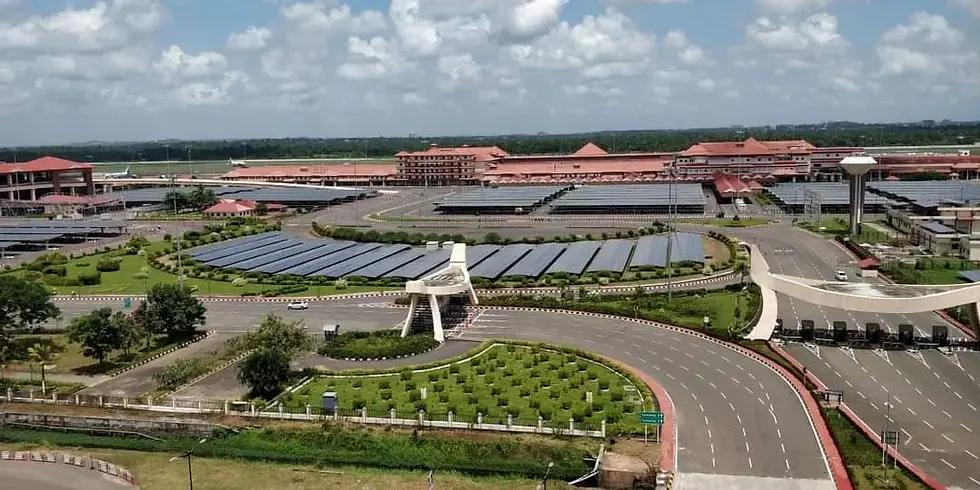
Khavda Solar Park and the Rise of India's Renewable Industrial Operating System

Executive Intelligence Synthesis of Khavda Solar Park
Khavda Solar Park has commissioned 9.4 GW of installed capacity and 3.37 GWh of operational battery storage by FY26, making it India's most advanced renewable delivery at scale. Planned at 30 GW across 538 square kilometres of Gujarat's Kutch region, it functions as an integrated renewable-industrial operating system — combining generation, dispatchable storage, transmission infrastructure, and future industrial demand linkages at a single site. With a further ₹15,000 crore committed for 10 GWh of additional BESS in FY27, Khavda is the primary live test case for India's 500 GW non-fossil strategy.

Khavda Solar Park has delivered more commissioned capacity than any comparable integrated renewable development in India. As of FY26, Adani Green Energy has commissioned 9.4 GW at the site — placing it among the highest-capacity operational renewable parks on earth — and has simultaneously deployed 3.37 GWh of battery storage, described by Economic Times Energy as the world's largest battery storage project at the time of its commissioning, whilst committing a further ₹15,000 crore to add 10 GWh of additional BESS capacity in FY27. Storage at this scale changes the project's character entirely: it becomes a dispatchable asset, not a weather-dependent one.
Five executive signals define Khavda's strategic significance for industrial and investment decision-makers.
Signal 01
Renewable Infrastructure at Industrial Scale
At 30 GW planned capacity across 72,400+ hectares, Khavda occupies an area 5 times the size of Paris. This is not incremental deployment — it is infrastructure-class commitment requiring industrial-grade supply chain, transmission, and project management capability.
Signal 02
Storage Is Now Core Infrastructure
The commissioning of 3.37 GWh of operational BESS and a ₹15,000 crore plan for 10 GWh more establishes that storage is no longer optional at giga-scale renewable sites. It is the mechanism that converts intermittent generation into grid-reliable, contractually dispatchable supply.
Signal 03
Transmission Will Determine Success
The Indian government has raised the equity ceiling per Power Grid Corporation subsidiary from ₹5,000 crore to ₹7,500 crore to accelerate evacuation infrastructure — an explicit acknowledgement that the transmission gap is already constraining active renewable deployments.
Signal 04
Gujarat as India's Renewable Manufacturing Hub
Gujarat combines high solar irradiation, coastal industrial access, PLI-driven module manufacturing, and developing green hydrogen corridors. Khavda anchors a broader industrial-energy geography that extends well beyond the park boundary.
Signal 05
Khavda as a Blueprint for Future RE Corridors
Full 30 GW delivery by 2029 with integrated storage and evacuation would establish Khavda as the operational template for India's next generation of renewable corridors in Rajasthan, Andhra Pradesh, and Tamil Nadu — directly shaping India's path toward its 500 GW non-fossil target.
Transmission inadequacy — not technology — is the single greatest systemic risk. Renewable generation capacity is being commissioned faster than transmission capacity can be built. India's distribution companies carry structural financial weakness that limits their ability to absorb new contracted power volumes. These are present-day frictions visible in comparable projects across Western India. Khavda's success depends on resolving them, not outbuilding them.


Section 02
Macro Context & Strategic Drivers
India's push toward giga-scale renewable infrastructure is driven by four converging forces: a legally committed domestic target of 500 GW non-fossil power by 2030, rising export exposure to the EU's Carbon Border Adjustment Mechanism, intensifying geopolitical competition for clean energy supply chain dominance, and the structural cost collapse of utility-scale solar and storage. Khavda directly addresses all four. It functions simultaneously as a domestic energy-security asset, an industrial competitiveness hedge against EU carbon tariffs, and a manufacturing localisation anchor for India's PLI-driven solar module industry.

The Global Race for Renewable Infrastructure Dominance
Renewable deployment at giga-scale has become a matter of national industrial strategy, not energy planning alone. China dominates global solar module manufacturing, supplying the majority of the world's PV modules — a supply chain concentration that India's PLI scheme and Khavda's captive procurement are directly designed to counter. India's response — anchored by sites like Khavda — is to build generation capacity and manufacturing depth simultaneously, rather than depend on imported equipment or capital. India's utility-scale solar strategy is framed as economic sovereignty, not environmental aspiration.
Project / Programme | Country | Scale | Technology | Status (2026) |
Khavda Renewable Energy Park | India | 30 GW planned | Solar + Wind + BESS | 9.4 GW operational |
Bhadla Solar Park | India | 2.245 GW | Solar PV | Operational |
IRA-backed Solar Portfolio | USA | Multiple GW-scale sites | Solar + Storage | Buildout phase |
Source: Adani Green Energy | GFJ Research | Green Fuel Journal Research Division
India's 500 GW Non-Fossil Strategy
India's commitment to 500 GW of non-fossil fuel installed electricity capacity by 2030 — affirmed by the Ministry of Power on 18 September 2023 — is a hard policy target. The country crossed 203.18 GW of renewable capacity in 2024, with the Ministry of New and Renewable Energy (MNRE) confirming that India derives over 53% of cumulative installed power capacity from non-fossil sources as of 2026.
Closing the gap to 500 GW requires India to more than double its renewable base in under five years. Khavda, at 30 GW planned, represents 6% of the entire national target within a single project footprint.
MNRE Secretary Santosh Kumar Sarangi indicated in January 2026 that India may raise the 500 GW target further, reflecting both political confidence and accelerating deployment momentum.
"India may raise its target of 500 GW non-fossil fuel power capacity by 2030."
— Santosh Kumar Sarangi, Secretary, Ministry of New and Renewable Energy (January 2026, S&P Global Platts)
CBAM, Industrial Decarbonisation, and Export Pressures
The European Union's Carbon Border Adjustment Mechanism (CBAM) — with full carbon pricing operational from 2026 and free allowance phase-out completing by 2034 — applies tariffs on carbon-intensive imports including steel, aluminium, fertiliser, and chemicals specific CBAM dates at ec.europa.eu before publication. India's exporters in these sectors carry direct financial exposure. The most durable commercial response is to decarbonise electricity supply — which requires large-scale, dispatchable renewable power of precisely the character Khavda is designed to deliver.
India's industrial decarbonisation pathways are becoming commercially urgent: exporters dependent on carbon-intensive grid power face competitive disadvantage in European markets within the decade.
Geopolitics of Renewable Supply Chains
India's solar module industry has historically relied on Chinese imports for cells and wafers. The PLI Scheme for solar PV modules targets domestic manufacturing capacity expansion to reduce this dependency. Khavda's buildout creates captive procurement demand for domestically manufactured modules, which directly justifies PLI-supported factory investment. A project requiring 30 GW of module procurement cannot maintain strategic coherence if its supply chain runs through a geopolitically contested source.
Why Gujarat Became the Strategic Epicentre
Gujarat's positioning as India's primary renewable corridor reflects structural geographic and industrial advantages, not policy preference alone. The state combines high solar irradiation in its northern Kutch region, existing coastal port infrastructure for industrial supply chains, state government policy support, and proximity to proposed green hydrogen export corridors. Kutch specifically offers flat, low-value land at scale — a precondition for any project targeting 72,400+ hectares. These advantages are not replicable in most Indian states at comparable cost or speed.
Section 03
India-Specific Analysis
India crossed 203.18 GW of renewable capacity in 2024 and now derives over 53% of its installed power capacity from non-fossil sources, per MNRE data. Khavda's 30 GW target accounts for 6% of the national 500 GW goal. The project is the single site where five policy instruments converge simultaneously: MNRE deployment mandates, Ministry of Power grid planning, Green Energy Corridor transmission investment, PLI-driven module manufacturing, and a national BESS market expected to grow 10-fold — from 507 MWh to 5 GWh — within 2026 alone.

MNRE, Ministry of Power, and CEA Alignment
Three central institutions govern the regulatory and infrastructure environment in which Khavda operates. The Ministry of New and Renewable Energy (MNRE) sets national deployment targets and manages the framework under which projects like Khavda receive policy support — including India's 500 GW non-fossil capacity ambition. The Ministry of Power oversees grid integration and interstate transmission planning. The Central Electricity Authority (CEA) coordinates capacity planning and transmission at the national level.
The Green Energy Corridor Programme — specifically designed to evacuate renewable power from high-generation states like Gujarat and Rajasthan — represents a capital commitment to the transmission infrastructure that Khavda requires. Without CEA-coordinated transmission planning that keeps pace with MNRE deployment timelines, generation capacity runs ahead of grid absorption capacity. This sequencing risk is the central policy execution challenge of the 500 GW programme, and Khavda is its most visible test case.
Gujarat's Renewable-Industrial Corridor Strategy
Gujarat is constructing the structural conditions for a renewable-industrial corridor extending well beyond electricity generation. The state's coastal geography enables port-based industrial development aligned with green hydrogen export infrastructure. Its existing petrochemical and manufacturing base creates demand for decarbonised electricity. The Kutch region specifically — where Khavda is sited — has land availability at scale that is structurally unavailable in more densely populated Indian states.
The corridor logic is self-reinforcing: cheap renewable electricity from Khavda powers manufacturing; manufacturing demand justifies PLI-supported module factories; those factories reduce import dependency and lower project costs for future renewable builds. The cycle holds — provided transmission and storage infrastructure are built to support it.
PLI Schemes and Manufacturing Localisation
India's Production-Linked Incentive (PLI) Scheme for solar PV modules is a direct mechanism to reduce China-dependency in India's renewable supply chain. The scheme has driven domestic module manufacturing capacity expansion. Khavda's buildout — requiring module procurement at 30 GW scale — creates the most significant single source of captive demand for domestically manufactured solar equipment in India's history.
PLI-supported factories require assured procurement volumes to justify capacity investment; a project the scale of Khavda provides precisely that assurance. The connection between Khavda's buildout timeline and India's domestic manufacturing ambitions is direct, not incidental.
Transmission Infrastructure and Grid Expansion
The Government of India raised the equity threshold per Power Grid Corporation of India subsidiary from ₹5,000 crore to ₹7,500 crore in February 2026, specifically to accelerate renewable evacuation infrastructure investment — a targeted financing measure responding to a recognised bottleneck. India's interstate transmission grid has not kept pace with renewable capacity addition rates. Renewable transmission infrastructure is the binding constraint on India's clean energy programme.
For Khavda, this constraint is acute. The park sits in Kutch — geographically remote from India's major industrial demand centres. Moving 30 GW of power to load centres requires HVDC transmission lines and significant substation investment that must be commissioned before, not after, generation capacity reaches full scale. Delays in transmission commissioning translate directly to curtailment — generation that cannot be delivered and revenue that cannot be realised.
India's BESS Market Expansion
India's battery energy storage market is in its most significant growth phase to date. National BESS deployment is expected to increase from 507 MWh in 2025 to 5 GWh in 2026 — a 10-fold jump within a single year (Economic Times, January 2026). Khavda's 3.37 GWh operational BESS commissioning on 26 May 2026 marks a structural inflection: it demonstrates that grid-scale storage is operationally viable in Indian conditions and commercially justifiable at the scale giga-projects demand.
Adani Green Energy's commitment to invest a further ₹15,000 crore to add 10 GWh of BESS in FY27 will shape India's overall storage market structure. BESS policy support under MNRE storage tenders will determine how quickly the cost curve falls for subsequent projects.
DISCOM Constraints and Renewable Market Risks
India's distribution companies (DISCOMs) represent the most structurally fragile link in the renewable energy delivery chain. Several state DISCOMs carry significant accumulated financial losses that constrain their ability to honour power purchase agreements or procure new renewable power at contracted volumes. Several major state DISCOMs have historically shown financial stress leading to delayed payments, PPA renegotiation pressure, and curtailment of renewable generation during low-demand periods specific state DISCOM financial health rankings at Ministry of Power PRAAPTI portal before citing individual states.
As Khavda scales toward 30 GW, the power purchase and distribution infrastructure required to absorb and monetise that generation volume will depend on the financial health of counterparty utilities — a risk that grows proportionally with project scale. This is not a Gujarat-specific problem; it is a systemic market-structure risk that every giga-scale renewable project in India faces, and Khavda confronts it at greater magnitude than any before it.
Section 04
Operational & Technical Deep-Dive
Khavda's 9.4 GW operational capacity combines solar PV and wind generation across 538 square kilometres, supported by a 3.37 GWh BESS system that converts intermittent generation into dispatchable firmed power. A further 10 GWh of BESS is planned for FY27. Transmission synchronisation — moving power from the remote Kutch site to load centres — remains the primary operational constraint. At full build-out, Khavda is projected to generate approximately 81 billion units of electricity annually, sufficient to power more than 16 million homes.
Solar-Wind Hybrid Infrastructure Design
Temporal complementarity between solar and wind generation is the operational rationale for Khavda's hybrid design. Solar generation peaks during midday hours. Wind resources in Gujarat's Kutch region tend to be stronger in early morning and evening periods. This complementarity increases the combined system's capacity utilisation factor relative to either technology deployed in isolation, producing a more consistent generation profile across the day — which directly reduces the storage requirement needed to firm supply to a dispatchable standard.
Land management at 538 square kilometres is itself a significant engineering challenge. The site requires coordinated layout planning to optimise wind turbine spacing, prevent shading of solar arrays, and maintain access for maintenance at scale. Power collection networks, monitoring infrastructure, and access roads across this footprint represent a capital and operational complexity independent of the generation equipment they support.
Battery Storage Economics and Dispatch Logic
The commissioning of 3.37 GWh of BESS at Khavda on 26 May 2026 converts what would otherwise be intermittent generation into a contractually dispatchable product. This fundamentally changes the revenue model. Intermittent solar commands lower tariffs and faces curtailment risk during oversupply periods. Dispatchable firmed renewable power — backed by storage — commands premium tariffs and qualifies for capacity payment mechanisms under CERC regulatory frameworks.
The economics of long-duration energy storage at Khavda are driven by three revenue streams: peak-shifting, which captures tariff arbitrage between midday surplus and evening peak demand; ancillary services provision to the grid operator, including frequency regulation; and capacity payments under firmed renewable power purchase agreements. Adani Green's ₹15,000 crore FY27 BESS investment signals that internal modelling supports positive returns across these streams at this scale.
Transmission Synchronisation Challenges
Khavda's operational ceiling is set not by generation capacity but by the transmission capacity available to evacuate that generation. The park's remote position in Gujarat's Kutch district requires dedicated HVDC infrastructure capable of carrying multi-gigawatt power flows over hundreds of kilometres with acceptable transmission losses.
If 9.4 GW of generation is operational but transmission can only absorb 6 GW, the remainder is either curtailed or stored — neither of which delivers the contracted revenue that justifies the capital investment. Power Grid Corporation's equity threshold increase to ₹7,500 crore per subsidiary is official recognition of this gap. Transmission investment acceleration is a necessary condition for Khavda achieving its targeted generation economics.
Curtailment and Grid Stability Risks
Solar curtailment is a structural risk at giga-scale renewable sites where generation periodically exceeds grid absorption capacity. During low-demand periods — weekends, nights, and off-peak seasons — a site operating at 30 GW nameplate capacity generates power at rates the grid cannot always consume. Without sufficient storage or demand flexibility, curtailment is the operational outcome: revenue is destroyed, the asset's effective capacity factor falls, and the financial model underpinning debt service is undermined.
Grid stability in Western India is further challenged by high renewable penetration across Gujarat and Rajasthan simultaneously. As multiple large parks commission in adjacent regions, coordinated grid management becomes critical. The Central Electricity Authority's capacity planning mandate covers these aggregate integration risks — but deployment pace is currently straining existing grid management frameworks.
Land, Water, and Environmental Constraints
Water scarcity is an operational constraint, not a peripheral concern. Kutch is an arid, semi-desert region. Solar panel cleaning — essential for maintaining generation efficiency in dusty desert conditions — requires water that is structurally scarce in the area. At 72,400+ hectares of panel area, cleaning frequency and methodology carry material operational cost and environmental implications. Dry-cleaning and robotic technologies reduce water dependency but add capital cost. Environmental assessments of ground-mounted solar at this scale require ongoing monitoring of impacts on local flora, grazing land use, and community land rights — documented concerns at comparable Indian solar parks.
Infrastructure Scaling Complexity
Advancing from 9.4 GW operational to 30 GW by 2029 requires commissioning approximately 20.6 GW of additional capacity over roughly three years — an average installation rate exceeding 6 GW per year. No Indian project has sustained this tempo. Labour challenges documented at Khavda — including reports of delayed wages and extreme-heat working conditions (The Guardian, September 2025) — represent execution risks that translate directly into commissioning delays and revenue shortfalls at this installation pace.
Section 05
Named Company Case Studies
Four companies define Khavda's operational and infrastructure ecosystem. Adani Green Energy is the project developer, with 9.4 GW commissioned and a ₹31,000 crore FY26 capex commitment. Power Grid Corporation of India is building the transmission backbone, with a raised subsidiary equity ceiling of ₹7,500 crore. NTPC Limited holds allocated land within the Khavda ecosystem for renewable participation. Gujarat Industries Power Company Limited contributes state-linked renewable capacity. Their combined involvement reveals the multi-party architecture that 30 GW of integrated renewable infrastructure demands.
Adani Green Energy — 30 GW Renewable Buildout
Adani Green Energy (AGEL) is the primary developer, financier, and operator of Khavda, backed by capital commitments that place it among the most significant private renewable programmes in India. AGEL commissioned 9.4 GW of installed capacity at Khavda by FY26, delivering on its publicly stated 5 GW annual addition commitment. Its FY26 clean-energy capital expenditure reached ₹31,000 crore — approximately $3.64 billion — across its portfolio.
The BESS commitment is the most strategically revealing dimension of AGEL's Khavda position. The company commissioned 3.37 GWh of battery storage at Khavda on 26 May 2026 — and immediately committed a further ₹15,000 crore to add 10 GWh in FY27. This sequencing — generation first, storage second at scale — reflects a business model transitioning from intermittent-power tariffs to dispatchable-power premium pricing. The 10 GWh addition, if delivered, would give Khavda the largest co-located renewable-plus-storage system in India and among the largest globally.
"We have a comprehensive capital management framework to fully fund our growth up to 50 GW by 2030."
— Ashish Khanna, CEO, Adani Green Energy (29 April 2025, Reuters)
Adani Green carries a governance overlay on its financing strategy. The US bribery indictment linked to Adani Group executives in November 2024 created reputational and financing exposure that cannot be managed away by project delivery alone. Reuters reported that the indictment placed the renewable energy operation under scrutiny at precisely the moment AGEL needed to mobilise international capital at scale. Access to competitive international financing — green bonds and ESG-linked debt in particular — is directly affected by this governance exposure, regardless of physical delivery performance.
Power Grid Corporation of India — Transmission Backbone Expansion
Power Grid Corporation of India (Powergrid) is the state-owned transmission utility whose interstate infrastructure determines whether Khavda's generation reaches paying customers. The Government of India raised the equity ceiling per Powergrid subsidiary from ₹5,000 crore to ₹7,500 crore in February 2026 — a 50% increase — with the explicit rationale of accelerating renewable evacuation infrastructure to support the 500 GW non-fossil target by 2030.
The policy action carries a direct implication: the transmission gap is already constraining active renewable deployments, not merely anticipated. For Khavda, transmission remains the most consequential external dependency — the variable the developer controls least but which determines whether generation volume translates into contracted revenue.
NTPC Limited — Renewable Participation Strategy
NTPC Limited — India's largest power generation utility — holds allocated land within the broader Khavda renewable development ecosystem, signalling institutional validation of the site and the company's deliberate shift from coal-dominated generation toward a diversified renewable portfolio. NTPC's presence at Khavda positions it to leverage shared infrastructure while building renewable credentials ahead of India's broader energy transition.
Gujarat Industries Power Company Limited — State-Linked Deployment
Gujarat Industries Power Company Limited (GIPCL) participates in the Khavda renewable ecosystem as a state-linked developer, reflecting the Gujarat government's direct financial and operational stake in ensuring the state retains industrial and economic benefit from renewable energy produced within its borders. State-linked entities in large renewable parks also serve a regulatory stabilisation function: their participation aligns project developers with state-level regulators on land rights, water access, grid connectivity, and industrial demand offtake.
Section 06
Friction, Risk & Systemic Bottlenecks
Transmission inadequacy is Khavda's most consequential risk — generating power that cannot be evacuated to demand centres destroys revenue and strains the project's debt service model. This is followed by DISCOM financial fragility limiting contracted power absorption, governance scrutiny following the US bribery indictment linked to Adani Group executives, capital-intensive BESS deployment economics, labour execution complexity at giga-scale, and environmental stress from water-scarce operations across 72,400+ hectares. Khavda's physical delivery record is strong. Its systemic risk profile is substantial and currently unresolved.
Risk Category | Severity | Likelihood | Primary Driver | Mitigation Status |
Transmission Bottleneck | HIGH | HIGH | Transmission lag vs. generation build rate | Partial — Powergrid equity ceiling raised |
DISCOM Financial Weakness | HIGH | MEDIUM | Structural losses; PPA absorption risk | Ongoing — structural reform slow |
Governance / Financing Scrutiny | HIGH | MEDIUM | US bribery indictment; ESG financing access | Unresolved — active legal process |
Storage Cost Pressure | MEDIUM | MEDIUM | Capital intensity of BESS at 10+ GWh scale | Partial — cost curve declining |
Labour & Execution Risk | MEDIUM | MEDIUM | Delayed wages; heat; subcontractor complexity | Inadequate — documented issues ongoing |
Environmental / Water Stress | MEDIUM | LOW-MEDIUM | Arid site; panel cleaning water demand | Partial — dry-cleaning technology adoption |
Source: GFJ Research Synthesis | Reuters (Nov 2024) | The Guardian (Sept 2025) | Economic Times | Times of India

Transmission Bottlenecks
Transmission is the most severe structural constraint facing Khavda — and one that project-level management cannot resolve. Renewable generation capacity in Western India is being commissioned faster than the interstate transmission grid is being upgraded. The government's decision to raise Powergrid's equity ceiling per subsidiary by 50% in February 2026 is the correct policy response, but major HVDC transmission corridors require several years to commission. Generation commissioned in 2025–2027 risks running ahead of evacuation capacity, with curtailment — and the revenue destruction it entails — as the operational consequence through at least 2027.
Storage Cost Pressures
AGEL's ₹15,000 crore commitment to 10 GWh of additional BESS in FY27 is strategically justified but capital-intensive. Grid-scale BESS in India remains expensive relative to pure generation assets. The revenue model — premium tariffs for dispatchable power, ancillary services, capacity payments — requires regulatory and market structures that are still maturing under CERC frameworks. If those frameworks do not evolve at the pace the BESS investment model requires, the economics of the storage programme weaken. This is a policy-regulatory risk embedded within an investment commitment already made.
Governance and Financing Scrutiny
The US bribery indictment linked to Adani Group executives, reported by Reuters in November 2024, placed Khavda directly in the frame of international scrutiny. The practical financing impact is real: ESG-oriented capital allocators, sovereign wealth funds, and green bond investors operate under mandates requiring governance screening of counterparties. Any financing programme that depends on international ESG capital — the natural funding source for a 30 GW renewable asset — faces headwinds until this governance question is resolved through the legal process.
Labour and Execution Complexity
The Guardian documented in September 2025 that workers at Khavda raised concerns about unpaid wages, extreme heat exposure, and the complexity of managing a large subcontracted workforce across a remote, arid site. Labour execution at the pace required to commission more than 6 GW per year demands workforce stability, competitive wages, and safety conditions that can sustain high-output work in harsh conditions. Labour attrition and contractor disputes generate commissioning delays that directly affect revenue recognition and debt repayment schedules.
Environmental and Water Stress
Water scarcity at Kutch creates a structural operational risk independent of the project's environmental compliance posture. Panel cleaning across 72,400+ hectares of ground-mounted solar requires water resources that are genuinely constrained in this arid region. Dry-cleaning and robotic cleaning technologies reduce water intensity but add capital and operating cost. The environmental footprint of large-scale ground-mounted infrastructure on semi-arid land requires ongoing ecological monitoring — a long-duration obligation that carries regulatory and reputational exposure if not actively managed.
Section 07
Capital & Investment Implications
AGEL's FY26 capex of ₹31,000 crore (~$3.64 billion) is one data point within a capital mobilisation requirement that scales with each GW commissioned toward the 30 GW target. Khavda's investment significance extends beyond AGEL's balance sheet: it is restructuring India's renewable financing market, establishing storage monetisation models that other developers will replicate, setting industrial electricity price benchmarks for Gujarat's manufacturing sector, and generating supply chain investment demand across modules, inverters, cables, and BESS components. Investors positioned across the supply chain — not only in AGEL equity — capture the broadest return profile.
Renewable Infrastructure as Strategic Capital Asset
A fully commissioned, storage-firmed, transmission-connected 30 GW renewable park is not a conventional power plant — it is a strategic national energy asset with regulated revenue streams, long-duration PPAs, and inflation-linked tariff structures. For infrastructure investors seeking long-duration, government-backed yield, this asset profile is comparable to toll roads or airport infrastructure. The distinguishing risk is construction exposure: unlike operational infrastructure, Khavda carries multi-year commissioning risk that must be priced into return expectations. AGEL's capital management framework — stated as sufficient to "fully fund growth up to 50 GW by 2030" — reflects the developer's confidence in financing access, subject to the governance resolution discussed in Section 6.
Storage Monetisation Models
The long-duration energy storage investment at Khavda is monetised through three mechanisms. Peak-shifting captures the tariff differential between midday solar surplus and evening peak demand. Ancillary services — frequency regulation and grid stability provision to the grid operator under CERC market frameworks — generate capacity-based revenues independent of energy pricing. Firmed PPA premiums apply to power purchase agreements for dispatchable renewable power, which command tariffs above those available for intermittent generation. The aggregate economics of these three streams, not any single one, justify the ₹15,000 crore FY27 BESS investment.
Industrial Power Pricing Implications
As Khavda scales, it establishes a reference price for large-volume industrial renewable power in Gujarat. Industries seeking to decarbonise their electricity supply — steel, chemicals, cement, textiles — can negotiate long-term power supply agreements benchmarked against Khavda's generation economics. Industrial buyers who demonstrate renewable power procurement at competitive tariffs gain a cost-competitive decarbonisation pathway without on-site generation investment — a direct commercial response to CBAM exposure. Khavda functions, at scale, as a decarbonisation utility for Gujarat's industrial sector.
Investment Opportunities Across Supply Chains
Module procurement at 30 GW scale, multi-gigawatt BESS installation, and hundreds of kilometres of transmission infrastructure generate sustained demand across the entire renewable equipment supply chain. Module manufacturers, inverter suppliers, cable producers, battery manufacturers, and civil infrastructure contractors face a procurement programme without precedent in India's renewable history. PLI-supported manufacturers who position capacity to serve Khavda-scale procurement — rather than depending solely on export markets — secure a captive demand anchor that structurally de-risks capacity investment decisions.
Green Hydrogen and Export Potential
The National Green Hydrogen Mission identifies Gujarat as a priority geography for green hydrogen corridor development. Khavda's surplus midday solar generation is a credible feedstock for electrolytic hydrogen production. The commercial pathway is conditional on three infrastructure requirements: electrolyser manufacturing scale-up to reduce capital costs, Gujarat port infrastructure capable of handling liquid hydrogen or ammonia export, and international offtake agreements at prices competitive with fossil-based hydrogen. As of 2026, none of these three conditions is fully met. Green hydrogen from Khavda is a viable medium-term industrial pathway — not a near-term revenue contributor.
Section 08
Future Scenarios & Forecast (2026–2035)
Khavda's trajectory through 2035 is shaped by four variables: transmission infrastructure delivery pace, BESS cost curve trajectory, governance resolution at AGEL, and India's regulatory evolution for firmed renewable power. The base-case risk — transmission constraints slowing effective capacity utilisation — is currently the most probable outcome unless Powergrid's accelerated investment programme delivers ahead of schedule. The optimistic scenario requires all four variables to resolve favourably within a compressed timeframe. By 2035, Khavda's strategic significance will be judged against whether 30 GW of integrated capacity is operational, or whether policy execution gaps have produced a capable but underutilised asset.
Scenario 1 — Renewable Industrial Breakthrough
Key Variable: Transmission commissioned ahead of generation; BESS cost curve falls materially by 2028.Outcome by 2030: Khavda delivers 25+ GW operational. India achieves or exceeds 500 GW non-fossil target. Gujarat establishes green hydrogen export capacity. Project replication underway in 3+ new states.
Scenario 2 — Grid Constraints Slow Expansion (Base Case Risk)
Key Variable: Transmission capacity lags generation by 2–3 years; curtailment at material levels erodes revenue.Outcome by 2030: Khavda reaches 18–22 GW operational but underperforms revenue targets. India falls materially short of the 500 GW target. Storage investment slows as curtailment undermines storage economics.
Scenario 3 — Storage Cost Collapse Accelerates Adoption
Key Variable: Global BESS prices fall faster than expected; AGEL's 10 GWh FY27 commitment is expanded beyond 2028.Outcome by 2032: Khavda becomes India's primary dispatchable renewable asset. Storage economics improve the project revenue model materially. India's BESS market reaches significant cumulative scale. [GFJ analytical projection — not sourced]
Scenario 4 — Replication Across Indian RE Corridors
Key Variable: Khavda delivery validates the giga-project model; MNRE designates 2–3 new renewable corridors in Rajasthan, Andhra Pradesh, and Tamil Nadu by 2027.Outcome by 2035: India operates 4–5 Khavda-scale parks. Total integrated renewable capacity from corridor parks exceeds 100 GW. India becomes an operational reference for giga-scale renewable deployment globally.
2035 Strategic Outlook
By 2035, Khavda's strategic significance will be determinable against a clear set of verifiable conditions. Full 30 GW operational capacity with integrated storage and complete transmission evacuation would make it the proof-of-concept that justifies India's renewable-industrial model to global infrastructure investors. Partial delivery — constrained by persistent transmission gaps — would demonstrate the policy execution deficit that limits India's infrastructure scaling ambitions.
The 2035 outcome depends on four conditions: whether Powergrid's transmission acceleration delivers by 2028; whether CERC's regulatory framework for firmed renewable power matures to monetise the storage investment already deployed; whether AGEL's governance questions resolve in a manner that preserves international financing access; and whether India's DISCOM financial reform programme progresses to the point where distribution-level absorption matches generation-level growth. None is currently guaranteed. All are currently in motion.
Section 09
Strategic Recommendations
Industrial strategists should secure long-term renewable power agreements before 2028, when Khavda-scale offtake competition increases. Infrastructure investors should weight positions toward transmission and storage assets — not generation — where returns are structurally less crowded and policy urgency is highest. Policymakers must accelerate CERC tariff frameworks for firmed renewable power and resolve DISCOM financial structures before giga-scale generation makes distribution the system-wide bottleneck. Renewable manufacturers should align production capacity with Khavda's FY27–FY29 procurement window — the largest captive procurement programme in India's renewable history.
Recommendations for Industrial Strategists
Industrial companies — particularly those in steel, chemicals, cement, and manufacturing with CBAM exposure — should negotiate long-term power supply agreements benchmarked against Khavda-scale generation economics before 2028. The optimal entry point is 2026–2027, when commissioning is advancing but offtake competition remains limited. Companies that secure these agreements early gain a cost-competitive decarbonisation advantage over those waiting for spot market access. Engage with Gujarat-based industrial corridor infrastructure planning now to position supply chain assets for renewable-powered manufacturing.
Recommendations for Infrastructure Investors
Transmission and storage assets — not generation — represent the highest-priority investment opportunity emerging from Khavda's development. Generation assets are plentiful and competitively priced. Transmission infrastructure for renewable evacuation is structurally undersupplied and government-backed, offering regulated returns with lower merchant price risk. BESS assets providing firmed power and ancillary services represent a premium revenue tier above standard generation. Investors targeting India's renewable infrastructure market should weight portfolios toward transmission JVs with Powergrid, BESS project financing, and storage manufacturing supply chain equity.
Recommendations for Policymakers
Three regulatory interventions are structurally necessary. First, CERC must accelerate defined capacity payment mechanisms and tariff structures for BESS-backed generation, to monetise the storage investment already commissioned. Second, the DISCOM financial reform programme must be enforced with sufficient urgency that distribution-level financial health keeps pace with generation-level growth. Third, PLI scheme eligibility criteria for solar modules and BESS components should be structured to ensure domestic manufacturing capacity scales in proportion to Khavda's procurement timeline — preventing the project's supply chain from defaulting to imports despite national manufacturing policy intent.
Recommendations for Renewable Manufacturers
Module manufacturers with PLI-supported capacity should align production scheduling with Khavda's commissioning timeline. The project's 30 GW buildout — requiring procurement of modules, inverters, mounting systems, cables, and BESS components at giga-scale — is the largest captive procurement programme in India's renewable history. Manufacturers positioning logistics, quality certification, and delivery capacity to serve the FY27–FY29 procurement window capture first-mover advantage in what will become the reference project for India's next generation of renewable corridor developments.
Strategic Signals to Monitor
Five data points will indicate whether Khavda is tracking toward its optimistic or constrained scenario over the next 24 months: Powergrid's transmission commissioning pace and actual evacuation capacity additions in Western India; AGEL's governance resolution progress and its effect on ESG financing access; CERC tariff order developments for firmed renewable power products; BESS cost trajectories in India relative to global markets; and MNRE's designation of new renewable corridor sites, which would confirm that Khavda's model has been operationally validated for replication.
Monitor India's renewable energy market developments through these specific indicators rather than headline capacity announcements.
Executive FAQ
1. Why is Khavda Solar Park strategically important for India's industrial transition?
Khavda Solar Park integrates 30 GW of planned renewable generation, 3.37 GWh of operational battery storage, and transmission infrastructure into a single industrial-energy system — the most comprehensive deployment of this kind in India. At 9.4 GW already commissioned, it is a direct contributor to India's 500 GW non-fossil target and functions as a dispatchable renewable power source for Gujarat's industrial sector, enabling manufacturers to decarbonise electricity supply and reduce exposure to EU carbon border tariffs.
2. How much battery storage is being deployed at Khavda and why does it matter?
Adani Green Energy commissioned 3.37 GWh of battery storage at Khavda on 26 May 2026 and has committed ₹15,000 crore to add a further 10 GWh in FY27. Storage converts intermittent solar generation into contractually dispatchable power — qualifying for premium tariffs and capacity payments under CERC frameworks — and reduces curtailment risk that would otherwise destroy revenue during grid oversupply periods.
3. Can India's transmission infrastructure realistically absorb 30 GW of renewable power from Khavda?
Not without significant accelerated investment. The Government of India raised Power Grid Corporation's equity ceiling per subsidiary from ₹5,000 crore to ₹7,500 crore in February 2026 — an explicit acknowledgement that transmission capacity is currently insufficient. Major HVDC transmission corridors require several years to build, meaning generation commissioned in 2025–2027 risks curtailment until evacuation infrastructure catches up. Transmission is the most consequential operational constraint at Khavda.
4. Could Khavda become the foundation of India's green hydrogen economy?
Khavda's surplus midday solar generation is a credible feedstock for electrolytic green hydrogen production, and Gujarat's coastal geography supports port-based hydrogen export infrastructure. Commercial viability requires three conditions to be met: electrolyser costs must fall to competitive levels, Gujarat export terminal infrastructure must be built, and international offtake agreements must be secured at prices competitive with fossil-based hydrogen. None of these conditions is fully resolved as of 2026, placing green hydrogen in the 2030–2035 opportunity window rather than the near-term revenue picture.
5. What are the biggest financial and infrastructure risks facing Khavda Solar Park?
The three highest-severity risks are transmission inadequacy causing curtailment and revenue shortfall; DISCOM financial weakness limiting contracted power absorption; and governance scrutiny following the US bribery indictment linked to Adani Group executives in November 2024, which directly affects AGEL's access to international ESG financing. Storage cost pressures and documented labour execution challenges at giga-scale add further operational exposure.
6. Will India replicate the Khavda renewable corridor model in other regions?
MNRE Secretary Santosh Kumar Sarangi indicated in January 2026 that India may raise its 500 GW target, signalling institutional confidence in the deployment model. Rajasthan, Andhra Pradesh, and Tamil Nadu each have the land availability, solar resource, and industrial demand base to support Khavda-scale developments. Replication will accelerate if Khavda demonstrates full 30 GW delivery with integrated storage and transmission by 2029 — validating the giga-project model to investors, developers, and policymakers simultaneously. India's renewable infrastructure pipeline is under active review for next-generation corridor designations.
Legal Disclaimer:
This report is published by the Green Fuel Journal Research & Intelligence Team for informational and analytical purposes only. The content does not constitute financial advice, investment recommendations, or a solicitation to buy or sell any securities or financial instruments. All data, statistics, and figures are drawn from publicly available sources and verified research as cited. Green Fuel Journal makes no representations or warranties — express or implied — regarding the accuracy, completeness, or fitness for purpose of any information in this report. Forward-looking statements and scenario forecasts are based on analytical inference from cited research and carry inherent uncertainty. Readers should conduct their own due diligence and seek qualified professional advice before making any investment, commercial, or policy decision based on this report. For full editorial and liability terms, refer to: https://www.greenfueljournal.com/disclaimers
References & Strategic Sources;
This report is backed by authoritative research, institutional analysis, industry intelligence, and strategic data sources.
Government & Regulatory
Ministry of Power, Government of India | 500GW Non-Fossil Fuel Target | 18 September 2023 | https://powermin.gov.in/en/content/500gw-nonfossil-fuel-target
Press Information Bureau (PIB) | India's Renewable Energy Capacity Hits New Milestone | 13 November 2024 | https://www.pib.gov.in/PressReleaseIframePage.aspx?PRID=2073038
Ministry of New and Renewable Energy (MNRE) | MNRE Portal — Current Renewable Capacity Data | 2026 | https://mnre.gov.in/en/
Institutional & Research
S&P Global Platts | India May Raise Its Target of 500 GW Non-Fossil Fuel Power Capacity | 26 January 2026 | https://www.spglobal.com/energy/en/news-research/latest-news/energy-transition/012626-iew-2026-interview-indias-500-gw-non-fossil-fuel-power-capacity-goal-may-be-raised-ministry-official
Corporate & Market
Adani Green Energy | Adani Green Energy Operationalises 1,000 MW of the 30,000 MW Khavda Renewable Energy Park | 11 March 2024 | https://www.adanigreenenergy.com/newsroom/media-releases/adani-green-energy-operationalizes-1000-mw-of-the-30000-mw-khavda-renewable-energy-park
Adani Group | Adani Green Energy Delivers on 5 GW Commitment in FY26 | 2026 | https://www.adani.com/newsroom/media-releases/adani-green-energy-delivers-on-5-gw-commitment-in-fy26
Reuters | India's Adani Green Aims 5 GW Clean Energy Addition in FY26; $3.6 Billion Capex | 29 April 2025 | https://www.reuters.com/business/energy/indias-adani-green-aims-5-gw-clean-energy-addition-fy26-36-bln-capex-2025-04-29/
Reuters | Adani's Renewable Energy Marvel Trapped in US Bribery Indictment | 26 November 2024 | https://www.reuters.com/business/energy/adanis-renewable-energy-marvel-trapped-us-bribery-indictment-2024-11-26/
Media & Trade
Economic Times Energy | Adani Green Energy Launches World's Largest Battery Storage Project in Khavda | 26 May 2026 | https://energy.economictimes.indiatimes.com/amp/news/power/adani-green-energy-launches-worlds-largest-battery-storage-project-in-khavda/131321924
Economic Times | Adani Green to Invest ₹15,000 Crore to Add 10 GWh Battery Storage in FY27 | 26 April 2026 | https://m.economictimes.com/industry/energy/adani-green-to-invest-rs-15000-crore-to-add-10-gwh-battery-storage-in-fy27/articleshow/130527030.cms
Economic Times | Battery Energy Storage to Jump 10x in 2026 | 6 January 2026 | https://m.economictimes.com/industry/renewables/battery-energy-storage-to-jump-10x-in-2026/articleshow/126379919.cms
pv magazine India | Adani Adds 150 MW Solar Capacity to Khavda 30 GW Renewable Energy Park | 11 May 2026 | https://www.pv-magazine.com/2026/05/11/adani-adds-150-mw-solar-capacity-to-khavda-30-gw-renewable-energy-park/
Times of India | Centre Boosts Powergrid Equity Threshold to ₹7,500 Crore Per Subsidiary | February 2026 | https://timesofindia.indiatimes.com/business/india-business/centre-boosts-powergrid-equity-threshold-to-rs-7500-crore-per-subsidiary-move-to-support-500-gw-non-fossil-target-by-2030/articleshow/128749152.cms
The Guardian | Unpaid Wages, Searing Heat, Long Hours: Why Workers Are Quitting the World's Largest Renewable Energy Park | September 2025 | https://www.theguardian.com/global-development/2025/sep/11/unpaid-wages-searing-heat-long-hours-why-workers-are-quitting-the-worlds-largest-renewable-energy-park
© 2026 Green Fuel Journal | GreenFuelJournal.com